








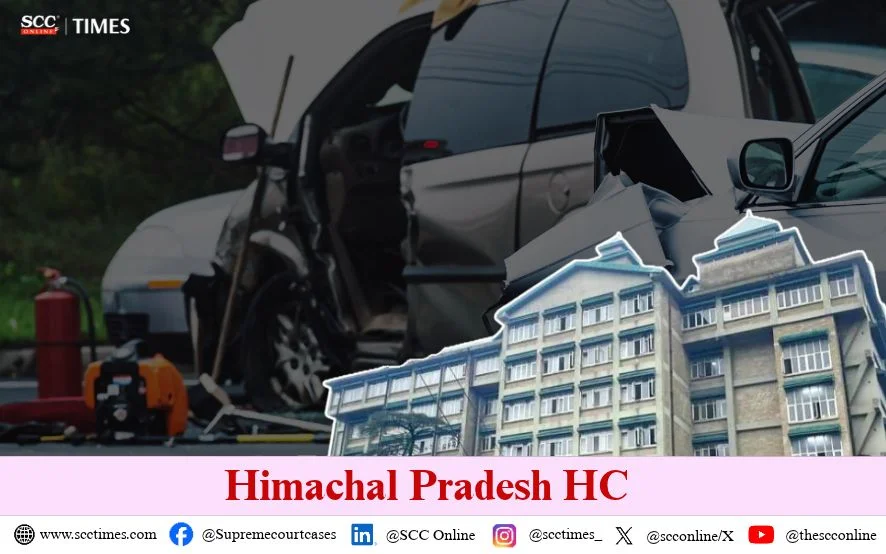
Himachal Pradesh High Court: While considering an appeal challenging a Motor Accident Claims Tribunal award arising out of the death of an unmarried victim in a motor vehicle accident, a Single Judge Bench of Sushil Kukreja, J., held that father and sisters of bachelor deceased are not entitled as dependents in absence of evidence to the contrary and only mother is entitled to motor accident compensation. The Court further held that the Tribunal had rightly assessed the deceased’s notional income and that compensation was liable to be recalculated by treating only the mother as the dependent.
Also Read: Kar HC: Driving without license not sole ground for contributory negligence
Background
The claim petition was instituted under Section 166, Motor Vehicles Act, 1988 (MV Act) seeking compensation of ₹25,00,000 on account of the death of the deceased, who allegedly sustained fatal injuries when a car struck his motorcycle from behind on 25 November 2020. The claimants pleaded that the offending vehicle was being driven rashly and negligently and that the accident resulted in head injuries and multiple fractures leading to death. They further asserted that the deceased was working as a Munshi and was earning ₹15,000 per month.
The respondents, however, denied negligence and contended that 3 persons were riding the motorcycle, that they were under the influence of alcohol, and that the motorcycle was being driven by a minor in a rash and negligent manner. According to them, the riders skidded from the motorcycle and collided with the car, and therefore the accident occurred due to the negligence of the motorcycle riders themselves.
The Tribunal ultimately allowed the claim petition and awarded compensation of ₹17,20,400 along with interest at 7.5 per cent per annum, holding the respondents jointly and severally liable. Aggrieved thereby, the present appeal was preferred.
The appellants contended that there was no evidence to establish the deceased’s income and therefore the Tribunal had erred in fixing notional income. It was further argued that the father and sisters of the deceased were not dependent upon him and were thus not entitled to compensation. On the other hand, the claimants supported the award and sought its affirmation.
Analysis
The Court first examined the challenge relating to assessment of deceased’s income. The Court relied on National Insurance Co. Ltd. v. Pranay Sethi, (2017) 16 SCC 680, wherein it was observed that Section 168, MV Act deals with the concept of “just compensation” and the same has to be determined on the foundation of fairness, reasonableness and equitability on acceptable legal standard because such determination can never be in arithmetical exactitude. It can never be perfect. … The determination has to be on the foundation of evidence brought on record as regards the age and income of the deceased and thereafter the apposite multiplier to be applied.
The Court noted that the deceased’s mother had deposed that he was employed as a Munshi and earning ₹15,000 per month. However, she admitted in cross-examination that no proof regarding such income had been produced. In these circumstances, the Court observed that the Tribunal’s assessment of notional income at ₹8250 per month, calculated at ₹275 per day, was appropriate, and therefore declined to interfere with the notional income fixed by the Tribunal.
The principal issue before the Court was dependency. The Court noted that it was an admitted position that the deceased was a bachelor. The Court relied on Sarla Verma v. DTC, (2009) 6 SCC 121, wherein it was held that in the absence of evidence to the contrary, brothers and sisters will not be considered as dependents, because they will either be independent and earning, or married, or be dependent on the father. Even if the deceased is survived by parents and siblings, only the mother would be a dependent.
The Court opined that the Tribunal had committed an error in treating the father and sisters as dependents and in extending compensation to them on that basis. The Court applied the ratio in Sarla Verma and held that only the deceased’s mother could be regarded as a dependent on his earnings.
The Court next considered the question of future prospects. The Court referred to Pranay Sethi, wherein it was observed that where the deceased was self-employed or on a fixed salary and below 40 years of age, an addition of 40 per cent of the established income must be made towards future prospects. Consequently, the Court held that since the deceased was below 40 years of age, a 40 per cent enhancement was required.
The Court further noted that Sarla Verma prescribes multiplier “16” for a deceased aged 31 years. The Court found that the multiplier adopted by the Tribunal was therefore correct. Since the deceased was a bachelor and only his mother was treated as dependent, the Court observed that 50 per cent of the income was liable to be deducted towards personal and living expenses.
Applying these principles, the Court recalculated the compensation. The deceased’s monthly income was taken at ₹8250. After adding 40 per cent towards future prospects, the monthly income came to ₹11,550. After deducting 50 per cent towards personal expenses, the monthly dependency was assessed at ₹5775. Applying multiplier “16”, the Court recalculated the loss of dependency at ₹11,08,800.
The Court then examined compensation payable under conventional heads. Following Pranay Sethi, the Court held that the mother was entitled to ₹15,000 towards loss of estate, ₹15,000 towards funeral expenses and ₹40,000 towards filial consortium. The Court accordingly determined the total compensation payable at ₹11,78,800.
Also Read: Motor Vehicle Rules: Unpaid Toll Fees Introduced
Decision
The Court modified the Tribunal’s award and held that only the mother of the deceased was entitled to compensation. The total compensation was recalculated at ₹1,78,800. The Court directed that the remaining terms of the award, including the interest component, would remain unchanged.
[Om Parkash v. Anita, FAO (MV) No.113 of 2026, decided on 18-11-2026]
Advocates who appeared in this case:
For the Appellants: Mohinder Verma and Sumit Sharma, Advocates.
For the Respondents: Vinod Chauhan and Nandita, Advocates.







0 replies