








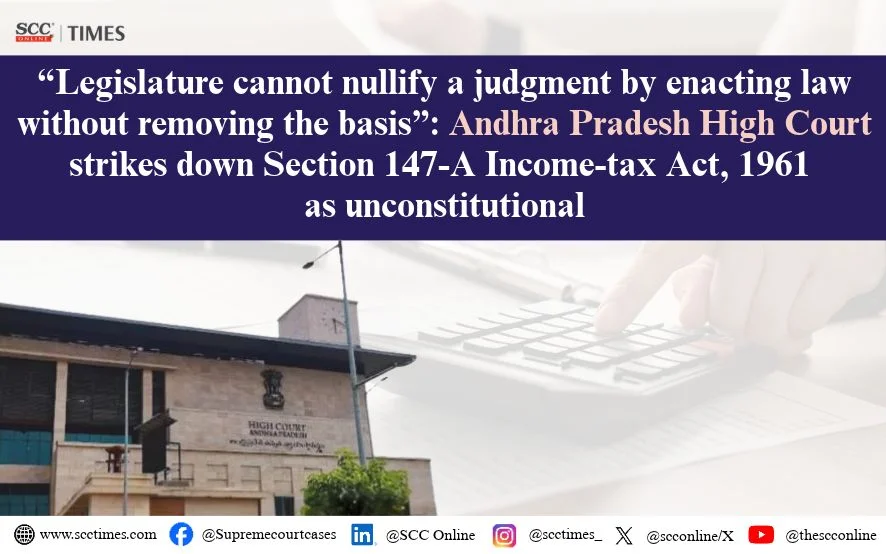
Andhra Pradesh High Court: The petitions were filed challenging the constitutional validity of Section 147-A, Income-tax Act, 1961 (IT Act), inserted by the Finance Act, 2026, with retrospective effect from 1 April 2021, as being ultra vires and violative of the basic structure of the Constitution, including the principles of Rule of Law and separation of powers. The petitioners also challenged the proceedings initiated by Jurisdictional Assessing Officers (JAOs) under Sections 148-A and 148, IT Act, contending that the same were without jurisdiction and contrary to the faceless assessment framework under Section 151-A. A Division Bench of Ninala Jayasurya and T.C.D. Sekhar, JJ., struck down Section 147-A as unconstitutional and set aside the impugned proceedings and orders. The Court held that the provision, though introduced with effect from 1 April 2026 and given retrospective effect from 1 April 2021, sought to overcome judicial pronouncements without removing the basis of those decisions. It further held that Section 147-A could not have been inserted into the IT Act, after the latter had already been repealed.
Background
The e-Assessment Scheme, 2019 (notified 12 January 2019) was later renamed the Faceless Assessment Scheme, 2019, and was incorporated into the IT Act as Section 144-B by the Finance Act, 2021 with effect from 1 April 2021. The Finance Act, 2022 extended Section 144-B to proceedings under Section 147. Separately, Section 151-A, inserted with effect from 1 November 2020, empowered the Central Government to frame a scheme for faceless assessment, reassessment or re-computation under Section 147, and for issuing notices under Section 148 and passing orders under Section 148-A. In exercise of this power, the Central Board of Direct Taxes notified the e-Assessment of Income Escaping Assessment Scheme, 2022 on 29 March 2022. Clause 3 provides that assessment, reassessment or re-computation under Section 147 and issuance of notice under Section 148 shall be “…through automated allocation, in accordance with risk management strategy formulated by the Board as referred to in Section 148 of the Act for issuance of notice, and in a faceless manner, to the extent provided in Section 144-B of the Act with reference to making assessment or reassessment of total income or loss of assessee.”
The petitioners challenged notices and orders under Sections 148-A(b), 148-A(d) and 148 issued by JAOs, arguing that the 2022 Scheme required these steps to be taken in a faceless manner, so that the JAOs lacked jurisdiction. The Revenue countered that the notification did not specify whether notices under Section 148 were to be issued by the National Faceless Assessment Centre (NFAC) or the JAO. It said the notification only laid down procedure, that notices under Section 148 are issued in accordance with the risk management strategy, and that only the assessment itself must be faceless under Section 144-B. A coordinate Bench by order dated 28 October 2025, accepted the petitioners’ case and set aside the impugned notices and orders as violative of Section 151-A read with Notification No. 18/2022. The Revenue then approached the Supreme Court by way of special leave petitions (SLPs).
While the SLPs were pending, Parliament enacted Section 147-A (in force from 1 April 2026, deemed inserted retrospectively from 1 April 2021). Notwithstanding any court judgment, order or decree, Section 151-A or any scheme framed under it, it clarifies that “assessing officer” for the purposes of Sections 148 and 148-A means and has always meant an officer other than the NFAC or any assessment unit under Section 144-B(3). In view of this, the Supreme Court, by order dated 10 April 2026, set aside the High Court judgments on the limited ground that their foundation, the JAOs’ lack of competence, stood altered by the amendment. It remitted the matters to the High Courts for fresh consideration, with liberty to the assessees to amend their petitions within 4 weeks to challenge Section 147-A or any connected provision, and to the Revenue to file submissions within 3 weeks thereafter. The Supreme Court expressed no opinion on the merits, including the validity, scope, effect, retrospectivity or applicability of the amendment, ordered an interim stay of further reassessment proceedings subject to the High Courts’ terms, and requested that the matters be decided preferably by 30 September 2026. On remand, the petitioners amended their prayers to challenge Section 147-A as ultra vires in the instant petitions and the consequential reassessment orders and sought a stay of further proceedings, including recovery.
Analysis and Decision
The Court’s analysis proceeds on 2 interconnected issues: firstly, whether the statutory framework under Sections 151-A and 144-B, read with the 2022 Scheme, required reassessment proceedings under Sections 148-A and 148 to be undertaken through the faceless mechanism; and secondly, whether the insertion of Section 147-A with retrospective effect could validly alter that position and confer jurisdiction upon the JAOs.
The Court noted that the memorandum explaining the Finance Bill, 2026, sought to distinguish between the pre-assessment stage, comprising the inquiry under Section 148-A and issuance of notice under Section 148, and the subsequent assessment stage under Section 147. The Revenue relied upon Snehdham Trust v. CIT, 2025 SCC OnLine Guj 5771, to contend that the JAO could undertake the pre-assessment proceedings, with the case being transferred to the NFAC thereafter. However, the Court was not persuaded by this interpretation and observed that Clause 3 of the 2022 Scheme expressly includes issuance of notice under Section 148 and mandates automated allocation in accordance with the Board’s risk management strategy. The Court particularly emphasised that the Revenue had admitted that no such automated allocation mechanism had been put in place and that the cases had instead been identified by the JAOs themselves. Consequently, the initiation of proceedings by the JAOs was contrary to the statutory scheme. The Court further held that Section 148-A could not be isolated from Sections 148 and 147, since the inquiry and order under Section 148-A constitute the necessary foundation for issuance of notice under Section 148 and subsequent reassessment. It also was not in agreement with the Gujarat High Court’s interpretation in Snehdham Trust, particularly its approach to excluding Section 148-A from the Scheme.
The Court further examined Sections 127 and 130 of the Act, along with the Faceless Jurisdiction of Income-tax Authorities Scheme, 2022, notified vide Notification No. 15/2022 dated 28 March 2022. It observed that where the Revenue claimed that the reassessment proceedings were undertaken by 2 different authorities, namely, the JAO up to the issuance of notice under Section 148 and the NFAC thereafter, the transfer of the case to the NFAC ought to have been effected in accordance with Section 127, including the requirement of affording an opportunity of hearing and recording reasons, wherever applicable. However, the Revenue had not followed this procedure. The Court also rejected the reliance placed upon Notification No. 61/2022 dated 10 June 2022 to justify concurrent jurisdiction of JAOs, holding that such a notification could not override Sections 130 and 151-A or the schemes framed thereunder. It emphasised that allowing JAOs to undertake the proceedings would defeat the legislative objective of eliminating personal interface between the tax authorities and assessees and ensuring efficiency, transparency and accountability through faceless mechanisms. The Court accordingly held that proceedings under Sections 148-A and 148 were also required to be undertaken in a faceless manner, and that the Revenue could not exclude Section 148-A merely because it was not expressly mentioned in Clause 3 of the 2022 Scheme.
On examining the constitutional validity of Section 147-A, the Court observed that although the legislature possesses the power to enact retrospective legislation and validate past actions, such power is subject to constitutional limitations. Placing reliance on Prithvi Cotton Mills Ltd. v. Broach Borough Municipality, (1969) 2 SCC 283, the Court reiterated that a validating enactment must remove the defect or infirmity identified by the Court in the existing law and make adequate provisions to validate the action in question. It held that, in the present case, the earlier judicial pronouncements had not identified any defect in Section 151-A or the 2022 Scheme; rather, they had held that the JAOs lacked jurisdiction in view of the existing statutory framework. Despite this, Parliament introduced Section 147-A without making any corresponding amendment to Section 151-A or the Scheme, which continued to include issuance of notice under Section 148 within its scope. The Court further relied upon State of Tamil Nadu v. M. Rayappaiah Gounder, (1971) 3 SCC 1, with reference to The Municipal Corporation of the City of Ahmedabad v. The New Shrock Spg. & Wvg. Co. Ltd., (1970) 2 SCC 280, to reiterate that although the legislature may retrospectively remove the basis of a judicial decision, it cannot simply direct State instrumentalities to disregard or nullify judicial pronouncements. The Court consequently held that Section 147-A, in the absence of any corresponding amendment to the underlying statutory scheme, amounted to an attempt to overcome the decisions of constitutional courts and encroached upon the judicial domain, offending the doctrine of separation of powers, which forms part of the basic structure of the Constitution.
The Court also considered the petitioners’ contention that Section 147-A had been inserted into the IT Act, after the repeal of that Act with effect from 1 April 2026. Upon examining Section 1(3) of the Income-tax Act, 2025, Section 2(a), Finance Act, 2026 and the repeal-and-savings provision under Section 536, 2025 Act, the Court held that the IT Act stood repealed at midnight on 31 March 2026, whereas the Finance Act, 2026, notwithstanding having received Presidential assent on 30 March 2026, expressly came into force only on 1 April 2026. The Court observed that Section 5, General Clauses Act, 1897, could not be invoked to give the Finance Act an earlier commencement date when the enactment itself expressly prescribed 1 April 2026. In this regard, reliance was placed upon Common Cause v. Union of India, (2003) 8 SCC 250, wherein the Supreme Court explained that Section 5, General Clauses Act applies only where an enactment does not expressly specify its date of commencement. The Court further noted that Section 536(2)(c) and (u), Income-tax Act, 2025 preserved the applicability of the repealed Act and the schemes framed thereunder in respect of the relevant pending and subsequent proceedings. Accordingly, it concluded that the insertion of Section 147-A into an Act which had already stood repealed, when the Finance Act itself came into force, was legally unsustainable and had no legal sanctity.
Accordingly, the Court held that Section 147-A, IT Act, was unconstitutional and struck it down. The Court, having invalidated the retrospective amendment, held that the proceedings initiated by the JAOs under Sections 148-A and 148 were without jurisdiction, since such proceedings were required to be undertaken in a faceless manner in accordance with Section 151-A and the 2022 Scheme. The writ petitions were consequently allowed and the impugned proceedings and orders were set aside, with no order as to costs.
[Bala Sreenivas Rao Somisetty v. CIT, 2026 SCC OnLine AP 4509, decided on 12-10-2026]
Judgment Authored by T.C.D. Sekhar, J.
Advocates who appeared in this case:
For the Petitioners: Sri A.V.A. Siva Kartikeya, Sri Kondala Rao Kotapati, Sri P. Pavan Kumar Rao, Sri Vivek Chandra Sekhar, Sri N. Rupeswar Reddy, Sri Dundu Manmohan, Sri V. Harish Kumar, Sri M.V.J.K. Kumar, Sri V. Vinod K. Reddy, Sri M. Naga Deepak, Smt. Jyothi Ratna Anumolu, Sri C. Sanjeeva Rao, Sri Phani Viswanath Challa, Sri A. Sarveswar Rao, Sri L. Chandra Obul Reddy, Smt. Mallavolu Nikitha, Sri P. Rama Sharana Sharma, Sri G.V.N. Hari, Sri B. Abhay Siddhanth Mootha, Sri K.P.S. Sailesh Reddy, Sri K. Ravindra Nath Tagore, Sri Kadimisetty Sai Sreenadh, Sri Anil Kumar Bezawada, Sri P. Sravan Kumar Reddy, Sri Vivekananda Virupaksha, Sri Sreemannarayana Mallela, Sri T. Venu Gopal, Sri Sricharan Telaprolu, Sri Nuvvula Ram Babu, Sri Badranaga Seshayya, Sri B. Siva Kesava Reddy, Sri A.V. Raghu Ram, Sri T. Chaitanya Kumar, Sri Ravi Kiran Ponnuru, Smt. T.V.P. Sai Vihari and Sri T. Pradyoth.
For the Respondents (Revenue): Sri N. Venkataraman, Additional Solicitor General of India; Sri T. Niranjan, Additional Solicitor General, High Court of Andhra Pradesh; Sri Y.N. Vivekananda, Senior Standing Counsel for Income Tax; and Sri Anup Koushik Karavadi, Senior Standing Counsel for Income Tax.






0 replies