Disclaimer: This has been reported after the availability of the order of the Court and not on media reports so as to give an accurate report to our readers.
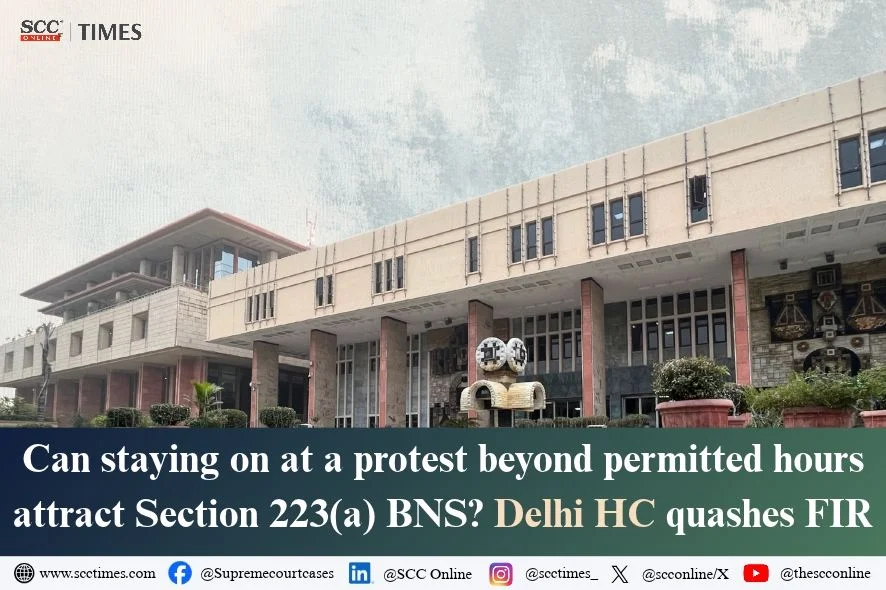
Delhi High Court: The present petition was filed under Article 226 of the Constitution of India read with Section 528, Nagarik Suraksha Sanhita, 2023 (BNSS) seeking quashment of FIR registered against a Staff Selection Commission (SSC) aspirant over his alleged participation in a protest at Ramlila Maidan beyond the permitted hours. A Single-Judge Bench of Sanjeev Narula, J., quashed the impugned FIR and all consequential proceedings, holding that mere presence among protesters, without material establishing the essential ingredients of the alleged offences under Sections 223(a) and 3(5), Nyaya Sanhita, 2023 (BNS), i.e. disobedience of a duly promulgated order by public servant, was insufficient to justify continuation of criminal proceedings.
Background
The instant matter arose from a protest organised by SSC aspirants at Ramlila Maidan, Delhi, on 24 August 2025, against alleged irregularities in examinations. Although permission had been granted for a peaceful demonstration between 10.00 a.m. and 5.00 p.m., the police alleged that protesters continued to occupy the venue beyond the permitted hours despite repeated directions to disperse and announcements regarding prohibitory orders under Section 163 BNSS and the police further alleged that certain organisers refused to conclude the demonstration and instigated the gathering, and that some of the protesters pushed and scuffled with police personnel.. Consequently, 44 persons, including the petitioner, were detained and a FIR was registered against them under Sections 223(a) and 3(5) BNS.
The petitioner contended that he had attended the protest to express his grievances regarding SSC examinations but was neither an organiser nor a speaker. No specific allegation of instigation, violence, obstruction or altercation with the police was attributed to him and there was no material to show that he had knowledge of any particular prohibitory order under Section 163 BNSS. He argued that the essential ingredients of Section 223(a) BNS were not made out and relied on Bhoop Singh Tyagi v. State, 2002 SCC OnLine Del 277 and State of Haryana v. Bhajan Lal, 1992 Supp (1) SCC 335. He further submitted that he had joined and cooperated with the investigation.
The State opposed the petition, contending that the protesters continued occupying Ramlila Maidan beyond the permitted hours despite repeated announcements directing them to disperse. The petitioner was among those who remained at the venue and was consequently detained. The State further submitted that a charge-sheet had been filed against 29 persons and that investigation concerning the remaining protesters was continuing. It argued that the allegations warranted examination in criminal proceedings and that no case for quashing the FIR was made out.
Issue for Consideration
Whether the material on record discloses the commission of the alleged offence insofar as the petitioner is concerned?
Analysis
At the outset, the Court observed that knowledge of a lawfully promulgated order and disobedience were essential elements of an offence under Section 223(a) BNS. However, such disobedience of the public servant’s lawfully promulgated order must also cause, or tend to cause, obstruction, annoyance or injury, or the risk thereof, to persons lawfully employed.
The Court acknowledged the allegations of continued occupation beyond permitted hours despite police directions, but in the present the question was whether the material disclosed the alleged offence specifically against the petitioner.
The Court noted that the allegations of refusing to vacate the ground, instigating protesters and scuffling with police personnel were directed against the organisers or the gathering generally. Neither the FIR nor the subsequent status report attributed any such conduct to the petitioner. His alleged role was confined to remaining at the venue after the permitted hours despite the directions issued by the police.
The Court observed that although repeated announcements through loudhailers might be relevant to establish that the petitioner had knowledge of the directions to disperse and that continued presence despite such knowledge might amount to disobedience. However, for an offence under Section 223(a) BNS, the disobedience must also cause, or tend to cause, obstruction, annoyance or injury, or the risk thereof, to persons lawfully employed, and the material did not disclose how the petitioner’s continued presence attracted that requirement. The Court observed that, “his mere presence amongst the protesters cannot, without more, be treated as sufficient to establish the offence”.
The Court noted that common intention requires that the criminal act be committed in furtherance of an intention shared by the persons sought to be held jointly liable. On the allegation of common intention under Section 3(5) BNS, the Court held that mere participation in the same demonstration did not, by itself, establish a common intention to disobey lawful directions or obstruct police personnel. The material on record disclosed no basis for attributing such common intention to the petitioner.
The Court further noted that petitioner had joined the investigation pursuant to Section 35 BNSS notice, and the State also did not allege that he failed to cooperate or attempted to obstruct the investigation.
Relying on the principles laid down in Bhajan Lal, the Court reiterated that criminal proceedings could be quashed where the allegations, even if accepted at face value, did not prima facie constitute an offence against the accused. Where the foundational ingredients of the offence were absent, continuation of the proceedings would amount to an abuse of the process of law.
The Court was conscious that jurisdiction to quash must be exercised with restraint and that a detailed appreciation of evidence is ordinarily impermissible at this stage, but held that the petitioner could not be subjected to criminal proceedings merely on account of his presence amongst the protesters, in the absence of material indicating his knowing participation in the alleged disobedience or any common intention to commit the offence.
Decision
The Court allowed the petition and quashed impugned FIR along with all consequential proceedings, qua the petitioner. It clarified that the observations in the present case were confined to petitioner’s role and would not affect the investigation or proceedings against any other accused.
[Khurshid Ahmed v. State (NCT of Delhi), W.P. (CRL) 2356/2026, decided on 13-10-2026]
Advocates who appeared in this case:
For the Petitioner: Mr. Gaurav Arya, Mr. Naveen Bamel, Mr. Harsh Goyal and Mr. Manav Trivedi, Advs.
For the Respondent: Mr. Amol Sinha, ASC (Crl.) with Mr. Kshitiz Garg, Mr. Ashvini Kumar, Mr. Nitish Dhawan and Mr. Anshul Sharma, Advs.
SI Virender, P.S. Kamla Market.