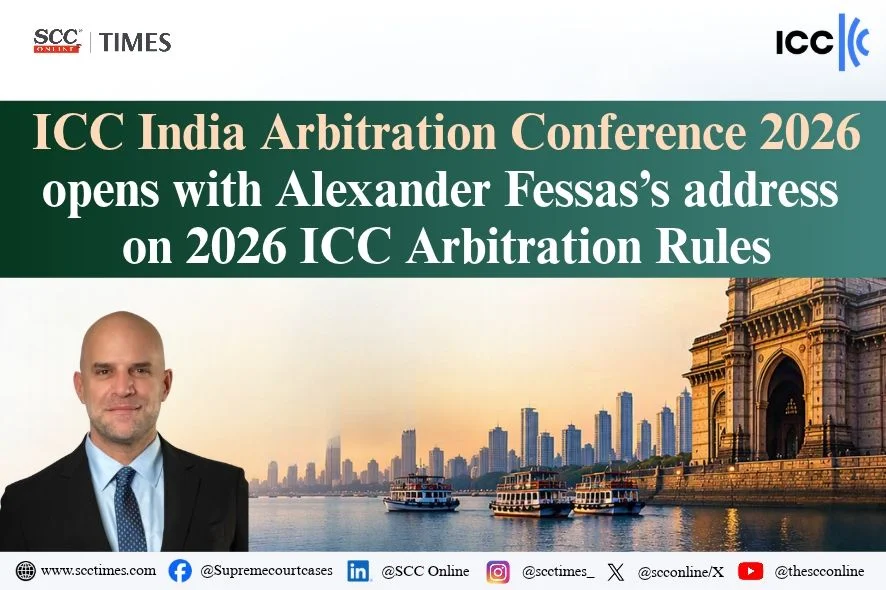
The ICC India Arbitration Conference, Mumbai 2026, held on October 31, 2026, at the Trident Hotel, Nariman Point, Mumbai, commenced with an address by Alexander Fessas, Secretary-General of the ICC International Court of Arbitration, who outlined the key developments, institutional priorities and procedural innovations under the 2026 ICC Arbitration Rules.
Focusing on the objectives underlying the revision of institutional arbitration rules, Mr.Fessas highlighted the importance of preserving the ICC’s institutional reputation, enhancing time and cost efficiency, incorporating evolving arbitral practices, responding to users’ expectations and making the rules more accessible to both legal professionals and non-lawyers.
He emphasised that institutional rules must continue to evolve alongside arbitral practice and remain responsive to the needs of parties from different industries, jurisdictions, and commercial backgrounds.
2026 ICC Arbitration Rules: Greater flexibility and procedural efficiency
Removal of mandatory Terms of Reference
One of the significant changes under the 2026 ICC Arbitration Rules is the removal of the mandatory requirement for Terms of Reference. Previously, this document was prepared by the arbitral tribunal in consultation with the parties shortly after the tribunal’s constitution to establish the basic parameters of the dispute.
Explaining the rationale behind this change, Mr. Fessas observed that preparing Terms of Reference may be useful in complex disputes where an early identification of the issues can assist the tribunal in framing the proceedings. However, in other cases, the process may become counterproductive, potentially taking a month or longer without adding corresponding value.
Accordingly, the revised framework gives parties and arbitrators the flexibility to decide whether Terms of Reference are necessary in a particular arbitration, rather than requiring their preparation in every case.
Disclosure obligations and arbitrator independence
Mr. Fessas also highlighted changes concerning the disclosure obligations of arbitrators. While the substantive standard of disclosure remains unchanged, the revised rules allow parties to identify individuals or entities that they consider relevant for an arbitrator’s disclosure assessment.
He explained that arbitrators are expected to make maximum disclosure and that the revised rules expressly clarify that, where there is doubt about whether a circumstance should be disclosed, disclosure should be made. At the same time, disclosure by itself does not indicate the existence of a conflict of interest or establish a lack of independence or impartiality.
Emergency arbitration and ex parte relief
Discussing emergency arbitration, which has been available under the ICC Rules since 2012, Mr. Fessas highlighted the express recognition of emergency arbitrators’ power to issue preliminary orders on an ex parte basis.
He noted that such orders were already being issued in practice and that the revised rules now expressly recognise this procedural facility, enabling parties to seek urgent interim or conservatory relief even before the constitution of the arbitral tribunal.
He also discussed the ICC’s expediated arbitration procedure, introduced in 2017, which has administered more than 1,200 cases. According to Mr. Fessas, the procedure can enable parties to obtain a final award within six months from the case management conference, with fees approximately 20% lower than those applicable in ordinary proceedings.
The automatic application threshold for this procedure has also been increased to USD 4 million.
Early determination and highly expedited arbitration
Another development under the revised rules is the express recognition of the arbitral tribunal’s power to determine applications for early determination concerning claims or defences that are manifestly outside its jurisdiction or manifestly without merit.
Mr. Fessas further highlighted the introduction of a new highly expedited arbitration procedure, under which parties may obtain a final award within 90 days. The procedure is intended for disputes involving discrete legal issues or specific aspects of wider disputes that may be dispositive, including certain patent infringement disputes where delays can result in substantial commercial consequences.
Unlike the automatic expedited procedure, highly expedited arbitration requires the parties to opt in. Mr. Fessas noted that the ICC had not yet received a case proceeding under this new mechanism at the time of his address, although requests inviting the other party to opt in had been made.
ICC arbitration statistics and institutional engagement
Providing an update on the ICC’s recent case activity, Mr. Fessas stated that, from June 1 to September 30, 2026, more than 300 cases had been registered under the 2026 Rules. These included over 30 emergency arbitration applications and more than 45 applications or automatic applications for expedited arbitration.
He further indicated that the ICC’s caseload remained healthy, with projections suggesting that new case filings could exceed 900 by the end of 2026, while the total number of pending matters could approach 1,900.
Concluding his address, Mr. Fessas emphasised the importance of continued engagement between the ICC and arbitration users. He invited practitioners to approach the ICC’s teams in India, Singapore, Paris and other offices for guidance, queries and suggestions, observing that bilateral communication is essential to maintaining legitimacy and trust in private dispute resolution.
SCC Times is the Information & Documentation Partner for the conference. Stay tuned for comprehensive coverage, key insights and highlights from the event!