Rajasthan High Court: In the present appeal, court dismissed a batch of criminal appeals against the rejection of bail in the Udaipur Kanhaiya Lal murder case. The Division Bench of Sanjay K. Agrawal, CJ. and Sameer Jain, J., held that the prosecution material disclosed a prima facie true case under Section 43D(5) UAPA, and that the accused could not secure bail merely on the basis of prolonged custody when the trial was proceeding at a fast pace.
Background
In May 2022, remarks made by Nupur Sharma, then a spokesperson of a political party, during a television debate led to widespread agitation and protests across the country. According to appellants’ version, Kanhaiya Lal later posted remarks on facebook linked to that controversy, prompting a FIR against him at Police Station Dhanmandi, Udaipur. He was arrested in that matter and released on bail within a few days. Fearing for his safety, he installed CCTV cameras outside his shop, ‘Suprim Tailors’, and an altercation is also said to have taken place.
On 28 June 2022, Kanhaiya Lal was murdered inside his shop at Udaipur by two assailants armed with sharp weapons, and two shop assistants were injured. His son lodged a complaint, leading to FIR under Sections 452, 302, 153A, 153B, 295A and 34 of the Indian Penal Code, 1860 (IPC) and Section 16, 18 and 20 of the Unlawful Activities (Prevention) Act, 1967 (UAPA). The case was later taken over by the National Investigation Agency (NIA). The prosecution that the two main accused recorded the murder and circulated the videos on social media, as part of a wider conspiracy intended to spread terror and communal disharmony. After investigation, the NIA filed a charge-sheet and the Trial Court framed charges on 12 January 2024 and 13 February 2024. The five appellants, arrested between 1 July and 10 August 2022, have remained in judicial custody from their respective arrest dates. Their bail applications were rejected, which led to the present appeals from a FIR, registered at Police Station NIA, New Delhi, for the alleged commission of offences.
Contentions of the appellants
The appellants challenged the rejection of their bail applications before the Special Judge, NIA, Jaipur, arguing that there was no cogent material to show their presence near deceased’s shop and none of them were seen in the vicinity during the relevant period, and that there was no evidence of any whatsapp message, voice note, or text showing communal provocation or promotion of enmity. They also pointed out that their names were not reflected in the FIR and the implication solely based on presumptions, assumptions and Call Detail Records (CDRs) because they were neighbours and had been in communication with each other. They also contended that the disclosure statements were recorded in English language, which they did not understand, and therefore the recovery was vitiated under Sections 25 and 27 of the Indian Evidence Act, 1872 (IEA). They further, relied on the fact that co-accused had already been granted bail, on the absence of criminal antecedents, and on their prolonged incarceration of more than 4.5 years. For that purpose, they invoked Union of India v. K.A. Najeeb, (2021) 3 SCC 713, Syed Iftikhar Andrabi v. NIA, Jammu, 2026 SCC OnLine SC 881, and Yedala Subba Rao v. Union of India, (2023) 6 SCC 65.
Contentions of Respondent (NIA)
NIA opposed the present appeals by stressing that the FIR has been registered under a Special Act-UAPA, and the investigation was meticulously carried out by a specialized agency-NIA, and appellants had an active, indispensable and integral role in a deep-rooted criminal conspiracy. It was submitted that the unlawful activities were executed in a highly pre-planned and pre-meditated manner, culminating in a brutal murder and a heinous offence against the State. It was further submitted that the subsequent broadcasting and circulation of videos of the gruesome act through various social media platforms was a calculated move with the sole aim and object to instil fear, terrorize the common conscience of the society, and strike terror in the nation at large. It was urged that the incident had been deliberately given a communal colour to divide communities and disturb communal tranquillity.
The NIA strongly relied on NIA v. Zahoor Ahmad Shah Watali, (2019) 5 SCC 1, to argue that the Court could not conduct a mini-trial or weigh the evidence meticulously at the bail stage. It also clarified that the trial was moving expeditiously, the witness list had been reduced from 180 to 89, and around 30 material witnesses had already been examined, so the plea based on delay had no force.
The NIA further submitted that the role of each appellant was distinct and well documented in the charge-sheet, and that the co-accused who were granted bail stood on a different footing, one of them being a minor granted bail on the ground of juvenility.
The NIA further submitted that the trial was being conducted on a day-to-day basis at the State’s request, which the appellants had objected to, making them responsible for the alleged delay. It also relied on witness statements, call details, video recordings and recovery of weapons as concrete evidence.
Ratio and Analysis
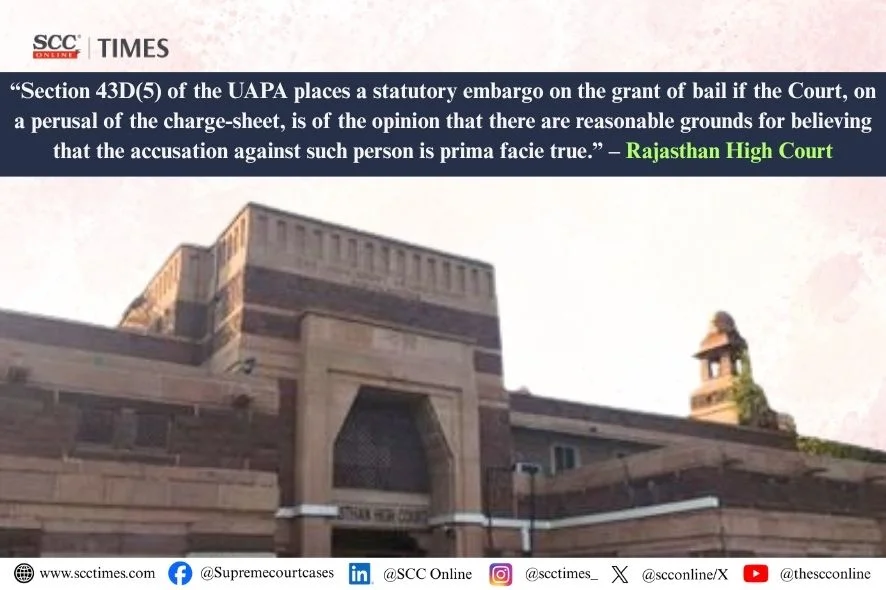
The Court accepted the NIA’s approach and examine the provisions under Section 21(4) of the National Investigation Agency Act, 2008 (NIA Act) read with Section 43D(5) and (6) UAPA, which provides that a person accused of offences under Chapters IV and VI of the Act shall not be released on bail if the Court, on a perusal of the case diary or charge-sheet, forms the opinion that there are reasonable grounds for believing that the accusation is prima facie true.
The Court heavily relied on NIA v. Zahoor Ahmad Shah Watali (supra), wherein it was clarified that at the bail stage, the Court must apply the ‘Prima Facie True Test’ and is not required to conduct a mini-trial or weigh the evidence meticulously. The Court must look at the materials provided by the investigative agency at its face value, and if it discloses reasonable grounds for believing the accusation to be prima facie true, bail must be rejected. The case specifically noted, since charges have already been framed in the present case, the material has already crossed a preliminary judicial filter, thereby elevating the threshold for the accused.
The Court also referred to Gulfisha Fatima v. State (NCT of Delhi), 2026 SCC OnLine SC 10, where the Court explained that Section 43D(5) UAPA, reflects a legislative judgment that offences affecting the security of the State call for a distinct bail regime, the inquiry must be accused-specific, and the Court must ask whether the prosecution material, taken as it stands, discloses the essential ingredients of the offence, the Court should not assess evidentiary sufficiency or credibility at the bail stage, the bail court must exercise judicial restraint, not judicial abstention.
Relying on Gulfisha Fatima, the Court held that, where Parliament has conditioned bail in a special statute on a defined threshold, a constitutional court cannot treat that restraint as avoidable, and that Article 21 commands the manner of application of the statute but does not dissolve the statutory condition itself.
The Court noted that, in Union of India v. K.A. Najeeb, (2021) 3 SCC 713, a three-judge bench held that the statutory restriction under Section 43D(5) cannot render the constitutional guarantee of personal liberty under Article 21 illusory, and that its rigors melt down where there is no likelihood of the trial being completed within a reasonable time and the incarceration already undergone has exceeded a substantial part of the prescribed sentence. This was reaffirmed in Syed Iftikhar Andrabi v. NIA, 2026 SCC OnLine SC 881. However, the Court held that these cases did not assist the appellants because, as demonstrated by the ASG, this was not a case of an idle or stalled trial. The trial was proceeding on a day-to-day basis, the witness list had been reduced substantially, and approx 30 primary witnesses had already been examined. In the Court’s view, the factual matrix did not show the extreme delay that would trigger the “melt down” of Section 43D(5) UAPA on the ground of Article 21 of the Constitution. On the defence contention that disclosure statements were in English language and recoveries were defective or hit by Sections 25 and 27 IEA, the Court followed well-settled preposition of law that the stage of bail does not require or permit the evaluation of defences, such as the language of the disclosure statements, the weighing of evidence, or the conducting of a mini-trial regarding the admissibility of electronic evidence, as these are the matters for trial court to examine during the course of trial, not for a bail court.
The Court noted that the brutal murder coupled with recording and dissemination of the act of such a grave and heinous nature to create communal disharmony and terror struck at the very foundation of the State. The gravity of the offence, the specific roles attributed to the appellants in the alleged larger criminal conspiracy and what it described as the heinous nature of the terrorist act justified refusal of bail, and that a strict approach must be adopted unless the appellants dislodged the rigors of Section 43D(5). Since the appellants had failed to dislodge the rigour of Section 43D(5) UAPA, their appeals were dismissed.
Decision
Considering the facts in the present case, the Court found that the gravity of offences, the alleged role in the larger conspiracy, and the nature of the terrorist act justified denial of bail. The impugned orders of the Special Judge (NIA Cases), Jaipur, dated 9 October 2024 and 12 November 2024, were sustained. The Court clarified that its observations were made only for deciding the bail appeals and did not express an opinion on the merits, and directed the Trial Court to proceed uninfluenced by them.
[Wasim Ali v. NIA, New Delhi, D.B. Criminal Appeal (Db) No. 438 of 2024, decided on 3-10-2026]
Advocates who appeared in this case:
For the Appellant(s): Syed Saadat Ali, Salim Khan, Nadeem Qadeer, Uzma Ilyas, Aafreen Rizvi, K.M. Siddiqui, Sumit Kumar, Anshul Mathur, Aatif Aman Khan
For respondent: Raja Thakare, Senior Advocate/ASG, Sneh Deep Khyalia, Special Public Prosecutor, Rohit Khare, Siddharth Sharma, Himanshu Choudhary