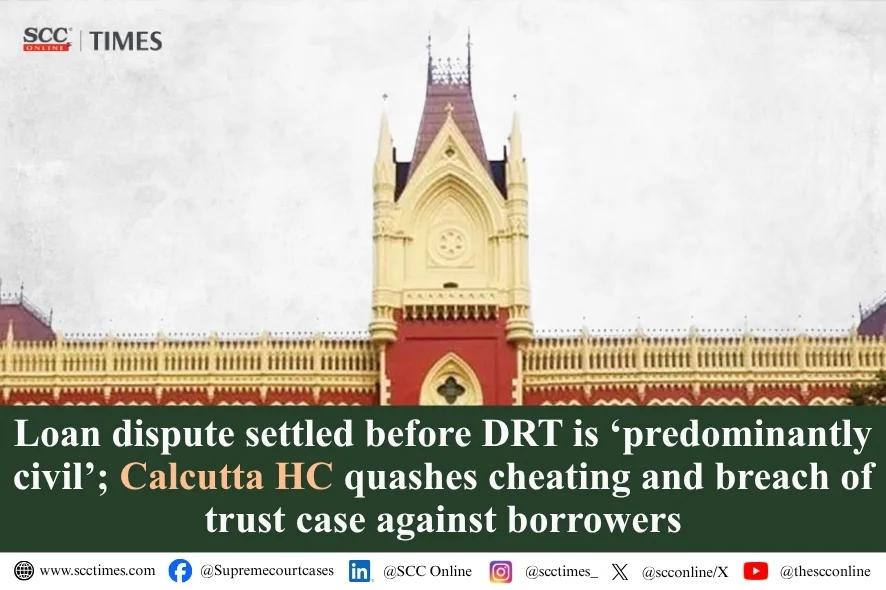
Calcutta High Court: In a petition seeking quashing of criminal proceedings arising out of a loan transaction, a Single Judge Bench of Chaitali Chatterjee Das, J. examined whether the borrowers could be prosecuted for offences relating to cheating and criminal breach of trust in respect of a loan repayment dispute that the petitioners had settled with the original lender before the Debt Recovery Tribunal (DRT). The Court noted that the complainant company was a stranger to the loan transaction, that the complaint disclosed neither the DRT settlement nor the essential ingredients necessary to constitute the alleged offences. Holding that the dispute was predominantly civil in nature and that permitting criminal prosecution in relation to the settled transaction would amount to an abuse of the process of law, the Court quashed the criminal proceedings and all consequential orders passed against the petitioners.
Facts of the Case
A private company, in pursuit of development project, approached a non-banking finance company for a construction loan for the development of a property situated in Bhopal, Madhya Pradesh. A construction finance loan of up to ₹15,00,00,000 was sanctioned, and a sum of ₹12,44,82,844 was subsequently disbursed to the company on 30-11-2015. Thereafter, the company made regular EMI payments as per the repayment schedule. However, due to financial constraints faced by demonetisation, the company experienced severe economic difficulties, leading to a shortfall in the payment of certain EMIs.
Consequently, the lender company issued a demand notice under Section 13(2) of the SARFAESI Act, 2002 which was challenged by the petitioner before the Debt Recovery Tribunal, Jabalpur. The demand notice and the recovery proceedings were withdrawn on account of settlement arrived at between the parties.
Subsequently, the complainant company (a different entity that had taken over the business of the original lender company) filed a complaint under Section 200 of the Code of Criminal Procedure before the Chief Metropolitan Magistrate, Calcutta, on 22.3.2024 against the petitioners alleging commission of offences under Sections 406, 411, 417, 418, 420, and 422 of the Indian Penal Code.
The Magistrate took cognizance of the complaint and transferred the matter to the Court of the Metropolitan Magistrate, Calcutta, for further inquiry and disposal in accordance with law. Thereafter, warrants of arrest were issued against the petitioners without affording them an opportunity to appear before the court. Aggrieved thereby, the petitioners filed an application under Section 528 of the Bharatiya Nagarik Suraksha Sanhita, 2023, seeking quashing of the criminal proceedings.
Contentions
The petitioners contended that the initiation of the impugned proceedings was not maintainable in law. It was argued that, while issuing the warrant of arrest, the Court failed to satisfy itself regarding compliance with the provisions of the Code of Criminal Procedure, particularly when no part of the cause of action had arisen within its territorial jurisdiction. The petitioners further contended that the dispute was essentially related to recovery of money arising out of a loan transaction and was, therefore, civil in nature, though it had been given a criminal colour. The petitioners further argued that EMI’s had been regularly paid, therefore no question of deception at the inception could arise. Accordingly, the petitioners submitted that the essential ingredients of offences under Sections 406 and 420 IPC were not made out and that the entire criminal proceedings were liable to be quashed.
The petitioners also contended that the complaint was lodged after the civil remedy before the DRT had been availed and the matter resolved by settlement, with the recovery proceeding dismissed in 2020, and that no reasons had been assigned while allowing the application under Section 200 CrPC.
The Respondent, on the other hand, contented that the order was passed to issue warrant and the petitioner cannot pray for quashing the entire proceeding when specific prayer was made for setting aside the order of the Court. The respondent submitted that the Magistrate had conducted an inquiry by examining the complainant and, therefore, no defect could be found in the order issuing summons. It was argued that the orders taking cognizance and issuing summons were never challenged by the petitioners and that the warrants were issued only because they failed to appear before the court. The petitioners never intended to repay the outstanding dues, despite demand notice and therefore the complaint had to be lodged. The Respondent further prayed that the matter should be returned to the magistrate for considering the procedural corrections if found by the court.
Law, Analysis and Decision
The Court examined the decision of Supreme Court in Vijay Dhanuka v. Najima Mamtaj, (2014) 14 SCC 638 and observed that where an accused resides beyond the territorial jurisdiction of the Magistrate, it would be mandatory to hold an inquiry or investigation, before summons are issued to decide whether or not there is sufficient ground for proceeding. The Court noted that since both the complainant as well as the witness had been examined there remains no doubt that the enquiry as envisaged under Section 202 of the criminal procedure Code was held by the Magistrate.
However, the Court observed that the real question was how far the Magistrate was justified in issuing summons against the petitioners. It noted that no part of the cause of action had arisen within the Magistrate’s territorial jurisdiction. The complainant company had no privity of contract with the petitioners and that both the parties carried on business in Mumbai and Bhopal, Madhya Pradesh. The Court, upon a close scrutiny of the complaint lodged under Section 200 CrPC and the order issuing process, found that the Magistrate had failed to apply his judicial mind while conducting the inquiry. The Court further held that the Magistrate failed to ascertain sufficiency of ingredients to constitute the offences under Section 406, 420 of IPC or even it is a fit case for issuing process.
The Court further referred to the decision in S.W. Palanitkar v. State of Bihar, (2002) 1 SCC 241, to examine the distinction between the ingredients of the offence of criminal breach of trust under Section 406 IPC and the offence of cheating under Section 420 IPC. The Court found that, for an offence of criminal breach of trust, there must be entrustment of property or dominion over property and dishonest misappropriation or conversion thereof by the person entrusted. Similarly, for the offence of cheating, there must be deception through a false or misleading representation along with a fraudulent or dishonest inducement to deliver property. The Court further observed that there are plethora of decision highlighting that allegations under Sections 406 and 420 IPC against the same accused cannot go simultaneously. Nevertheless, the Magistrate had issued summons against the petitioners for both the offences.
The Court, while referring to Lalit Chaturvedi v. State of Uttar Pradesh, (2024) 12 SCC 483, observed that there exists a clear distinction between a civil wrong arising from breach of contract, non-payment of money, or violation of contractual terms and the criminal offences punishable under Sections 406 and 420 IPC. The Court further observed that, as held by the Supreme Court in V. Y. Jose v. State of Gujarat, (2009) 3 SCC 78, a mere contractual dispute or breach of contract, by itself, should not result in the initiation of criminal proceedings.
The Court found that no agreement was executed with the complainant company with the petitioners and they did not file any Affidavit opposing the withdrawal of the proceeding before the Debt Recovery Tribunal, Jabalpur despite receiving the copy of the revisional application. The Court, while relying upon Vijay Kumar Kela v. CBI, 2026 SCC OnLine SC 1003, observed that the disputes arising out of Banking transaction are commercial transactions having overwhelmingly or predominantly elements of civil disputes. The Court further observed that where a loan dispute has already been settled before the Debt Recovery Tribunal, allowing criminal proceedings in respect of the same transaction would adversely impact the sanctity of the settlement which has become the part of the judicial forum like DRT.
The Court held that the complainant company appeared to be an alien to the entire transaction, as the loan agreement had been executed with the original lender and the dispute had already been settled between the parties before the Debt Recovery Tribunal. The Court also noted that the Magistrate without considering the above factors mechanically issued the summons against the petitioners for committing offence under Section 406 and 420 IPC which has no sanctity in the eyes of law. The Court held, that in the present case, it is evident that the dispute was predominantly civil in nature and the complaint is bereft of the essential ingredients necessary to constitute offences under sections 406 or 420 IPC, therefore, continuation of the criminal proceedings would be wholly unwarranted. The Court observed that there was no justifiable basis for allowing the proceedings to continue and that doing so would amount to an abuse of the process of law and the criminal justice system.
Accordingly, exercising its inherent jurisdiction under Section 482 CrPC, the Court allowed the petition and quashed the entire proceedings pending before the Chief Metropolitan Magistrate, Calcutta, along with all consequential orders passed therein.
[Arjun Singh. v. State of West Bengal, CRR 4464 of 2024, decided on 07.08.2026]
Advocates who appeared in this case:
For the Petitioners: Mr. Arabinda Chatterjee, Sr. Advocate and Mr. Pradyat Saha, Advocate
For the Respondent: Mr. Avishekh Guha, Mr. Subham Chatterjee, Ms. Sonal Agarwal, Mr. A. Dutta, Advocates