


Against the backdrop of India’s ambition to emerge as a Viksit Bharat by 2047, leading members of the legal fraternity came together at Nyaya Nirmaan 2026: India @ 2047 to deliberate on the legal architecture needed to support the country’s economic, technological and institutional transformation. The insights brought into focus the future of the legal profession, commercial certainty, global legal convergence, technology-enabled justice and the need to build an integrated legal ecosystem capable of responding to the demands of a connected global economy.
The conference entailed insightful discussions on various aspects of a growing and changing India in light of global developments and rise of new tech. From using tech as a tool to changing role of lawyers, from judicial law making to global commerce, and from hybrid dispute resolution mechanisms to becoming an arbitration hub, the panellists explored various issues and measures to be taken in achieving the goal of Viksit Bharat 2047.
PANEL 1: Dialogue by the Next-Gen Legal Leaders
The first session of Nyaya Nirmaan 2026, titled “Dialogue by the Next-Gen Legal Leaders”, focused on how globalisation, technology and changing business requirements are reshaping legal practice, with particular attention to artificial intelligence, online dispute resolution, mediation, legal education, cross-border practice and the evolving role of Indian lawyers. The panel featured Ms. Aakanksha Kaul, Advocate, Mr. Apurv Kumar Mishra, Consultant at the Economic Advisory Council to the Prime Minister, Mr. Avishkar Singhvi, Advocate at the Delhi High Court and Supreme Court of India, Mr. Jagdish Chandra Solanki, Consultant at the Ministry of Law & Justice, Mr. Nikhil Rohatgi, Advocate and Mr. Sidhant Kumar Marwah, Partner at UNUM Law, with Mr. Varun Singh, Founder and Managing Partner, Foresight Law Offices India, as moderator.
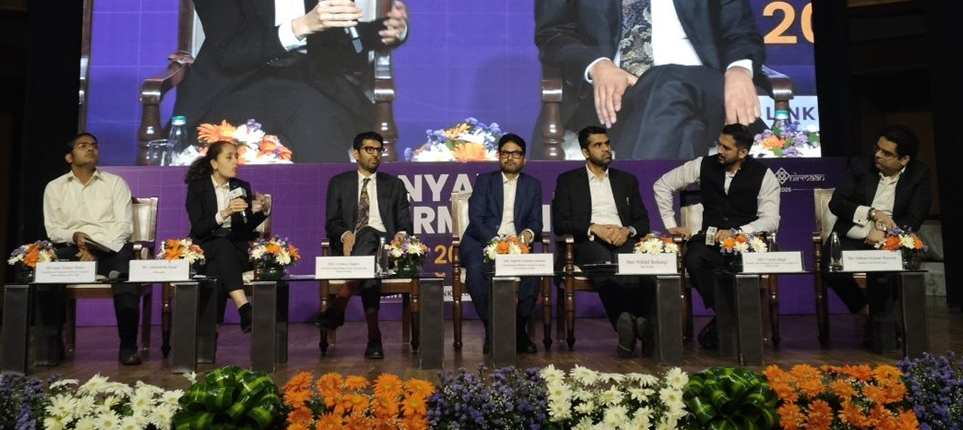
[In frame: Mr. Apurv Kumar Mishra, Ms. Aakanksha Kaul, Mr. Avishkar Singhvi, Mr. Jagdish Chandra Solanki, Mr. Nikhil Rohatgi, Mr. Varun Singh, and Mr. Sidhant Kumar Marwah]
Technology as a tool, not a substitute for legal judgment
Opening the discussion on technology, Mr. Varun Singh noted the transformation of legal research and court processes over the last decade, including the growing use of digital tools. Referring specifically to legal research, he observed that lawyers had moved from traditional book-based research to platforms such as SCC Online, which now also has an AI version capable of identifying relevant case law from a detailed prompt. He raised the broader question of how lawyers must adapt as information becomes increasingly accessible.
Responding to this, Mr. Nikhil Rohatgi said that AI is here to stay and will increasingly be used in legal practice, but stressed the importance of safeguards and verification. He suggested that AI should primarily be used to reduce clerical and repetitive work, allowing lawyers to devote their time and intellect to tasks requiring human judgment and analysis. Referring to the use of AI tools in legal research and preparation, he said, “rather than being scared of AI, I think we should see it as a tool to save time only.”
He also emphasised that AI-generated material, including case law, must not be relied upon without cross-checking.
Taking the discussion forward, Mr. Singh asked whether technologies such as online dispute resolution could become more prominent in India. Mr. Avishkar Singhvi observed that such technologies are already emerging and are likely to become increasingly prevalent. He highlighted the ability of AI to process large volumes of information but stressed that human judgment remains necessary to determine what information is relevant. Referring to the importance of experience in legal practice, he stated, “…the role of human beings is extremely important because human beings are able to pass that judgement and sift through the information.”
He further emphasised the importance of original thinking and succinct legal analysis despite the increasing availability of technology.
Analytical thinking and the changing role of lawyers
The discussion then moved to the changing nature of legal education and professional skills. Ms. Aakanksha Kaul observed that the increasing availability of information would reduce the importance traditionally attached to memorising citations, provisions and other legal material. According to her, the greater value in future legal practice would lie in the ability to analyse and apply information.
Mr. Singh similarly noted that as routine tasks such as preparing basic drafts and list updates become increasingly automated, analytical thinking would become a key differentiating skill for lawyers. The discussion highlighted the need for younger lawyers to develop the ability to approach a brief independently, evaluate information and provide practical legal solutions rather than merely reproduce available material.
Mediation, Settlement and Dispute Resolution
The panel then considered whether litigation would remain the principal route for resolving disputes or whether mediation and other mechanisms would assume a greater role. Responding to Mr. Singh’s questions, Ms. Kaul said that she had consistently favoured mediation and settlement. She noted that even a seemingly strong case cannot guarantee a particular outcome or timeline and therefore stressed the value of exploring settlement. She observed, “I strongly believe that it’s better to settle.”
Mr Singh subsequently asked Mr. Sidhant Kumar Marwah about the role of technology in mediation and dispute resolution. Mr. Marwah suggested that disputes should not be treated as a single category and that technology could be customised to address particular kinds of disputes. He pointed to construction disputes involving issues such as delay, cost escalation and changes in scope as areas where technology could assist adjudication, subject to appropriate human oversight. He also discussed the importance of enforcement architecture and professional mediation services, stressing the role of independent institutions and trained mediators.
Mr. Singhvi further described mediation as “the bridge between conflict and resolution”, while emphasising the need for institutional mechanisms, certified independent mediators, pre-mediation in appropriate commercial matters and a genuine approach towards settlement. He noted that mediation ultimately requires an attitudinal shift and a willingness to compromise.
Legal education and the need to preserve human judgment
The panel also examined how AI could affect the training of young lawyers. Mr. Marwah cautioned that while technology can significantly reduce repetitive tasks, the profession must reconsider how young lawyers acquire practical judgment and experience. He noted that earlier generations developed professional instincts through repeated exposure to briefs, documents and legal problems, whereas some of these tasks are now increasingly capable of being performed by technology. He therefore stressed the need to rethink training and education in the context of AI.
The discussion also highlighted the importance of preparing lawyers to use technology without losing the ability to reason independently. Mr. Singh observed that future lawyers would increasingly distinguish themselves through their analytical approach to a brief, while the panel broadly emphasised that technology should support rather than replace professional judgment.
Building India as a global legal services destination
The conversation subsequently turned to the question of India’s position in the global legal services market. Mr. Singh raised the example of jurisdictions such as Singapore and Dubai, where institutional development and dispute resolution infrastructure have contributed to their attractiveness as destinations for international disputes.
Ms. Kaul observed that simply permitting foreign law firms would not by itself replicate the experience of jurisdictions such as Singapore. She stressed the importance of the wider legal system, particularly efficiency and timelines. As she put it, “It is the system that needs to change.”
She further observed that the attractiveness of such jurisdictions lies significantly in the efficiency and predictability of their dispute resolution systems.
Addressing the broader question of India’s engagement with the global legal market, Mr. Apurv Kumar Mishra spoke about the opening of opportunities for foreign universities and law firms and the need for Indian professional institutions to consider the terms on which they participate in an increasingly connected global economy. He also referred to the importance of enabling Indian professional services to expand internationally and compete in global markets.
Technology can help address repetitive litigation
Mr. Jagdish Chandra Solanki brought the discussion back to the composition of litigation pendency and the potential role of technology in addressing repetitive categories of cases. He highlighted the scope for greater use of technology in matters involving structured calculations and recurring issues, including accident claims.
He also pointed to the potential for mediation in matrimonial disputes, where matters frequently reach settlement after prolonged litigation.
“If this is the practical scenario, I think that can be settled.”
He suggested that the legal system could examine whether certain categories of disputes can be dealt with through more streamlined processes rather than relying on conventional litigation for every issue.
A more open and globally connected profession
In the concluding exchange, Mr. Marwah emphasised the need for the legal profession to rethink its approach to professional institutions and international engagement. He said that Indian lawyers and law firms have opportunities to learn from international practices and should approach greater openness with confidence. He observed: “…we don’t need to be insecure about ourselves, open up the profession to foreign practises.”
Mr. Rohatgi, drawing from his experience at a disputes conference in Singapore, discussed the perspective of foreign businesses seeking trusted legal representation in unfamiliar jurisdictions. He suggested that allowing foreign companies limited access to foreign lawyers could provide an additional layer of comfort to international businesses entering India. Mr. Marwah and Mr. Singhvi also contributed to the discussion on competition and reciprocity, with Mr. Singhvi observing that such arrangements could operate on a reciprocal basis.
Concluding the session, Mr. Singh noted that the discussion had brought together varied perspectives on technology, mediation, legal education and globalisation. He described the exchange as an example of “real Shastra in real sense of the term”, and observed that the discussion reflected the emergence of lawyers capable of contributing to the legal architecture of Viksit Bharat 2047.
Also Read: Legal luminaries on building India’s legal architecture for Viksit Bharat at Nyaya Nirmaan @ 2047
PANEL 2: Vasudhaiva Kutumbakam and Global Commerce
As part of Nyaya Nirmaan 2026: India @ 2047, the session titled “Vasudhaiva Kutumbakam and Global Commerce” examined whether the growing interdependence of economies requires greater convergence of legal systems and regulatory frameworks across nations. The session featured Mr. Pinaki Misra, Senior Advocate and Mr. Sajan Poovayya, Senior Advocate, and was moderated by Mr. Sudhir Mishra, Founder and Managing Partner, Trust Legal. The discussion focused on the changing global economic landscape, cross-border commerce, environmental concerns, data centres, technology and AI governance.
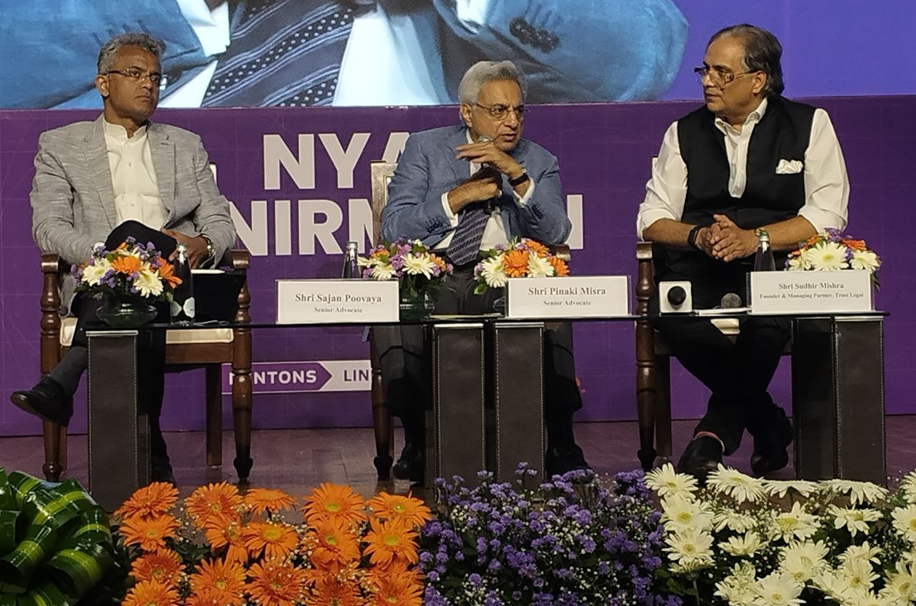
[In frame: Mr. Sajan Poovayya, Mr. Pinaki Misra, and Mr. Sudhir Mishra]
Effective legislation can facilitate economic development
Opening the discussion, moderator Mr. Sudhir Mishra asked Mr. Pinaki Misra how India and other countries could navigate a rapidly changing global environment and what role legal frameworks could play in addressing emerging challenges. Mr. Misra emphasised the importance of effective legislation in facilitating economic and infrastructure development. Referring to the Land Acquisition Act, 2013, he observed that appropriate legislation can provide the framework for infrastructure projects while addressing the interests of affected stakeholders.
He also referred to the Goods and Services Tax Act, 2017 and Real Estate (Regulation and Development) Act, 2016, as examples of important legislative measures shaping India’s economic and regulatory framework.
India needs stronger regulatory architecture for AI
Taking the discussion forward, Mr. Sudhir Mishra raised questions on India’s data landscape, data centres, environmental requirements and the country’s position in the global digital economy. Responding to these concerns, Mr. Sajan Poovayya discussed the infrastructure requirements associated with the expansion of data centres, particularly electricity, transmission and water, and highlighted the need for better alignment between technological growth and infrastructure planning.
Addressing the broader question of technology governance, Mr. Poovayya observed that India has developed considerable strength in technology infrastructure but needs to build stronger regulatory frameworks for emerging technologies, particularly artificial intelligence.
“What we missed out is on building soft infrastructure for governance of AI.”
He further discussed the different approaches to AI governance emerging globally and observed that India could have played a greater role in developing a framework suited to the Global South. He cited unified payments interface (UPI) as an example of an interoperable, home-grown technological architecture that has gained acceptance internationally.
PANEL 3: Codification v. Judicial Lawmaking: Can India Build Greater Commercial Certainty?
The third panel discussion comprising of Mr. Rajashekhar Rao, Senior Advocate and Mr. Atul Sharma, Executive Chairman, Dentons Link Legal (moderator) discussed whether there was a need for clearer codification rather than increasing reliance on judge made law.
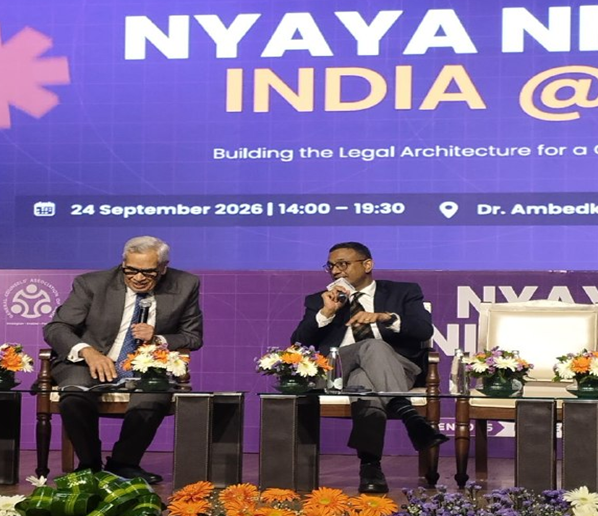
[In frame: Mr. Atul Sharma and Mr. Rajashekhar Rao]
Mr. Atul Sharma opened the session by stating that India’s constitutional courts possess powers of interpretation and review that are broad by any competitive standard. Article 32 makes access to the Supreme Court a fundamental right, Article 141 makes its declarations binding on all courts, Article 142 authorises it to pass any order necessary for doing complete justice, and Article 129 makes it a court of record with the power to punish for its own contempt. In a system governed by a written constitution, with a legislature that cannot anticipate every commercial configuration, these powers are not an aberration but part of the design.
He further noted that commercial certainty depends on stable rules and investor pricing. A coal-linked power project, a lender underwriting a telecom licence, or a party drafting an arbitration clause does not only need to know what a statute says. It needs a reasonable forecast of how a court will read it, what remedies it will grant, and when a judicial answer becomes final. That forecast is part of the price of the transaction.
Thus, he argued that the question for the session, therefore, was not whether judges should interpret legislation. The question was what happens when judicial interpretation materially develops the operative content of a statutory framework, or when remedies or extraordinary powers carry that development into areas where businesses have already committed capital. This was a narrower and more useful enquiry than a debate about activism and restraint.
In this backdrop, Mr. Sharma illustrated a few cases to frame the discussion, namely, SEBI v. Sahara India Real Estate Corpn. Ltd., (2014) 8 SCC 741, Manohar Lal Sharma v. Union of India, (2014) 9 SCC 516, Subramanian Swamy v. A. Raja, (2012) 9 SCC 257 (2G case), Gayatri Balasamy v. ISG Novasoft Technologies Ltd., (2025) 7 SCC 1, DMRC Ltd. v. Delhi Airport Metro Express (P) Ltd., (2024) 6 SCC 357.
The moderator asked what message this sends: whether there will always be a dichotomy between what business wants, what regulation wants, and what courts want.
The Tug of War and the Need for Clarity: Mr. Rajshekhar Rao
Mr. Rajshekhar Rao began by acknowledging that the tug of war between institutions will always exist as India is a democracy governed by the rule of law, with a defined distribution of powers and separation of powers. Thus, these cases were just illustrations of this tug of war.
Speaking from his personal experience, he argued that all lawyers need is clarity on the law; it cannot always be changing. The problem was not so much about which way to go, but whether the right message was being sent at the right time. As long as one knows what the law is and what the consequences of following or not following it are, it would be easier to make decisions.
Identifying 2016 as a watershed in the Indian commercial legislative landscape, he argued that if the amendments to the Arbitration and Conciliation Act, 1996, the Commercial Courts Act, 2015, the Insolvency and Bankruptcy Code, 2016 (IBC), and the Real Estate (Regulation and Development) Act, 2016, operated the way they were meant to, India would have had a largely clean landscape.
Taking the IBC as an example, Mr. Rao pointed out the inherent contradiction: India started calling itself a three to five trillion-dollar economy, but the threshold for triggering an IBC issue was still one lakh. Thus, in the case of huge enterprises which defaulted in crores, the IBC had become just another commercial court recovery regime.
He also emphasised the need for judicial interpretation by the judges and debate in the parliament, underscoring the value that these exercises add to a legislation. In the 2G case, the Supreme Court cautioned judges to be conscious of the economic consequences of decisions. Despite well-meaning intentions and apprehension towards writing the law, the judicial reaction is a gap either in the legislative framework or somebody taking advantage of a loophole.
On Article 142, he noted that the Supreme Court directs against taking repeated recourse to it but itself repeatedly takes recourse to it, thereby blurring the meaning and use of the provision.
The Enlargement of Article 226
Mr. Sharma then posed a final question on whether the enlargement of Article 226 has been the biggest problem. He recalled that when they started practising, going to the Supreme Court against an interlocutory order was an unwritten no. Under Article 226, the regime was that policy was not going to be reviewed, but that scope was enlarged, and Article 226 became an all-encompassing remedy.
Mr. Rao responded that he believed India would be in a worse situation without Article 226, particularly given the ambiguity in the law. Article 226 always allowed a party to go to court to ask for a mandamus, to ask a public authority to do something that it was duty-bound to do, but it was a whole other problem to tell them how to do their job. He acknowledged that there is a possibility of holding a person to whom a mandamus has been issued accountable, but questioned how often recourse is made to it. He suggested that if consistent guidelines were laid down and every transgression of an Article 226 order was rebuked by the Supreme Court, then courts would be mindful.
Citing the example of the Ganga and Yamuna river pollution cases, he observed that the Supreme Court monitored these for over twenty years and ensured that crores of rupees were spent. Despite such action, there was a lack of accountability. The way he sees it, the Supreme Court can say it can only push the executive to do its job and try to hold it accountable, but it is not responsible for cleaning the river as the judiciary is tasked with a thin space between executive and legislature to say what ought to be done, who should be doing it, and where it will regulate to ensure that the beneficiary actually gets that benefit.
Mr. Rao also noted a big problem: India is the only country where the numbers are so vast. India had leapfrogged in terms of technology, but the gap between legislation and change was huge. The country will constantly need to play catch-up.
He suggested that there needed to be a reset, going back and asking whether, twenty or thirty years ago, these institutions were meant to do these things. If not, some of these functions must be taken away, and other institutions should be allowed to do their job, with the hope that they do the job they are expected to do after the cleanup.
PANEL 4: The Bench, The Bar and the Future of Justice
The fourth panel discussion was held on the theme “From Pendency to Predictability: Reimagining Justice Delivery for Viksit Bharat @ 2047” with the central question being: Can India fundamentally transform justice delivery through institutional reform, technology, artificial intelligence, and a stronger culture of dispute prevention and consensual resolution?
The session was moderated by Mr. Tarun Nangia, Journalist, and consisted of eminent panellists namely, Justice Amit Bansal, Judge, Delhi High Court; Justice Saurabh Banerjee, Judge, Delhi High Court; Justice Tejas Karia, Judge, Delhi High Court; Mr. J Sai Deepak, Senior Advocate, Columnist, Author; and Mr. Kunal Vajani, Advocate, Arbitrator & Mediator.
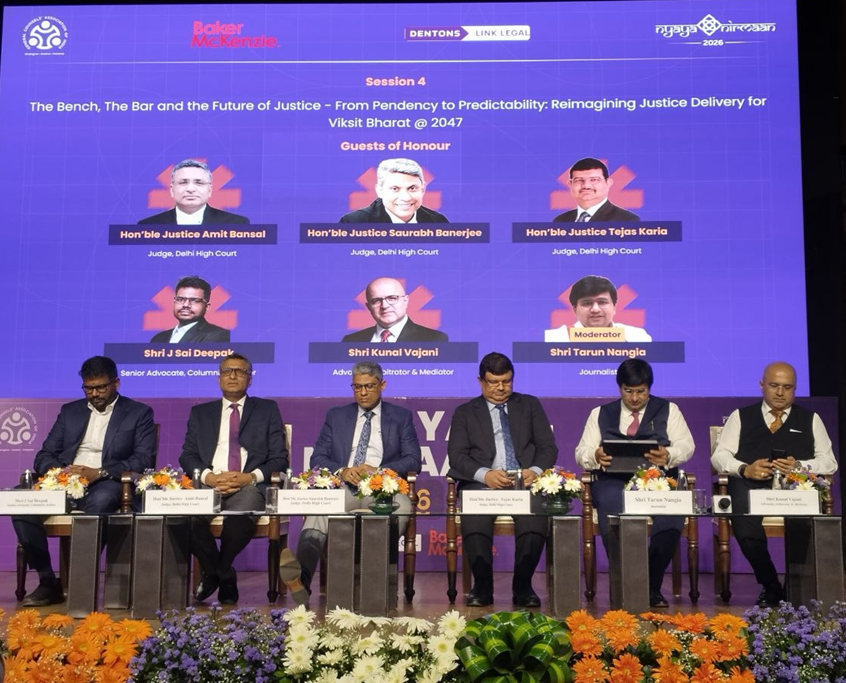
[In frame: Mr. J. Sai Deepak, Justice Amit Bansal, Justice Saurabh Banerjee, Justice Tejas Karia, Mr. Tarun Nangia, and Mr. Kunal Vajani]
Kickstarting the session, Mr. Tarun Nangia asked Justice Tejas Karia what needs to be done for India to become a chosen arbitration destination given that arbitration, which was intended to take commercial disputes out of an overburdened court system, had now become lengthy and expensive.
India needs arbitration hub cities, not a national approach: Justice Tejas Karia.
Responding to the question, Justice Karia acknowledged that while India has come a long way since the Arbitration and Conciliation Act, 1996, and the 2015 amendment, the ecosystem required significant strengthening. He questioned whether institutions and awareness were sufficient for establishing a sustainable ecosystem that will survive till 2047.
Underscoring the importance of courts in the arbitration ecosystem, he identified the persistent reliance on courts for the appointment of arbitrators as a major bottleneck. He suggested that parties who cannot decide on an arbitrator could opt for an institution. Furthermore, opting for institutional arbitration while drafting the contract would be more beneficial, as all technicalities like the appointment, rules, interim measures, etc., would be decided and clear at the outset. Opting for institutional arbitration, he opined, would address the issue of approaching courts for arbitrator appointment, which is a time-consuming process.
On developing India as a hub for international arbitration, Justice Karia emphasised that India’s diversity makes a single national arbitration hub impractical. He argued that hubs like Singapore, London, Hong Kong, and Paris were cities rather than countries and were equipped with institutions, a specialised arbitration bar, a huge pool of arbitrators, etc. India, in comparison, has centres like Delhi, Mumbai, and Bangalore which could be made hubs for international arbitration as they have trained arbitration lawyers, supportive courts, etc.
Justice Karia explained the requirements for establishing an arbitration hub:
-
Infrastructure: He stressed the need for both physical and soft infrastructure, like institutional rules, court system, supportive environment, etc. However, he stated that the soft aspects can only be established if there is adequate physical infrastructure, for example, hearing rooms as available in the Delhi High Court International Arbitration Centre.
-
Training: He also underscored the importance of training arbitrators and lawyers to conduct arbitration differently from conventional court proceedings. “Arbitration cannot be a replica of the court process. It has to be done differently. The purpose why parties choose arbitration is to have a simpler, flexible process which leads to finality.”
-
Reduced Court Interference: Adding to his previous point, Justice Karia emphasised the need for Courts to support the whole concept of finality in the awards by not interfering at the stage of challenge or at the stage of enforcement. For this, he suggested having specialist benches and judges well-versed in commercial laws to expeditiously decide arbitration matters.
Furthermore, Justice Karia advocated for the use of mediation in the arbitration process either before or during it. This hybrid process, he suggested, could change the way disputes are resolved in India. He also highlighted the potential of the Mediation Act, 2023, and the recently notified Mediation Council of India to enable hybrid processes like Med-Arb. “We can use mediation and arbitration in tandem with each other, and the court system supporting that with the infrastructure of institutions and the physical infrastructure, which can lead to less intervention at the challenge stage as well as at the enforcement stage.”
He reiterated that enforcement is the most important aspect of every arbitration because parties invest in India just to get the protection of their investment. Arbitration is the sole resort of foreign investors, as they cannot approach the courts, and a lack of timely enforcement would defeat the purpose of investment and arbitration.
In conclusion, he stated that, “We need to ensure that not only the challenges are decided expeditiously but also the enforcement is done on time, and if we think of all as one ecosystem, then I am sure we can develop Indian cities as the hub for international arbitration.”
What changes do we need?: Mr. J Sai Deepak
Responding to a question on what single structural change he would make to the Indian justice system today for impact visible by 2047, Mr. J Sai Deepak offered some suggestions.
First, he endorsed Justice Karia’s emphasis on decongesting commercial matters from the court system in order for it to perform its primary role as dispenser of justice to the lay person. Arbitration is one of those valves through which you can decongest the court system. His second suggestion was that since the training of an arbitrator is slightly different from the training of a conventional judge, maybe the law school curriculum and syllabus could cater to the same.
He further suggested expanding arbitration to Tier-2 cities as well because in those cities commercial matters do not get the kind of attention that they require from conventional courts. Availability of trained arbitrators in such cities could free up the courts for other cases.
Mr. Deepak also proposed a fundamental restructuring of the Supreme Court’s role. He argued that the Supreme Court must stop seeing itself and must not be seen as a court of appeal for commercial matters. He cited the example of the Federal Circuit Court of the United States to suggest the creation of another level to which commercial appeals and conventional appeals typically go unless there is a serious constitutional issue. This would allow the Supreme Court to preserve its status primarily as a constitutional court meant for resolution of disputes between states or between entities of government and as the enforcer of fundamental rights, giving emphasis to Article 32.
Four limbs to bridge gap between pendency and predictability: Justice Saurabh Banerjee
Justice Saurabh Banerjee addressed the question of bridging the gap between pendency and predictability, framing his response across four limbs.
-
From dispute resolution to dispute prevention: The first limb, he said, is the transition from dispute resolution to dispute prevention. This requires contracts and agreements to be strengthened with clear demarcation of technical, medical, topical, legal, monetary, and other aspects. These will eventually lead to the growth of the second limb, which is a shift from case disposal to case management.
-
Shift from case disposal to case management: He noted that advancements such as the Commercial Courts Act, 2015, admission-denial mechanisms, speedy filing of additional evidence, and case management mechanisms including pre-trial procedures have been introduced to keep pace with modern requirements. He argued, “Mediation, resolution, conciliation have not only to be recognised but also have to be given the same, if not more, weightage.”
-
Court-centric justice to multi-door justice: The third limb, he said, is a move from court-centric justice to multi-door justice. He emphasised that this is about the window of alternative means and ways of dispute resolution, which the legislation has also given shape, either in the form of the Arbitration and Conciliation Act, and now, in the form of the Mediation Act. Regarding the Mediation Act, he observed that it caters to the needs of the commercial enterprises to a large extent. It takes the idea of pre-litigation mediation under the present framework of Section 12A of the Commercial Courts Act a step further as it provides a comprehensive statutory framework for mediation. He highlighted that a mediated settlement agreement under the Act gives the same sanctity as that of a judgement and decree and can be challenged only on limited grounds. Justice Banerjee also batted for online mediation and accessible mediation. “A business does not necessarily want every dispute to culminate in a judgement. It wants the dispute to be resolved and resolved with a reasonable degree of certainty within a certain time limit and most importantly, without unnecessarily disturbing the commercial relationship.”
-
Rise of new tech: The fourth limb, he said, concerns the advent of AI, technology, knowledge, usage, correlation, time, assessment, tagging. These all play a vital role and have to be incorporated by all the commercial enterprises while entering into an agreement.
AI can assist, but ultimate decision-making must rest with the judge: Justice Amit Bansal.
Justice Amit Bansal addressed the impact of AI on the judiciary, noting that while AI is increasingly used by the legal community and other fields, its use in judicial functions remains limited. Speaking from his experience, he stated that though he had not personally used AI tools in his judicial work, he could foresee their greater use in judicial functions in the future, such as analysis of documents, summarization of documents, making a chronology of events, case law research, etc. On the administrative side as well, AI would certainly have a role to play in terms of case management, listing of matters, identifying cases which can be clubbed together, etc.
However, he drew a distinction when it came to preparing first drafts of judgments. In the first draft, the judge is taking a view which they want to decide. This judicial function must have a human element. There are certain very human sides to adjudication which only a judge can determine.
“Of course, AI can be a useful aid to a judge, but ultimate decision-making has to rest with the judge.”
He cautioned against over-reliance on AI, citing concerns about hallucination and untrusted sources, and suggested that there had to be a sense of caution while using AI and restraint in its use for essential judicial functions. However, he also acknowledged that the Supreme Court uses AI for transcription of submissions, translation of judgments, and case management, which was a usage he welcomed.
He suggested that AI could potentially be used on an experimental basis in more standardised, routine cases such as those under Section 138 of the Negotiable Instruments Act, 1881, but not for more serious offences like murder. He also suggested development of a dedicated platform for the Indian judiciary where case files containing confidential information can be uploaded, ensuring complete confidentiality.
Dispute prevention rather than resolution: Mr. Kunal Vajani
Addressing the issue of dispute prevention, Mr. Kunal Vajani suggested that before assessing how a dispute is to be resolved, parties should question its origin. He agreed that the prevention depended on case management and creation of a culture where pre-court resolution is prioritised. He emphasised that “the best way and the cheapest mode of dispute resolution is a well-drafted contract.” The most important clause in such a contract, he said, should be the dispute resolution mechanism, which should not immediately resort to courts or arbitration but should explore hybrid mechanisms.
Adding to what Justice Karia said about Med-Arb mechanisms, Mr. Vajani suggested a Med-Arb-Med mechanism wherein the resolution works in three levels: first, an internal constructive and a professional discussion; second, if the discussions fail, then initiating arbitration; and third, mitigating enforcement hurdles after receiving the award via mediation.
On disputes involving governments and PSUs, he underscored that the core issue lay in the lack of decision-making authority with the officers. He emphasised the need for an institutional mechanism or protection for the officers so that once a settlement is arrived at, there is no post-settlement audit on why that settlement was done and credence is given to the commercial wisdom and pragmatism of the officer for resolving the dispute via a settlement.
The session concluded with a small question-and-answer session with the attendees and the moderator thanking the panellists and the audience.
The conference concluded with a closing ceremony, which was graced by Shri Arjun Ram Meghwal, Minister for Law & Justice, Justice Satish Chandra Sharma, Judge, Supreme Court of India, Justice Sanjay Kishan Kaul, Former Judge, Supreme Court of India, and Dr Haseeb Drabu, Economist and Former Minister of Finance, Government of Jammu & Kashmir.





