About the Journal
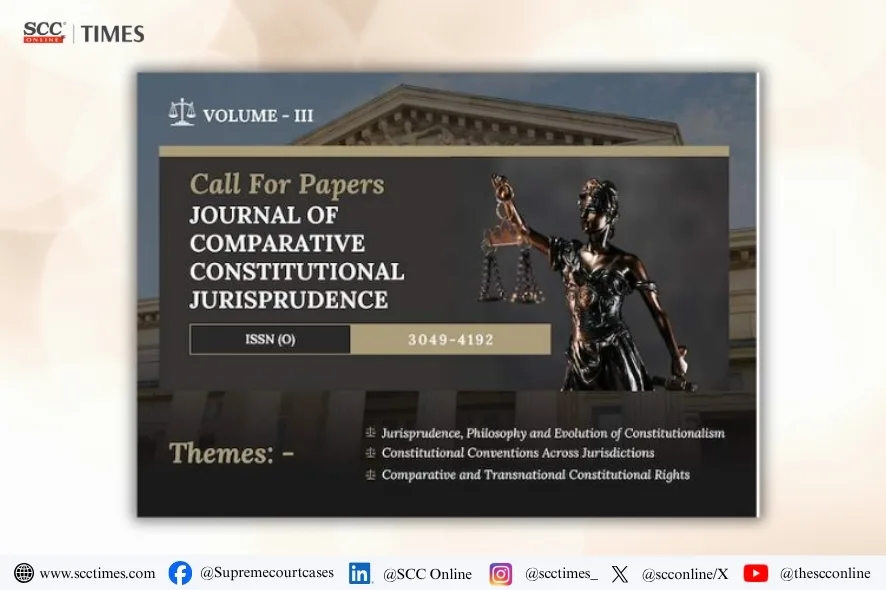
The Journal of Comparative Constitutional Jurisprudence (JCCJ) [ISSN (O): 3049-4192] invites original and unpublished manuscripts for Volume III, scheduled for publication in early 2027.
JCCJ is a double-blind peer-reviewed academic journal dedicated to advancing scholarship on the jurisprudential, philosophical, and historical foundations of constitutional law. While the Constitution of India remains its principal focus, the Journal actively encourages comparative and international perspectives that illuminate the evolution, theory, and practice of constitutionalism across jurisdictions. The Journal seeks to foster rigorous constitutional scholarship by providing a platform for meaningful academic engagement, with a particular emphasis on supporting early-career legal scholars, researchers, and law teachers. It welcomes contributions that move beyond doctrinal exposition to critically examine constitutional ideas, institutions, values, and traditions through analytical, theoretical, historical, and comparative approaches. JCCJ also invites submissions engaging with foreign constitutional systems, comparative constitutional law, and international constitutional theory, particularly where such analyses deepen the understanding of Indian constitutional jurisprudence or contribute to broader debates on constitutionalism in an increasingly interconnected legal order.
Topics
-
Jurisprudence, Philosophy and Evolution of Constitutionalism
-
Constitutional Conventions Across Jurisdictions
-
Comparative and Transnational Constitutional Rights
Submission Guidelines
-
Submissions must be made in Microsoft Word Format (.docx or .doc files). Soft copies should be submitted by 30th November, 2026, no later than 11:59 PM IST.
-
All submissions shall be made to jccjeditors@gmail.com. The subject of the email should read as “Submission_JCCJ_Volume III”. The submission should also be accompanied by a cover letter containing the professional and contact details of the author(s). The affiliation of author(s) shall not be revealed anywhere in the manuscript, else this will be treated as a serious ground for rejection of the submission, leading to a summary rejection of the manuscript.
-
All articles, and short articles, must be accompanied by an abstract not exceeding 350 words along with five (05) keywords. Tentative word limit:
-
Long Articles (4000 to 8000 words);
-
Short Articles (2000 to 4000 words);
-
Case Comments (1500to 3500 words);
-
Book Reviews (1000 to 3000 words).
-
-
The word limit can have a 10% deviation at the discretion of the Editorial Board. Further, it is not inclusive of the Footnotes and Abstract.
-
Heading and sub-headings will be formatted with case size of 12 in Times New Roman and Bold.
-
The body of the writing will be formatted with case size 12 in Times New Roman.
-
Footnotes shall follow the line spacing of 1, and the rest of the manuscript shall follow the line spacing of 1.5.
-
All referencing and footnoting shall strictly adhere to the standards laid down in the Oxford University Standard for the Citation of Legal Authorities (4th ed.).
-
Court decisions [including that of Supreme Court and/or High Court(s)/Foreign Court(s)] should preferably be cited using neutral citations or standard law reporters such as SCC/Manupatra. However, the use of neutral citations is encouraged.
-
Substantive footnoting is impermissible. Use of speaking footnotes is discouraged.
-
All the contributions should be the original work of the contributors and should not have been submitted for consideration in any other Publication. Plagiarized papers will be rejected. The Authors are discouraged to use the assistance of Artificial Intelligence (AI) and list AI as a co-author.
-
Co-authorship is permissible up to a maximum of three authors. There is no fee or article processing charges (APCs) at any stage of the publication process.
-
Copyright Policy- The Author(s) agrees to give the Editorial Board all the necessary rights to produce, distribute, and publish the manuscript, including but not limited to online and offline media.
-
For further information kindly visit our website https://jccj.in/ and follow our LinkedIn handle for regular updates.
-
The poster for the Call for Papers can be accessed here.
LinkedIn handle: https://in.linkedin.com/company/journal-of-comparative-constitutional-jurisprudence
Deadline
30th November, 2026.
Contact
For queries, please contact us at jccjeditors@gmail.com.