Disclaimer: This has been reported after the availability of the order of the Court and not on media reports so as to give an accurate report to our readers.
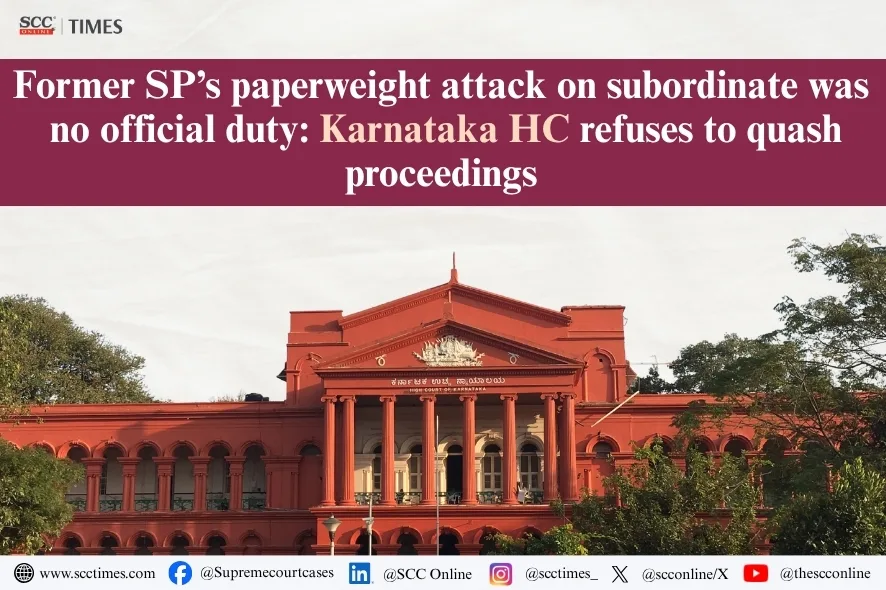
Karnataka High Court: In two connected criminal petitions seeking quashing of criminal proceedings against two police officers, on the ground that prior sanction for prosecution was required, the Single Bench of Ravi V. Hosmani, J., held that the acts attributed to accused No. 2, a Police Inspector, of admonishing the complainant for not participating in sports activities and threatening him with departmental action were connected with his official duty and, at the least, constituted reasonable excesses in maintaining discipline. However, the alleged physical assault by Accused 1, the former Superintendent of Police (SP), by hurling a paperweight and causing grievous injury to the complainant, had no apparent nexus with official duty. Accordingly, proceedings against Accused 2 were quashed, while Accused 1 was left to raise his contentions before the trial court.
Background
The complainant, a Police Sub-Inspector, alleged that Accused 2, a Circle Inspector, abused and threatened him over his absence from sports activities and informed Accused 1, the former SP. Thereafter, the complainant was taken to Accused 1’s office, where Accused 1 allegedly threatened him and threw a paper weight, causing an injury to his eyebrow. Alleging an attempt to suppress the incident, the complainant filed a complaint on 3 January 2012.
The FIR was registered on 3 September 2012, following which the police filed a ‘B’ report. The complainant filed a protest petition, but the Magistrate, without passing a specific order on the ‘B’ report, kept the issue of sanction open, took cognizance and issued summons. The accused then approached the High Court seeking quashing of the proceedings.
Analysis and decision
The Court relied upon Ghanshyam Soni v. State (Govt. of NCT of Delhi), 2025 SCC OnLine SC 1301, and observed that the period relevant for computing the limitation under Section 468 CrPC, was from the date of the incident to the date of filing of the complaint, and not to the date of taking cognizance. Since the complaint was filed on the day following the incident, the challenge on limitation was rejected.
On the ‘B’ report, the Court reiterated that failure to pass specific order would not be fatal where the Magistrate’s order reflected sufficient application of mind to the prosecution material and rejection of the report could be inferred.
The Court for sanction, relied upon D. Devaraja v. Owais Sabeer Hussain, (2020) 7 SCC 695 and G.C. Manjunath v. Seetaram, (2025) 5 SCC 390, and noted that sanction for prosecution of Government servants, including police officers, was mandatory. Though Ashwini Kumar Upadhyay v. Union of India, 2026 SCC OnLine SC 741 and Devinder Singh v. State of Punjab, (2016) 12 SCC 87, held that prior sanction was not necessary for initiation of criminal proceedings, the question of sanction had to be decided at or before the stage of taking cognizance. Since the proceedings had already crossed that stage, the Court noted that, it would only be appropriate to apply nexus test to overt acts and determine, if they are wholly or reasonably connected to discharge of official function by accused and by taking note of fact that Section 170 Karnataka Police Act, 1963 (KPA) extends statutory protection even to reasonable excesses.
The Court observed that, as both the complainant and the accused were police officers belonging to a uniformed force requiring round-the-clock duty and discipline, the acts attributed to Accused 2, admonishing the complainant for non-participation in sports activities and issuing verbal threats were intended to maintain discipline and had a clear nexus with official duty or, at the least, constituted reasonable excesses. Hence, failure to obtain sanction for prosecution of Accused 2 was fatal.
The Court relied upon the earlier observations in Crl.R.P. No. 1155 of 2015, filed by Accused 3 and found that the alleged physical assault and grievous injury by Accused 1, did not appear to have any nexus with official duty. The Court observed that whether the circumstances warranted such action, whether there was any reasonable explanation, or whether the incident occurred as alleged, required consideration at the appropriate stage. Accused 1 could not seek to disregard the earlier observations merely by asserting that the contentions were different or that there were changed circumstances without identifying any such change.
The Court allowed the petition filed by Accused 2 and proceedings against him were quashed, while Accused 1 was left to raise his contentions before the trial court.
[Vikash Kumar Vikash v. G S Chandrashekar, 2026 SCC OnLine Kar 11879, decided on 2-9-2026]
Advocates who appeared in this case:
For the petitioners: K B K Swamy and Parameshwar N. Hegde
For the respondent: Mahesh L. Advocate, Mahesha P. HCGP