


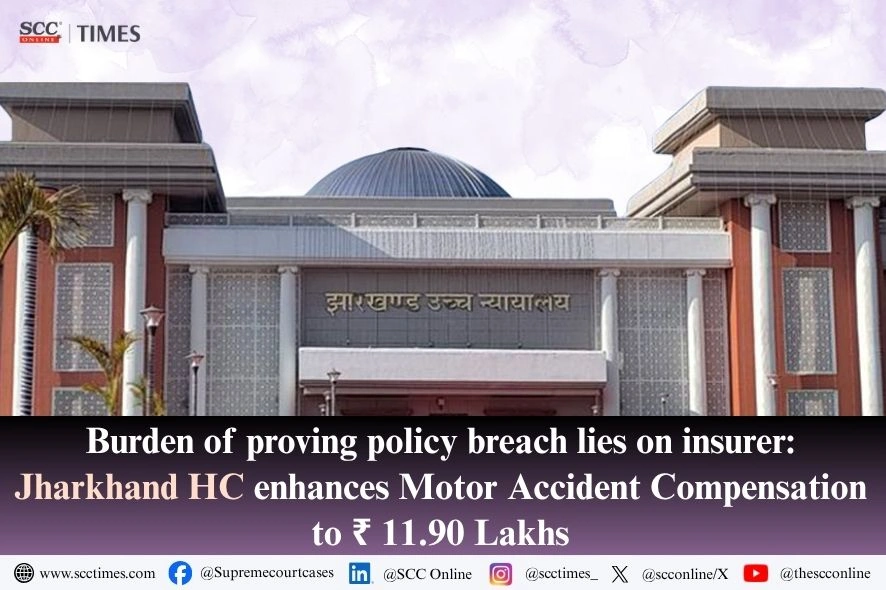
Jharkhand High Court: The Single Judge Bench of M.S. Sonak, CJ.,* dismissed the insurer’s appeal and enhanced compensation for the death of claimant’s husband from ₹7.10 lakhs to ₹11.90 lakhs. The Court held that an insurer must specifically plead and prove a fundamental policy breach before seeking pay-and-recover relief. As no convincing evidence established absence of a permit, liability remained with the insurer.
The Court relied upon the principles established by the Supreme Court in National Insurance Co. Ltd. v. Swaran Singh, (2004) 3 SCC 297. The onus for establishing fundamental breach of the terms of insurance policy would lie upon the insurance company which raises such a plea.
Background
The case arose from a motor accident which resulted in the death of claimants’ husband and father. The offending vehicle was insured with ICICI Lombard General Insurance Company Limited. The claimants included the deceased’s wife and 4 sons, who approached the Claims Tribunal, Palamau at Daltonganj. The Tribunal after examining the evidence on record, awarded ₹7,10,000 to the claimants, together with interest at 6 per cent per annum from the date of filing of the claim petition.
The appellant-insurer aggrieved by the impugned order, challenged the award on 2 grounds. First, it contended that the vehicle did not possess a valid permit on the date of the accident and that this constituted a breach of the policy conditions referring to Sections 149(2) and 134(c), Motor Vehicles Act, 1988. The insurer sought a direction permitting it to pay the compensation to the claimants and thereafter recover the amount from the owner of the vehicle. Second, the insurer challenged the method adopted by the Tribunal for determining the compensation. The claimants contended that the offending vehicle was being used for road-construction work and therefore did not require a permit in the circumstances of the case. The claimants opposed the insurer’s appeal and filed a cross-objection seeking enhancement of the compensation. They argued that the compensation awarded by the Tribunal was inadequate and had not been calculated in accordance with the principles established by the Supreme Court.
Issues
-
Whether the insurer had established that the offending vehicle was being operated without a valid permit,
-
Whether such alleged violation entitled the insurer to the benefit of a pay-and-recover order.
Decision and Analysis
The Court examined the statutory protections available under Sections 149(2) and 134(c), Motor Vehicles Act, 1988 and observed that such pleadings did not amount to a specific and categorical allegation that the vehicle actually had no permit on the date of the accident. The Court relied upon the principles established by the Supreme Court in National Insurance Co. Ltd. v. Swaran Singh, (2004) 3 SCC 297 and National Insurance Co. Ltd. v. Challa Upendra Rao, (2004) 8 SCC 517, that the onus for establishing fundamental breach of the terms of insurance policy would lie upon the insurance company which raises such a plea. The Court noted that the insurance company had neither produced the insurance policy nor led oral or documentary evidence to establish the alleged breach. The Court held that the mere production of the temporary permit was insufficient to conclusively establish that the vehicle had no permit on the date of the accident. The insurer’s request for a pay-and-recover direction was therefore rejected.
The Court considered Section 66, Motor Vehicles Act, 1988 and the exemptions contained in Section 66(3), particularly in relation to vehicles used for public purposes. The Court noted that the claimants had not been able to produce a categorical notification demonstrating that a vehicle engaged in road-construction work was exempt from the permit requirement. The Court upheld the Tribunal’s conclusion that the insurer remained liable to indemnify the owner.
The Court observed that the Tribunal had assessed the deceased’s monthly income at ₹6000 because the claimants had not produced documentary evidence establishing his precise income. The claimants had, however, produced three witnesses who consistently stated that the deceased was engaged in agriculture as well as contract work and earned approximately ₹10,000 per month. The Court referring to Chandra v. Mukesh Kumar Yadav, (2022) 1 SCC 198 and Oriental Insurance Co. Ltd. v. Kalu Ram, 2026 SCC OnLine SC 1187, observed that courts need not mechanically adopt the lowest income merely because exact documentary proof is unavailable. The Court considered Chameli Devi v. Jivrail Mian, 2019 SCC OnLine SC 24781, where the Court recognised that persons engaged in occupations where formal documentary proof of income may not ordinarily be available, oral evidence can legitimately form the basis of assessment.
The Court relied on the Supreme Court judgment in Ramachandrappa v. Royal Sundaram Alliance Insurance Co. Ltd., (2011) 13 SCC 236, where the Court permitted reasonable guesswork based upon the occupation of the deceased and the surrounding circumstances, while emphasising that the assessment must remain realistic. The Court assessed the deceased’s monthly income at ₹8000 considering the figure reasonable in view of his occupation as an agriculturist and block-level contractor. Since the deceased left behind 5 dependants, the Court applied a deduction of one-fourth towards personal and living expenses in accordance with Sarla Verma v. DTC, (2009) 6 SCC 121. The Court also awarded an addition of 25 per cent towards future prospects because the deceased was self-employed and approximately 45 years of age, following the principles laid down in National Insurance Co. Ltd. v. Pranay Sethi, (2017) 16 SCC 680.
The loss of dependency was accordingly worked out as follows:
-
Monthly income = ₹ 8000
-
Annual income: ₹8000 × 12 = ₹96,000
-
Add 25 per cent towards future prospects = ₹24,000
-
Annual income after addition of future prospects = ₹1,20,000
-
Less 1/4th towards personal expenses = ₹30,000
-
Annual contribution to the family: ₹90,000
-
₹90,000 × 14 = ₹12,60,000
The Court then considered compensation under the conventional heads by applying the principle of consortium recognised in Magma General Insurance Co. Ltd. v. Nanu Ram, (2018) 18 SCC 130, the Court awarded consortium of ₹40,000 to each of the 5 claimants, resulting in ₹2,00,000. It further awarded ₹15,000 towards funeral expenses and ₹15,000 towards loss of estate. No separate amount was granted for loss of love and affection. The total compensation before adjustment was therefore ₹14,90,000. The Court noted that ₹50,000 had already been paid as interim compensation under Section 140, Motor Vehicles Act, 1988. In addition, the owner of the offending vehicle had paid ₹2,50,000 to Claimant1 by 2 cheques. The Court held that this payment had a direct connection with the death caused by the accident and therefore could not be treated as an independent ex-gratia payment. It was required to be adjusted against the compensation payable under the claim.
After deducting ₹50,000 and ₹2,50,000 from the total compensation of ₹14,90,000, the net compensation payable came to ₹11,90,000. The Court maintained the Tribunal’s award of interest at 6 per cent per annum from the date of filing of the claim petition until payment. The Court consequently dismissed the petition filed by ICICI Lombard General Insurance Company Limited and allowed cross objection filed by the claimants. The compensation was enhanced from ₹7,10,000 to ₹11,90,000.
The Court directed the insurer to deposit ₹11,90,000 before the Court within 8 weeks, along with the applicable interest. The claimants were permitted to withdraw the amount through their bank accounts after verification of their identity and bank particulars. The shares of the minor claimants were directed to be kept in appropriate fixed deposits by their mother until they attained majority. The entire compensation was ordered to be apportioned equally among the 5 claimants.
[ICICI Lombard General Insurance Co. Ltd. v. Gayatri Kuar, 2026 SCC OnLine Jhar 2262, decided on 8-9-2026]
*Judgment authored by: Chief Justice M. S. Sonak
Advocates who appeared in this case:
For the Appellant: Swati Shalini, Advocate
For the Claimants: Arvind Kumar Lall, Advocate
1. Ed. Note: The Court, in the order, has cited Chameli Devi v. Jivrail Mian as (2019) 4 SCC 415. This citation, however, corresponds to a different case i.e. Khushwinder Singh v. State of Punjab, (2019) 4 SCC 415. As per the records, the said case is reported as Chameli Devi v. Jivrail Mian, 2019 SCC OnLine SC 2478.





