About the Institution
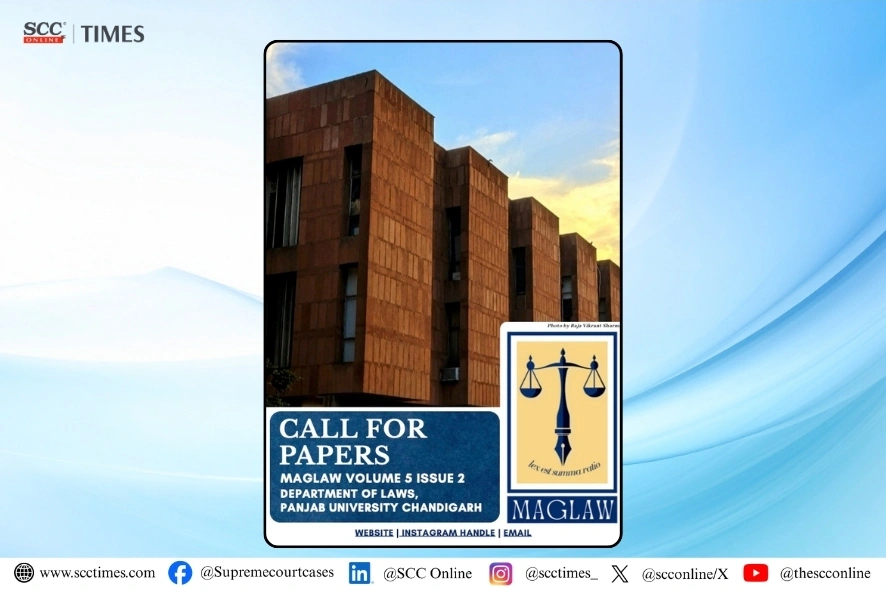
The Department of Laws, Panjab University originally established at Lahore in 1889, was re-established at Shimla in 1948, shifted to Jalandhar in 1950 and finally re-located at the University Campus at Chandigarh in 1959. Its Alumni include Judges of the Supreme Court and High Courts, Union Cabinet Ministers, State Chief Ministers, Cabinet Ministers, Ambassadors, Senior Bureaucrats, Police Officers and other legal luminaries. The Department always strives to create new opportunities for its students. The Department provides practical training to the students to hone their skills in various fields for overall development of personality such as-in the arena of Legal Research, Debate, Moot Court, Client Counselling, etc. by organizing various competitions and seminars.
About MAGLAW Law Journal
MAGLAW is a bi-annual publication by the Department of Laws, Panjab University, Chandigarh, published since 2017. It operates as a peer-reviewed and refereed journal, following a rigorous evaluation and selection process for articles submitted by law students. The journal covers a wide range of legal subjects, including constitutional law, criminal law, international law, intellectual property, human rights, and more.
MAGLAW has an editorial board of law students along with an editorial board consisting faculty members that ensures the quality of the content preliminarily, the student editors are responsible for handling the manuscript submissions, the review process, editing, and final publication. All matters concerning the Journal are overseen by the Editor in Chief.
The primary objective of this journal is to provide a platform for students to contribute their ideas and perspectives on current legal trends. It offers unique and nuanced viewpoints on contemporary legal topics and issues, aiming to encourage critical thinking, ignite debates and conversations, and enhance legal knowledge and understanding.
As a peer-reviewed and refereed journal, MAGLAW follows a strict evaluation process. Submitted manuscripts undergo assessment by qualified reviewers, usually law faculty members or legal professionals. The editorial board and the referees ensure that the publication maintains high-quality standards. Reviewers thoroughly evaluate the articles’ quality, relevance, and scholarly rigour before making recommendations for publication. MAGLAW exclusively focuses on publishing original research papers/articles, reviews, and case comments.
The journal serves as an excellent resource for exploring the captivating and ever-changing realm of law. We invite you to join us on this journey as we delve into the intersections of law, society, and justice.
About Call for Papers – Volume 5 Issue 2
In its quest of being a medium of exchange for diverse issues, the Editorial Board, after much deliberation, has curated this issue of MAGLAW to be truly multi-faceted, offering a host of themes spanning personality rights and digital identity, women-centric legislation and institutional reform, and a decade of judicial evolution across technology, access, and procedure. This has been done to give knowledge-givers a medium to express their views, and knowledge seekers an opportunity to gain diverse perspectives.
Submission Deadlines
-
Abstract Submission: till 30th August, 2026 by 11:50 p.m.
-
Manuscript submission: 30 days after the result for abstract round is declared.
Note: Both the submissions shall be made through OJS, linked on page 7.
Eligibility
8. ELIGIBILITY: Only bona-fide students pursuing L.L.B. (three-year and five-year law programmes), L.L.M., or Ph.D in the field of law are eligible to submit.
Conditions of Publication
-
ANONYMITY: The authors must maintain strict anonymity by not mentioning any personal credentials, names, institutional affiliations, or any other identifying details anywhere in their work, as we are committed to fairness and impartiality during the whole process of publication.
-
USE OF ARTIFICIAL INTELLIGENCE: The use of Artificial Intelligence—assisted writing tools is strictly prohibited. An AI report generated through Turnitin or Urkund must be submitted along with the manuscript to establish that the work is not AI-assisted. The AI similarity index must not exceed 0%.
-
LIABILITY FOR COPYRIGHT VIOLATIONS AND PLAGIARISM: Submissions are accepted for publication on the condition that they do not infringe the copyright or any other rights of third parties, and that the work does not contain any obscene, offensive, defamatory, or racially prejudiced material. The author(s) of the research paper, article, or book review shall be solely liable for any plagiarism or copyright violation, and the journal, publisher, and editorial board shall bear no liability whatsoever in this regard.
-
OPEN ACCESS POLICY: MAGLAW is committed to open access for academic work. All articles published in MAGLAW are freely accessible from the date of publication. There are no author charges, and there is no charge for any reader to access and download our articles for their own personal use. The ownership and copyright of the material published by submitters lie solely with the journal.
-
DISCLAIMER OF RESPONSIBILITY: MAGLAW shall bear no responsibility for any personal views, opinions, or interpretations expressed by the authors in their submissions. The journal is merely a medium for the dissemination of academic work, and the views expressed therein are those of the respective author(s) alone.
-
CO-AUTHORSHIP: Co-authoring of papers among individuals of the same or different institutions is permissible, up to a maximum of two authors per paper. Submissions from student authors with professionals as co-authors will not be considered.
-
NO PUBLICATION FEE: MAGLAW does not levy any publication fee or processing charge on authors at any stage of submission, review, or publication.
-
ELIGIBILITY: Only bona-fide students pursuing L.L.B. (three-year and five-year law programmes), L.L.M., or Ph.D in the field of law are eligible to submit.
-
EXCLUSIVITY OF SUBMISSION: Manuscripts submitted to MAGLAW must be original and submitted solely to MAGLAW. The same manuscript shall not be simultaneously submitted to, or under consideration by, any other journal or publication.
-
ETHICAL STANDARDS: Authors must ensure accuracy in representation of facts and sources. Fraudulent, misleading, or knowingly inaccurate statements constitute unethical conduct.
It is required that the authors submit a separate cover letter, in the prescribed format, consisting of their name, course pursued, email ID, institutional affiliation, and contact details, through the Open Journal System (OJS) along with the manuscript.
All submissions must be original and unpublished works. Authors should ensure that they have written entirely original work, and where the work and/or ideas of others have been used, the same must be appropriately cited or acknowledged.
A certificate of originality acquired from Turnitin must be submitted along with the work. The plagiarism/similarity index must not exceed 20%.
Note: The authors must submit the undertakings given in annexure, while making the Abstract Submission.
Themes & Sub-themes
Authors may pick any one of the following theme and one subsequent sub-theme.
-
Women centric legislation – Shield or weapon? Revaluating legislation, institutional failures and equitable path to reform.
-
The justice paradox: strategic misuse vs. failure of benefits to marginalised victims due to systemic barriers.
-
Judicial responses and procedural safeguards to prevent misuse.
-
Economic rights and alimony dilemma: maintenance or extortion.
-
-
Judicial reforms in the last decade: evaluating structural, technological and procedural evolution.
-
AI and Technology in legal sphere: Regulation, Governance and Integrity.
-
Access to Justice, Procedural and Institutional Barriers. (Note: brochure text reads “Access to Justice, Procedural cand hisdilutional Barriess” — this appears to be a typo in the original document. You may want to verify the intended wording with the editorial board before finalizing.)
-
Specialised Adjudication – Tribunalisation & Jurisdictional Conflicts. (Note: brochure text reads “Tribunalligation” — likely a typo for “Tribunalisation”; flagging for your verification.)
-
-
Personality rights in modern times: Ownership of identity, commercial value, and free expression.
-
Commercializing Identity: Names, voices, monikers and brand value. (Note: brochure text reads “monitors” — likely a typo for “monikers”; flagging for your verification.)
-
Postmortem rights: AI, deepfakes and digital replicas.
-
The gap in law: Need for codification and clear guidelines.
-
Submission Categories
Categories of submission:
-
Research Papers – 3,000 to 6,000 words
-
Case Notes – 2,500 to 3,000 words
-
Legal Opinion – 1,500 to 2,000 words (Focussed Opinion on a topic giving clear, independently reasoned position on one or all defined legal questions related to the relevant theme)
*Word limit is exclusive of footnotes; it includes the abstract.
Submission Guidelines
General
STAGE ONE — ABSTRACT SUBMISSION: AUTHORS MUST FIRST SUBMIT AN ABSTRACT OF NOT MORE THAN 200 WORDS, ALONG WITH FIVE KEYWORDS, THROUGH THE OJS.
-
Cover Letter and Undertaking: The abstract submission must be accompanied by a cover letter and a self-declaration/undertaking, as specified in the prescribed format (annexed as Annexure-1 & Annexure-2).
-
Selection of Abstracts: The submitted abstracts will be reviewed by the Editorial Board, and only selected abstracts will be invited to proceed to the manuscript stage.
STAGE TWO — MANUSCRIPT SUBMISSION: AUTHORS OF SELECTED ABSTRACTS WILL BE GIVEN ONE MONTH’S TIME FROM THE DATE OF INTIMATION TO SUBMIT THEIR COMPLETE MANUSCRIPT THROUGH THE OJS.
-
Anonymity of Manuscript: Other than the cover letter, no document submitted by the authors should reflect any personal information, including their name, institutional affiliation, or any other identifying details. Violation of anonymity will render the submission disqualified.
-
Plagiarism Report & AI Report: The authors are required to submit their Originality and AI Reports, generated via Turnitin.
-
Review Process: Upon submission, manuscripts will be sent to reviewers for evaluation. The reviewers’ decision will be communicated to the authors thereafter.
-
Revisions: Where the reviewers suggest minor or major changes, the authors will be given a period of 4 days to incorporate such changes and re-submit their anonymous manuscript.
-
Originality: The submission must not have been published or submitted for publication elsewhere. Submitting the same manuscript to more than one journal concurrently constitutes unethical publishing behaviour and is unacceptable.
-
Reporting Standards: The sources relied upon in the manuscript must be accurate and up to date. The primary or fundamental data forming the basis of the research should be represented accurately in the paper, with sufficient detail and references to permit others to verify or replicate the work. Fraudulent or knowingly inaccurate statements constitute unethical behaviour and are unacceptable.
-
Mode of Submission: Submissions must be made exclusively through the Open Journal System (OJS). i) Link to OJS: https://maglaw.puchd.ac.in/index.php/maglaw/login ii) Queries may be addressed at: maglaw.pulaws@gmail.com
Formatting
-
Font: Times New Roman
-
Language: British English
-
Page margins: 1 inch on all sides
-
Font Size: Main body & Headings: 12; Footnotes: 10
-
Line Spacing: Main body & Headings: 1.5; Footnotes: 1.0
-
Citation Style: ILI Footnoting
-
Footnotes shall be automated (use Ctrl+F wherever you wish to insert footnotes)
-
Alignment: Headings & Sub-headings: Left; Content: Justified
-
Indent to each paragraph: 1 inch (use Ctrl+Tab at the beginning of each paragraph)
-
Hyperlinks, if used, must be in black.
-
A single-line gap must be maintained between paragraphs.
-
All tables, figures, charts, or graphs must be numbered consecutively.
Processing Charge
7. NO PUBLICATION FEE: MAGLAW does not levy any publication fee or processing charge on authors at any stage of submission, review, or publication.
Contact Details
Write to us at maglaw.pulaws@gmail.com
Official Link to Notice cum Brochure