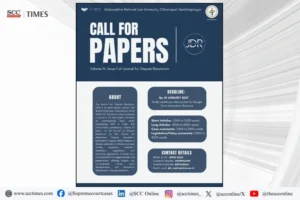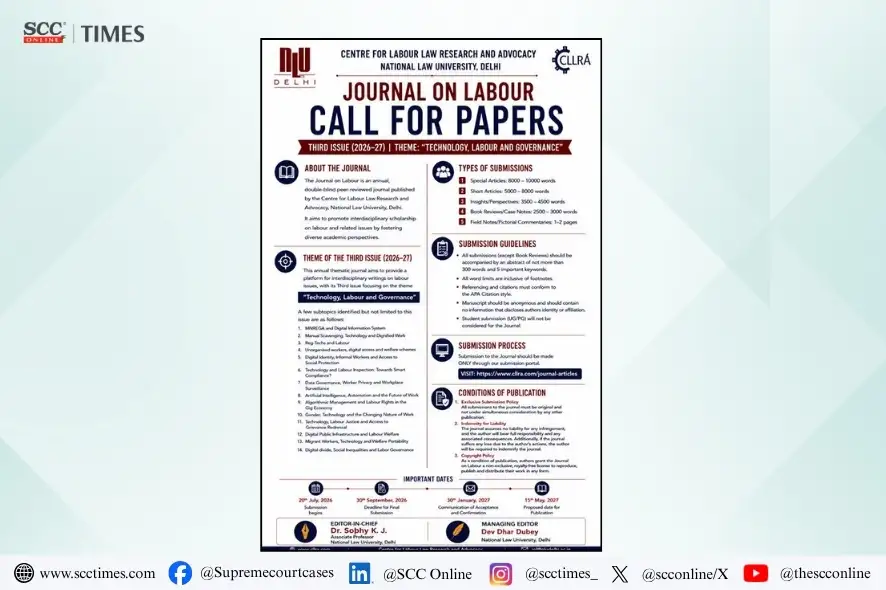
About the Journal on Labour
The Journal on Labour is now accepting submissions for its upcoming issue. It is published by the Centre for Labour Law Research and Advocacy at the National Law University, Delhi. This double-blind and peer-reviewed annual journal focuses on interdisciplinary scholarship on Labour. Each issue will centre debates on contemporary areas of Labour. The journal’s editorial board is committed to fostering diversity and inclusivity, and we invite scholars, researchers, practitioners and activists to contribute to this academic exchange.
Theme of the Third Issue (2026-27)
This annual thematic journal aims to provide a platform for interdisciplinary writings on labour issues, with its Third issue focusing on the theme “Technology, Labour and Governance’’
A few subtopics identified but not limited to this issue are as follows:
-
MNREGA/VB-G RAM G and Digital Information system
-
Manual Scavenging, Technology and Dignified Labour
-
Reg-Techs and Labour
-
Unorganised workers, digital access and welfare schemes
-
Digital Identity, Informal Workers and Access to Social Protection
-
Technology and Labour Inspection: Towards Smart Compliance?
-
Data Governance, Worker Privacy and Workplace Surveillance
-
Artificial Intelligence, Automation and the Future of Work
-
Algorithmic Management and Labour Rights in the Gig Economy
-
Gender, Technology and the Changing Nature of Work
-
Technology, Labour Justice and Access to Grievance Redressal
-
Digital Public Infrastructure and Labour Welfare
-
Migrant Workers, Technology and Welfare Portability
-
Digital Divide, Social Inequalities, and Labour Governance
Editorial Board
The Journal on Labour has a four-tiered editorial board composed of patrons, advisory boards, senior editors, and associate editors. It is composed of distinguished academician and experts in labour studies and law. The board is led by:
-
Chief Patron: Prof. (Dr.) G.S. Bajpai, Vice-Chancellor, National Law University, Delhi
-
Patron: Prof. (Dr.) Ruhi Paul, Registrar and Professor, National Law University, Delhi
-
Editor-in-Chief: Dr. Sophy K.J., Associate Professor & Director, CLLRA, NLU Delhi
The advisory board of the journal will be led by distinguished academicians, including Prof. (Dr.) Ritu Dewan, Prof. Babu Mathew, Prof. B.T. Kaul, Prof. Dr. Ranbir Singh, Prof. Ruth Dukes, and Prof. Alan Bogg.
The journal will benefit greatly from the knowledge and research experience that Senior Editors Dr. Roopa Madhav, Prof. Debasis Poddar, Dr. Maya John, Dipa Sinha, and Sawmiya Raja Ram will provide.
Dev Dhar Dubey, Senior Research Fellow and PhD Scholar at NLU Delhi, is the journal’s managing editor and handles its regular operations.
In order to ensure rigorous academic quality, the editorial board is further strengthened by committed team of Associate Editors.
Submission Guidelines
Types of Submissions
-
Special Articles: 8000 – 10000 words
-
Special articles should contribute to theoretical or empirical knowledge within the thematic area of the current issue. Contributors are expected to engage deeply with the journal’s overarching theme, offering innovative and reassessment perspectives.
-
-
Short Articles: 5000 – 8000 words
-
Authors are encouraged to choose themes of contemporary relevance to ensure the article’s significance and impact. While empirical research is highly valued, purely theoretical pieces that provide new insights or challenge existing paradigms are also welcome.
-
-
Insights/Perspectives: 3500 – 4500 words
-
Short theoretical discussions based on contemporary happenings or futuristic solutions to any deadlock around labour in specific areas are welcome under this section. This section invites write-ups based on real issues which are seldom noticed in the literature.
-
-
Book Reviews/Case Notes: 2500 – 3000 words
-
The journal accepts a limited number of book reviews and case notes for each issue. Authors are encouraged to review books published by nationally and internationally recognised publishers. Cases must be based on landmark decisions of the Supreme Court or the High Courts on labour issues.
-
-
Field Notes/Pictorial Commentaries: 1-2 pages
-
This section looks forward to hosting any methodological material, such as field notes or pictorial representation, that provides ground narratives/experiences.
-
Style Guidelines
-
All submissions (except Book Reviews) should be accompanied by an abstract of not more than 300 words and 5 important keywords..
-
All word limits are inclusive of footnotes..
-
Referencing and citations must conform to the APA Citation style..
-
Any submission made in any other citation style will not be considered.
Formatting and Citation Guidelines
-
The body of the manuscript should be in Times New Roman, font size 12, with 1.5 line spacing.
-
The footnotes should be in Times New Roman, font size 10, with single line spacing.
-
A one-line gap must be maintained between all paragraphs and headings.
-
All paragraphs must begin with a one-inch indent.
-
Referencing and citations must conform to the APA Citation style.
Conditions of Publication
-
Submission Policy
-
All submissions must be accompanied by a cover letter indicating the author’s name, affiliation, the submission’s title, the author’s email address/contact number and declaration of originality. The submissions will be reviewed by the Editorial Board and External Peer Reviewers.
-
The Manuscript submitted must be Anonymous and any submission that disclose the identity or affiliation etc., of author(s) will be outrightly rejected.
-
Co-Authorship is allowed (No restrictions on number of Authors) but Gift Authorship is strictly prohibited.
-
-
Indemnity for Liability
The journal assumes no liability for any infringement, and the author will bear full responsibility and any associated consequences. Additionally, if the journal suffers any loss due to the author’s actions, the author will be required to indemnify the journal.
-
Copyright Policy
Authors retain copyright. Authors grant the journal a non-exclusive licence to publish the article. Articles are published under CC BY 4.0. This ensures efficient and consistent handling of requests from third parties to reproduce articles and facilitates wide dissemination of the article. Upon assigning copyright, authors may reuse their own material in other publications, provided that Journal on Labour is acknowledged as the original place of publication and the journal is notified in writing and in advance.
Work submitted for publication must be original, previously unpublished, and not under consideration for publication elsewhere. If previously published figures, tables, or parts of text are to be included, the copyright holder’s permission must have been obtained prior to submission.
Submission Process
All submissions must be accompanied by a cover letter indicating the author’s name, affiliation, the submission’s title, the author’s email address/contact number, and a declaration of originality. The submissions will be reviewed and edited by the Editorial Board under the supervision of the Editor-in-Chief. All the submissions must be made online at the submission portal [Click here].
Important Dates
-
Submission begins from: 20th July, 2026
-
Deadline for Final Submission: 30th September 2026
-
Communication of Acceptance and Confirmation: 30th January 2027
-
Proposed date for Publication: 15th August 2027
Contact Information:
For any queries or further information, please contact:
Centre for Labour Law Research and Advocacy (CLLRA), National Law University, Delhi