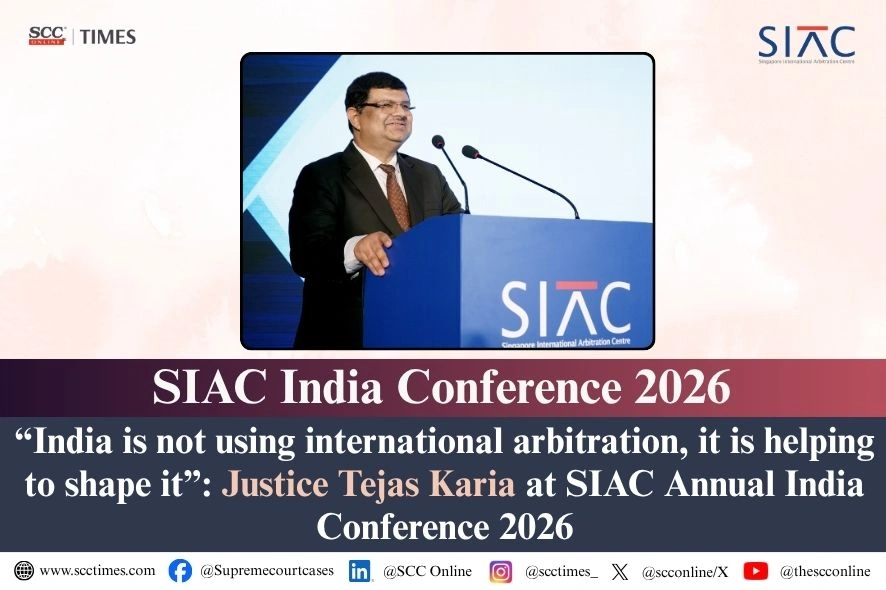
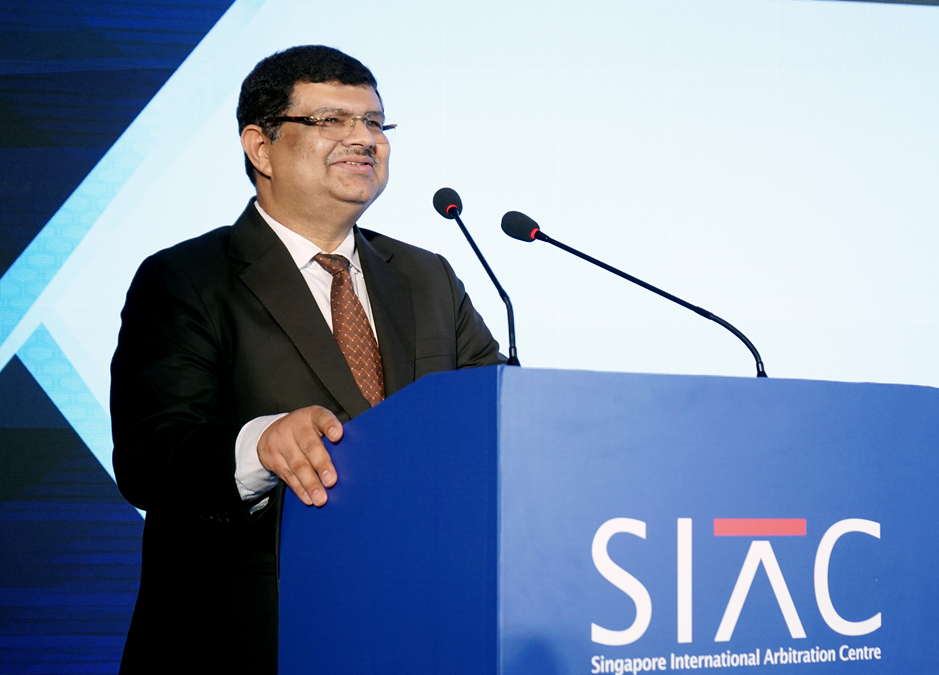
The Singapore International Arbitration Centre (SIAC) organised the SIAC Annual India Conference 2026 in New Delhi on 25 July 2026 under the theme “International Arbitration: Navigating New Realities and Stress-Testing the Fundamentals”. Delivering the conference’s closing remarks, Justice Tejas Karia, Judge, Delhi High Court, congratulated SIAC on inaugurating its Delhi Liaison Office and observed that the new office represents not merely an institutional expansion but a deeper engagement with India’s legal and commercial ecosystem.
SIAC’s Delhi office strengthens India-Singapore arbitration partnership
Justice Karia began by observing that the India-Singapore relationship provides a strong foundation for closer cooperation in arbitration, built upon robust economic ties, expanding business relationships and mutual confidence in stable legal institutions. He noted that Singapore continues to be one of the largest sources of foreign direct investment into India, while Indian businesses increasingly regard Singapore as their gateway to Southeast Asia and the wider Asia-Pacific region.
He explained that Indian parties have long been among SIAC’s most active users and that SIAC has demonstrated sustained confidence in the Indian legal market not only by administering disputes involving Indian parties but also by investing in long-term engagement with India’s arbitration community.
Recalling SIAC’s first overseas representative office in Mumbai in 2013, Justice Karia shared a personal reflection, observing that although he had hoped for a Delhi office at the time, that dream of his has come true today after 13 years.
Referring to the inauguration of the Delhi Liaison Office, he remarked that its significance extends far beyond geography. Delhi, he observed, is the seat of constitutional governance and policymaking, as well as one of India’s foremost legal centres.
“Delhi is not merely a location. It is a meeting point of law, policy, commerce and institutions.”
The Delhi office will facilitate sustained engagement with law firms, independent arbitration practitioners, in-house counsel, academic institutions and, where appropriate, the judiciary. Rather than limiting interactions to conferences and arbitral proceedings, the office will allow SIAC to maintain a continuing dialogue with India’s legal ecosystem.
Justice Karia observed that arbitral institutions evolve not merely by administering disputes but through engagement with the communities they serve. A permanent presence in Delhi, he said, would help SIAC better understand user expectations, commercial realities and regulatory developments while strengthening its institutional footprint in India.
India is helping shape international arbitration
Highlighting India’s growing influence within SIAC, Justice Karia noted that India has consistently remained among SIAC’s top three foreign users for almost a decade and, according to SIAC’s 2025 annual report, was its third-largest foreign user with 178 parties in 2025.
He further observed that in 2025, Indian law wasthe third most frequently chosen governing law in SIAC-administered arbitrations, reflecting increasing confidence in Indian commercial law and the sophistication of Indian cross-border transactions.
Drawing from his own experience, Justice Karia said he had handled several SIAC-administered arbitrations involving Indian parties, governed by Indian law and seated in India. He also highlighted the increasing contribution of Indian arbitration professionals, noting that Indian arbitrators are among the most frequently appointed nationalities in SIAC proceedings and that the SIAC Court of Arbitration presently includes four distinguished Indian members.
Reflecting on his tenure as a former member of the SIAC Court of Arbitration, Justice Karia explained the Court’s role in appointing arbitrators, deciding applications relating to joinder, consolidation, emergency proceedings and challenges concerning arbitrators’ independence, impartiality and jurisdiction of the tribunal. He also noted that members of the Court contribute to institutional policy and the continued development of the SIAC Arbitration Rules. Referring to the SIAC Rules 2025 (2025 Rules), Justice Karia shared that he had personally participated in the drafting process that culminated in the new rules.
Summarising India’s evolving role, he observed:
“India is not using international arbitration, it is helping to shape it.”
According to him, India’s contribution today extends beyond generating disputes and includes shaping arbitral practice through its lawyers, arbitrators, governing law and institutional participation.
India’s arbitration reforms complement its global ambitions
Justice Karia observed that India’s growing prominence in international arbitration aligns with the country’s own efforts to strengthen its domestic arbitration ecosystem. Legislative reforms, greater judicial support for party autonomy, commercial courts and increasing emphasis on institutional arbitration all reflect India’s objective of creating a legal framework built upon certainty, efficiency and institutional excellence.
According to him, the future of arbitration in India will depend upon how institutions, courts, practitioners and users respond to the profound changes reshaping international commerce. Questions concerning institutional adaptability, procedural efficiency and sustaining confidence in cross-border dispute resolution are no longer theoretical as they influence boardrooms, courtrooms, arbitral tribunals and commercial relationships every day.
Innovation must reinforce arbitration’s foundational principles
Referring to the conference theme, “International Arbitration: Navigating New Realities and Stress-Testing the Fundamentals”, Justice Karia observed that arbitration has continually evolved alongside global commerce, adapting to increasingly complex transactions while embracing technological change.
He noted that modern arbitral disputes increasingly involve artificial intelligence, digital assets, cyber incidents, sustainability obligations, sanctions regimes and regulatory fragmentation. At the same time, arbitration users expect proceedings that are proportionate, efficient, technologically enabled and commercially sensible.
Justice Karia, however, emphasised that innovation must never come at the cost of arbitration’s core values.
“A mature arbitration system is measured not only by the readiness to innovate, but by its ability to preserve the values that earn users’ trust over time.”
Innovation, he observed, is meaningful only when it reinforces arbitration’s foundational principles.
SIAC Rules 2025 improve accessibility and efficiency
Justice Karia highlighted several significant features of the 2025 Rules, particularly the streamlined procedure for disputes valued at up to Singapore Dollar 1 million, providing expedited timelines together with a 50 per cent reduction in SIAC’s administrative and tribunal fees.
He observed that these measures make arbitration more accessible, especially for small and medium-sized enterprises, demonstrating that arbitration must remain not only suitable for large commercial disputes but also a realistic and cost-effective option for smaller businesses.
He also referred to the newly introduced Protective Preliminary Order (PPO) mechanism under the 2025 Rules, explaining that it responds to modern commercial realities where assets can move rapidly across jurisdictions and potentially frustrate the effectiveness of interim relief.
The mock arbitration conducted during the conference, he observed, effectively demonstrated how these procedural innovations would function in practice while reinforcing that procedural reform should ultimately be judged by its ability to deliver fairness and effective justice.
Trust remains arbitration’s greatest strength
Concluding his address, Justice Karia observed that the future of international arbitration will ultimately depend not merely upon technology or procedural reform, but upon trust, trust that institutions remain impartial, tribunals remain independent, awards are respected and enforced, and innovation remains aligned with arbitration’s core values.
Congratulating SIAC on inaugurating its Delhi Liaison Office, he expressed confidence that the new office would strengthen collaboration between SIAC and India’s legal community while contributing meaningfully to India’s aspiration of becoming a leading global centre for international commercial arbitration.
Ending on an optimistic note, he remarked:
“Arbitration’s greatest strength lies not only in resolving disputes, but building bridges of trust across borders.”
Expressing hope that the Delhi Liaison Office would mark the beginning of a stronger institutional partnership between SIAC and India, Justice Karia wished SIAC continued success and encouraged the legal community to continue fostering dialogue, innovation and confidence in international arbitration.