The Singapore International Arbitration Centre (SIAC) organised the SIAC Annual India Conference 2026 – Delhi on 25 July 2026. The theme for this year’s conference was “International Arbitration: Navigating New Realities and Stress Testing the Fundamentals”. The highlight of the conference was the inauguration of the SIAC Delhi Liaison Office, which marks a significant milestone in SIAC’s global expansion and its growing engagement with India’s legal and business community.
Read more about the Delhi Liaison Office here: SIAC opens Delhi Liaison Office, strengthening engagement with India’s arbitration ecosystem
The inauguration ceremony was attended by several distinguished dignitaries, including Justice Surya Kant, Chief Justice of India; Edwin Tong SC, Singapore’s Minister for Law and Second Minister for Home Affairs; Arjun Ram Meghwal, Minister of State (Independent Charge) for Law & Justice and Minister of State for Parliamentary Affairs, Government of India; Justice Tejas Karia, Judge, High Court of Delhi; R. Venkataramani, Attorney General for India and Senior Advocate, Supreme Court of India; Davinder Singh SC, Chairman, SIAC and Executive Chairman, Davinder Singh Chambers LLC, and Lucy Reed, President of the SIAC Court of Arbitration.
In her opening remarks, SIAC CEO Gloria Lim noted that the annual India conference brings together judges, policymakers, business leaders, in-house counsel, practitioners, and arbitrators from across the international arbitration community, reflecting something fundamental about international arbitration today. She remarked that “arbitration does not operate in isolation; it sits at the intersection of law, commerce, and public policy”.
She noted that the theme of the conference is particularly timely, as businesses around the world are navigating profound changes. Technology continues to transform industries, investment flows are evolving, supply chains are being reconfigured, and geopolitical developments are reshaping commercial relationships. As a result, disputes are also becoming increasingly complex.
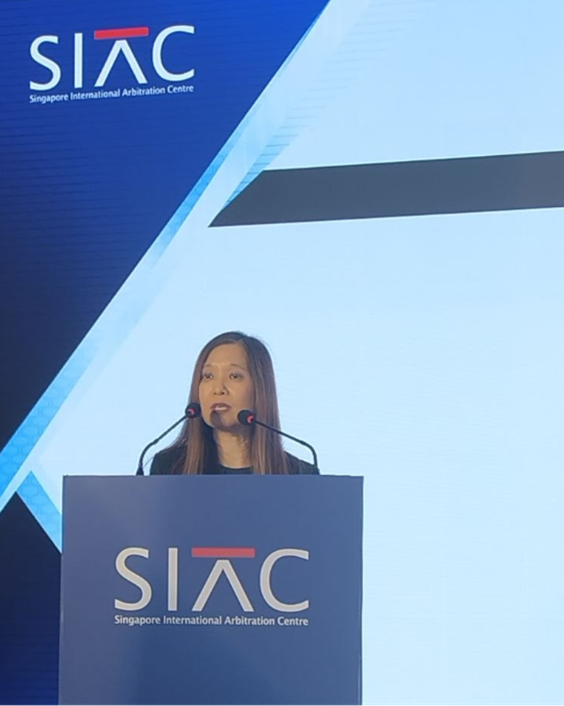
Gloria stated that against this evolving backdrop, SIAC continues to work hard to respond to the expectations and needs of arbitration users. She further explored the history of SIAC from administering just two cases in 1991 to becoming one of the world’s leading arbitral institutions. In 2025, SIAC handled 886 new cases, with 90 per cent of the cases being international in nature. These figures are not simply measures of growth; they reflect the continued trust that businesses across the world place in SIAC to resolve some of the most significant commercial disputes.
Regarding SIAC’s involvement with India, she mentioned how over the years, Indian parties had consistently been among SIAC’s top foreign users. In 2025, 178 Indian parties arbitrated at SIAC. She remarked that “these figures demonstrate the significant cross-border trade and economic activity Indian companies are engaged in all over the world. Indian users are familiar with international arbitration and actively play a role in shaping the development of this field. Every time I visit India, I leave inspired by the energy of the legal community and the openness with which ideas are exchanged. These conversations continue to shape SIAC’s thinking, and many of our initiatives have been inspired by feedback from our users here.”
She also announced that the SIAC Arbitration Rules 2025 would have a Hindi translation, which will be released for public consultation shortly.
Celebrating the opening of the Delhi Liaison Office, she stated that while Delhi was the 7th overseas representative office, Mumbai and Gift City liaison offices had, for more than a decade, enabled SIAC to build strong relationships with the Indian legal and business community and to better understand user needs. Noting Delhi’s unique legal and commercial position, she hoped that the Delhi office would provide an opportunity for SIAC to deepen its user engagement, strengthen its institutional partnerships, and contribute to the development and growth of international arbitration in India.
Reflecting on the spirit of collaboration, she further hoped that the conversations would not only examine the challenges facing international arbitration but also encourage everyone to think collectively about how these challenges could be met and the needs of the future could be addressed.