


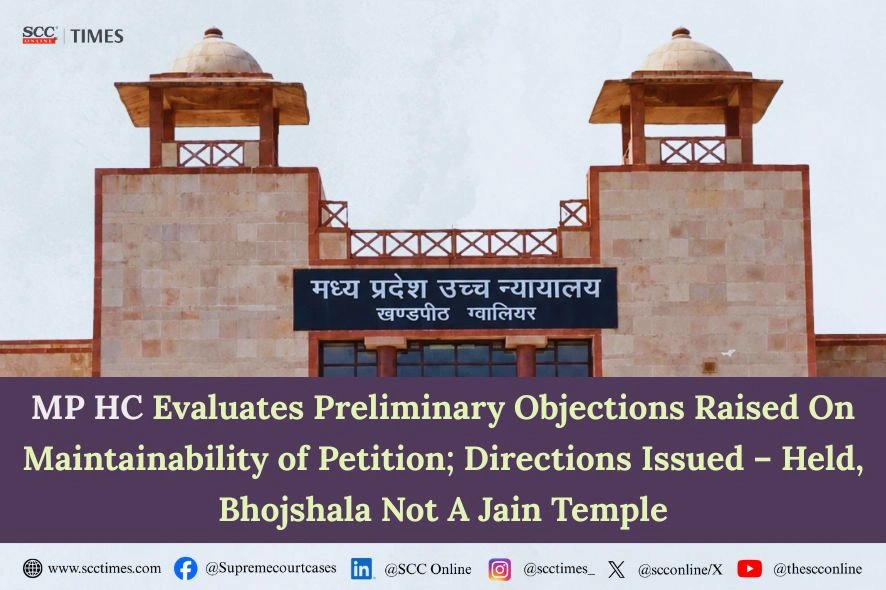
Madhya Pradesh High Court: In a writ petition filed under Article 226 of the Constitution, a Division Bench of Vijay Kumar Shukla* and Alok Awasthi, JJ., evaluated several preliminary objections raised by the respondents with respect to the maintainability of the petition, before moving on to the primary issue of “religious character” of the “disputed area”. The Court issued various directions emanating from the ruling of the Court, holding the “disputed area” of Bhojshala complex to be Bhojshala Temple of Goddess Vagdevi (Saraswati) and centre of Sanskrit learning, not a Jain Temple, and disposed of multiple writ petitions and an appeal through a common order as the issues raised and reliefs sought by the parties were same and upon the same subject-matter. The impugned order passed by Archaeological Survey of India (ASI) was quashed by the Court.
The Court held that, no material was placed either by way of historical literature, architectural features or in ASI survey suggesting that the disputed area was a Jain Temple.
Background
The legal history of the case goes back to 1962 when a civil suit was filed praying that the possession of Kamal Maula Mosque/Bhojshala be handed over to the plaintiff and to restrain the defendants from interfering in offering namaz. Eventually, several writ petitions, appeals and SLPs were filed by different parties over the period of time.
The Court took into account all the facts, arguments of all the parties and framed several issues from the side of the respondents that challenged the maintainability of the writ petition.
Prior to deciding the primary issue on merits, i.e. the “religious character” of the “disputed area” of Bhojshala Temple/Kamal Maula Mosque and the rights of the parties with respect to it, the Court evaluated the preliminary objections and issued several directions in light of the ruling and decision of the Court, while disposing of the petition.
The common impugned order passed in 2003 by ASI was quashed and the claim of Bhojshala being a Jain Temple was also examined by the Court.
Issues
Preliminary Issues
-
Whether the petitions filed by the Hindu Front for Justice v. Union of India, Kuldeep Tiwari v. Union of India, Salek Chand Jain v. Union of India and Antar Singh v. Union of India are maintainable as public interest litigation (PIL)?
-
Whether the petitioners in these petitions have locus to maintain the present petition?
-
Whether these petitions filed under Article 226 of the Constitution of India are maintainable in view of availability of alternate and efficacious remedy of civil suit and remedy under Waqf Act?
-
Whether the petitions are barred by doctrine of res judicata and constructive res judicata?
-
Whether the petitions are liable to be dismissed on the ground of delay and laches?
-
Whether the reliefs claimed in the aforesaid petitions can be considered in the light of the provisions of Places of Worship Act, 1991?
-
Whether the reliefs claimed in the aforesaid petitions can be considered in view of the order passed by the Supreme Court in the case of Ashwini Kumar Upadhyaya v. Union of India 2024 SCC OnLine SC 3749 where the hearing of the matters involving issues of Places of Worship Act have been directed not to be entertained and if pending have been directed to be deferred?
Analysis
Before adjudicating the matter on merits, the Court examined the preliminary objections raised by the respondents. The reasoning of every issue is as follows:
While examining the issue of public interest litigation, the Court observed that the petitions were concerned with the “right of worship” on the disputed area with respect to all 3 communities and cannot be dismissed merely on the ground of technical objections such as it was not filed as per the High Court Rules. Petitioner’s right to worship had to be tested on the anvil of the constitutional provisions and fundamental rights guaranteed under Articles 25 and 26. The test of disclosing public standing, professional status and antecedents was fulfilled by the petitioners. Thus, the petitions were held to be maintainable as PIL.
Regarding the second issue of locus standi, the Court held that these petitions were filed representing cause of a large number of members of different communities claiming their right to worship, which is a fundamental right guaranteed under the Constitution, so the petitions cannot be dismissed on the ground of locus.
Regarding the third issue, the Court stated that the petition is maintainable and needs to be adjudicated on merit because the power under Article 226 is extraordinary, discretionary and wider than Article 32 and is not confined to enforcement of fundamental rights but to issue directions “for any other purpose” too. There is no absolute bar on High Court to entertain a writ petition under Article 226 even if it involves questions of facts. The power can be exercised where facts need to be determined from existing documentary evidence such as on the anvil of the historians, writers, gazetteers, notifications, orders by erstwhile rulers, government pre and post-independence and the ASI survey report but not on the basis of oral evidence. Moreover, the petitions do not relate to the claim to “title of property” but fundamental right of worship for which Article 226 can be invoked.
With respect to the fourth issue of petition being barred by doctrine of res judicata, the Court held that since the issue of fundamental right to worship of members of a large community had neither been raised nor decided on merits in previous petitions, therefore, the petitions cannot be dismissed on the ground of principle of res judicata or constructive res judicata.
On the issue of delay and laches, the Court held that the impugned ASI order restricting the Hindu community’s right to worship is still operative and is a continuing cause of action. Referring to the argument of violation of Section 16, Ancient Monuments and Archaeological Sites and Remains Act, 1958, the Court opined that if any place of worship/shrine is subjected to usage through an order contrary to provisions of Act of 1958, then the continuation of activity by any community amounts to continuing illegality and is a perpetual wrong. Thus, the objection of limitation, delay and laches was not found to be sustainable.
In relation to the sixth issue, the Court observed that the Places of Worship (Special Provisions) Act, 1991, bars to change the “character” of the religious place of worship and bars the “suits” or other proceedings pending on 11th day of July 1991, stating it to be abated and barring further suits or other proceedings. But this does not apply to the extraordinary jurisdiction of High Court under Article 226 as this power cannot be overridden by legislation because power of judicial review forms part of the basic structure.
The Court held that if the “disputed area” is held to be a “protected monument” under the provisions of the 1958 Act, the bar under the 1991 Act would not apply to such disputed area and the area would be exempted from the application of the bar under the Act.
While considering the seventh issue, the Court noted that the Supreme Court in pending proceedings in Ashwini Kumar Upadhyay v. Union of India, 2024 SCC OnLine SC 3749 has directed that the matter is sub judice, fresh suits may be filed but no suits would be registered and no proceedings shall be undertaken. In the pending suits, no court will pass any effective interim orders or final orders, including orders directing surveys, etc. till the next date of hearing or further orders of this Court. It was the finding of the Court that the said order cannot be construed to apply to a writ petition as the directions are in respect of suits. Moreover, in light of the respondent’s case being remanded by Supreme Court for adjudication, the Court rejected the objection.
Therefore, the Court answered the objections in the manner abovementioned and held that the writ petition is maintainable and will be decided upon merits of the case.
Jain Temple Claim — The Saraswati idol was disputed to be idol of Jain religion i.e. of Goddess Ambika by one of the petitioners. The Court observed that Jainism and Hinduism are not distinct entities although the rituals of worship may differ, and the idols belonging to both Jain and Hindu traditions are frequently found within each other’s temples. A Jain Temple in Ratlam, M.P. houses enshrined idols of Lord Shiva in the form of Shivling and Ganesha. Moreover, the Hindu Marriage Act, 1955 and Succession Act, 1956 also establish that Jainism and Buddhism are a part of Hinduism.
The documentary evidences related to idol were also examined by the Court and it was held that the idol which was recovered in excavation and claimed to be in British Museum in London is of Goddess Saraswati.
On the point of “disputed area” claimed to be a Jain Temple, the Court further held that no material was placed either by way of historical literature, architectural features or in ASI survey suggesting that the disputed area was a Jain Temple.
Decision and Directions
While allowing the writ petitions, the Court gave the following directions —
-
The disputed area of Bhojshala and Kamal Maula Mosque was held to be a protected monument under 1958 Act, from 18 March 1904.
-
The religious character of the Bhojshala complex and Kamal Maula Mosque was held to be a Bhojshala with a temple of Goddess Vagdevi (Saraswati).
-
The impugned order was quashed to the extent restricting right of Hindus to worship within the Bhojshala complex and permitting the prayer by the Muslim community.
-
The Government of India and ASI were directed to take decisions for administration and management of the affairs of the Bhojshala Temple and Sanskrit learning within the property. ASI will continue to have overall administration and management of the property in accordance with the provisions of the Act 1958.
-
The ASI was given full supervisory control over the preservation, conservation and regulation of religious access.
-
The Court directed that the Government of India may consider the representations of the petitioners regarding bringing back the Pratima of Goddess Saraswati from London Museum, UK and re-establish the same within the complex.
-
To secure the religious rights of the Muslim community and ensure complete justice between the parties, the Court directed the State Government to consider the request of respondent, for allotment of a suitable land within the Dhar for construction of a Mosque or a place for prayer, in accordance with law for allotment of a suitable and permanent part of land in Dhar, if an application is moved either by respondent, appellant, interveners or a duly constituted waqf body for the construction, administration of a Mosque and associated religious facilities.
Hence, the writ petitions Hindu Front for Justice v. Union of India and Kuldeep Tiwari v. Union of India were allowed and disposed of. Writ petitions Salek Chand Jain v. Union of India, Maulana Kamaluddin Welfare Society Dhar v. State of M.P. and Qazi Zakullah v. State of M.P. were dismissed. The writ petition Antar Singh v. Union of India was disposed of without deciding on merits as the Court had already decided the character of the disputed area and the reliefs sought in this petition were of such manner that would avoid clashes between both the communities.
[Hindu Front for Justice v. Union of India, 2026 SCC OnLine MP 11410, decided on 15-5-2026]
*Judgment Authored By: Justice Vijay Kumar Shukla
Advocates who appeared in this case:
For Petitioners: Vishnu Shankar Jain, Vinay Joshi, Varsha Parashar, Harishankar Jain, Parth Yadav, Saurabh Singh, Mani Munjal Yadav, Utkarsh Dubey, Devendra Nagar, Vagish Parashar, Rohit Shukla, Shalini Joshi, Shivangee Parmar, Satyanarayan Dubey, Priyanka Sharma, Bhuvnesh Gupta, Lalit Namdev, Pradhumna Malpani, Arpit Singh Parihar, Rajesh Joshi, Pooja Verma
For Respondents: Salman Khurshid, Noor Ahmed Sheikh, Zishan Khan, Lubna Naaz, Azra Rehman, Tausif Warsi, Arshad Mansuri, Shobha Menon, Mohd. Ikram Ansari, Rahul Choubey, Sunil Kumar Jain, Aviral Vikas Khare, Rishi Bhargava, Ayushi Agrawal, Nandini Sharma, Kushagra Jain, Bhoomika Mev, Jyoti Sencha, Sachin Patel, Ayush Agrawal, Vishwajit Joshi, Ms. Nena Mishra, Shreesh Dubey, Surbhi Bahal, Syed Ashhar Ali Warsi, Poorvi Asati, Manan Sharma, Mohd. Hashim, Priyal Agrawal, Prashant Singh, Nilesh Yadav, Rahul Sethi, Dhirendra S. Parmar, Ashish Yadav, Sonal Gupta, Sudeep Bhargava, Shrey Raj Saxena, Swapnil Ganguly, Abhijeet Awasthy, Surendra Kumar Gupta, Viraj Godha, Sahil Sonkusale, Viraj S. Jha

Nice information