Disclaimer: This has been reported after the availability of the order of the Court and not on media reports so as to give an accurate report to our readers.
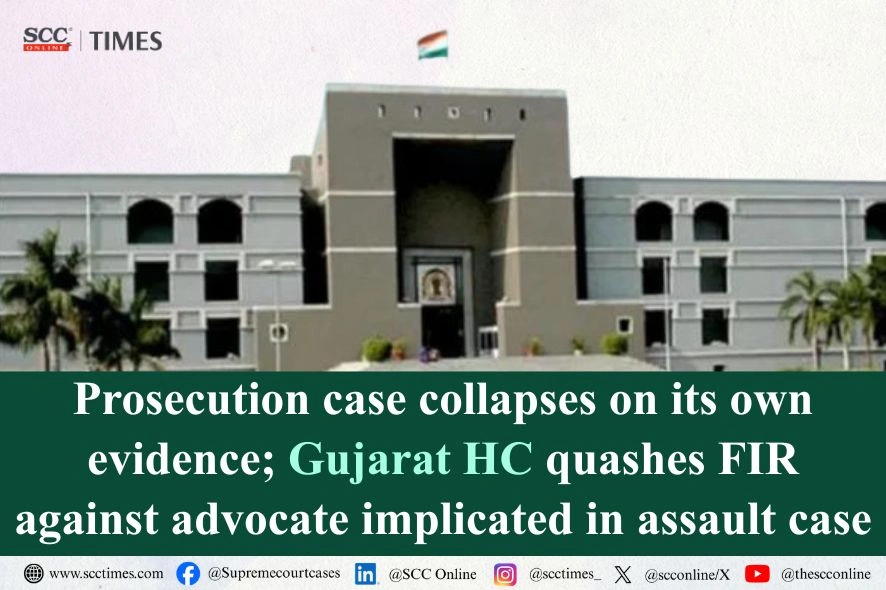
Gujarat High Court: In an application filed under Section 482, Criminal Procedure Code, 1973 (CrPC) seeking quashing of an FIR registered for offences under Sections 307, 326, 325, 324, 143, 147, 148, 149, 506(2) and 120-B, Penal Code, 1860 (IPC), the Single Judge Bench of P.M. Raval, J., quashed the proceedings against the applicant, holding that the prosecution’s own investigation had unearthed CCTV footage which completely belied the complainant’s allegation that the applicant had threatened him at the District Court premises prior to the assault. The Court held that apart from inadmissible statements of co-accused, a telephonic conversation with a client, and tower-location evidence, there was no independent material linking the applicant to the alleged conspiracy and thus in such circumstances, continuation of the prosecution would amount to an abuse of the process of law.
Background
The complainant alleged that on 10 December 2019, while he was present on the 3rd floor of the Sessions Court, Surat, the applicant a practicing advocate, representing one of the co-accused in another criminal case, approached the complainant and threatened him to withdraw an earlier case, warning that otherwise “his picture would come to an end”. The FIR further alleged that later on the same day, the complainant was assaulted by several accused persons with deadly weapons causing multiple injuries and fractures, pursuant to a conspiracy allegedly hatched by the applicant and others.
The applicant contended that he had been falsely implicated merely because he was an advocate representing one of the accused persons in another criminal case. Upon learning of the FIR, he immediately made representations to the Commissioner of Police and the investigating officer on 16 December 2019, asserting that he was not present at the court premises at the relevant time and requesting collection of CCTV footage.
Analysis and decision
The Court, following the High Court’s intervention, the investigating agency obtained CCTV footage from the court premises, which showed that the applicant was not present in the passage/balcony on the third floor at the relevant time. In view of this material, the Court found that the foundational allegation in the FIR, that the applicant had threatened the complainant at around 10:00 a.m. when he had come to meet his friend at the court premises, stood completely falsified.
The Court noted that, as far as criminal conspiracy is concerned, it is well settled principle that the essential ingredients of the offence of criminal conspiracy is agreement to commit an offence and that mere proof of such an agreement would be sufficient to establish criminal conspiracy.
The Court observed that although conspiracy is generally established through surrounding circumstances, as direct evidence is rarely available, the material on record did not disclose any agreement between the applicant and the co-accused to commit the offence. The Court noted that the applicant’s telephonic conversation with co-accused at 13:34 hours could not, by itself, be construed as evidence of conspiracy, particularly when the applicant was representing him as an advocate. The Court further noted that the CCTV footage had already falsified the allegation that the applicant had threatened the complainant at the court premises. The Court clarified that it was not undertaking a mini trial but as the applicant had specifically raised a plea of alibi and the CCTV footage collected during investigation disproved the complainant’s claim, it was necessary to examine such material to ensure that an innocent person was not wrongly implicated.
Though allegations of conspiracy were made, the Court found that the only material against the accused was the statement of a co-accused. Relying on P. Krishna Mohan Reddy v. State of Andhra Pradesh, 2025 SCC OnLine SC 1157, it reiterated that a police confessional statement is hit by Sections 24 and 25, Evidence Act, 1872, is inadmissible, and cannot be relied upon even at the stage of bail or trial, and therefore Section 30, Evidence Act cannot be invoked against a co-accused.
The Court found no material, apart from the co-accused’s statement and the complainant’s allegations, to establish the applicant’s involvement in a criminal conspiracy. Mere telephonic contact with a co-accused and tower location in Rander area were held insufficient to prove conspiracy. Thus, having found that present applicant was not present at the scene of offence and was also not visible at the District Court, Surat as alleged by the complainant from the CCTV footage, the said aspect would itself demolish the very basis of the FIR.
The Court found that, apart from vague and general allegations, there was no corroborative material against the applicant, while the CCTV footage collected during investigation itself contradicted the prosecution’s case. It therefore found that the proceedings amounted to an abuse of process, as the material on record falsified the allegations against the applicant.
The Court allowed the application and quashed the FIR and all consequential proceedings against the applicant and clarified that the observations made in the order were confined to the peculiar facts of the case and the applicant alone and should not influence any pending investigation or trial against the other accused.
[Mohammad Bilal Gulam Rasul Kagazi v. State of Gujarat, 2026 SCC OnLine Guj 4218, decided on 19-6-2026]
Advocates who appeared in this case:
For the applicant: Gulammustufa M Kapadiiya, Kashyap R Joshi
For the respondent: Rohan Shah, APP
Buy Code of Criminal Procedure, 1973 HERE

Buy Penal Code, 1860 HERE