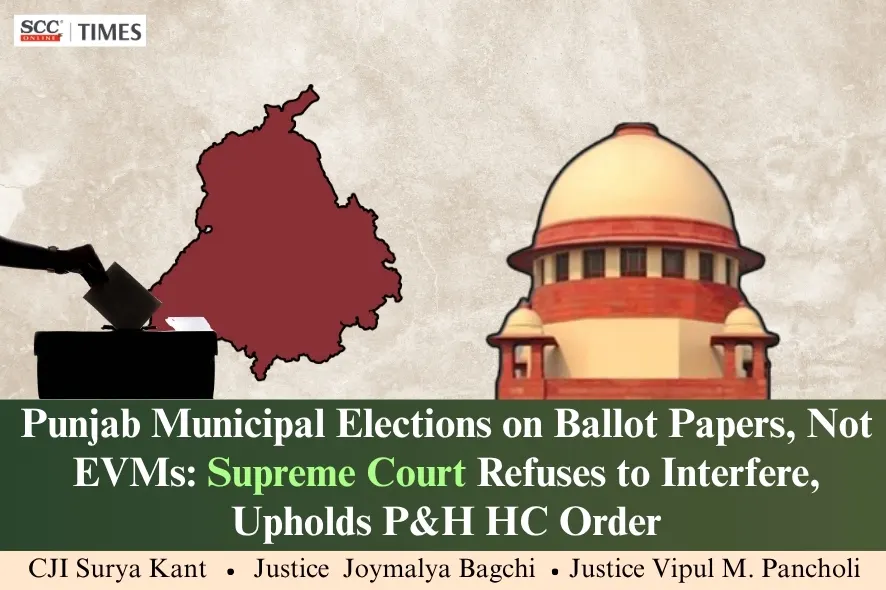
Supreme Court: While considering special leave petition (SLP) challenging the Punjab & Haryana High Court’s judgment dated 22 May 2026, refusing to interfere with the decision of the State Election Commission, Punjab (Punjab Election Commission) wherein it was held that conducting municipal elections in Punjab through ballot papers and ballot boxes, instead of Electronic Voting Machines (EVMs) was in gross violation of Assn. for Democratic Reforms v. Election Commission of India, (2025) 2 SCC 732 (Association for Democratic Reforms case), the 3-Judge Bench of Surya Kant, CJI, Joymalya Bagchi and Vipul M. Pancholi, JJ., dismissed the SLP, holding that no case to interfere with the impugned order was made out.
The P&H High Court had stated that it would not like to be a party to such blame game between Punjab Election Commission and Election Commission of India (ECI). However, the High Court had extended liberty to the petitioners to challenge the election process by way of an election petition since they approached the Court very late by the present petitions as election programme of municipal elections had already progressed to an advanced stage.
Also Read: Bombay HC Lays Down Test for Rejection of Election Petitions
Background
In the present case, notifications regarding elections to Municipal Corporations, Councils and Nagar Panchayats in Punjab were issued declaring that declaration of the election programme would commence on 13 May 2026 and conclude on 1 June 2026. The petitioners approached the High Court stating that the same was not in consonance with Association for Democratic Reforms case wherein the Supreme Court deprecated the traditional mode of using ballot papers and ballot boxes for polling.
The Punjab Election Commission raised a preliminary objection as to the maintainability of the present petitions on the following 2 grounds:
1. they do not satisfy the necessities of a public interest litigation, and
2. the constitutional bar under Article 243-ZG(b) of the Constitution disentitled the petitioners to any relief.
The petitioners contended that as per Rule 48-A, Punjab Municipal Election Rules, 1994 (Punjab Election Rules), the EVMs were the only mode through which voting could be made and counted. They further argued that despite ample opportunity before the Punjab Election Commission to requisition EVMs for municipal elections in Punjab, however no effort was made by it.
Per contra, the Punjab Election Commission submitted that it had sought the EVMs of M2 model whereas the EVMs being made available by the Election Commission of India (ECI) were of M3A model.
High Court’s Analysis and Decision
The High Court stated that there appeared to be a blame game between Punjab Election Commission and ECI and it “would not like to be a party to such blame game”.
Further, the High Court stated that the concept of EVMs was introduced in 2006 by adding Rule 48-A to the Punjab Election Rules which merely provided the composition of EVMs, however, while adding the said provision, Rules 52, 53, 54, 55, 58, 65, 67, 70, 71 etc. were retained in Punjab Election Rules which relates to ballot papers and ballot boxes.
The High Court stated that “in our society where illiteracy, poverty and ignorance continue to plague a large section of society, the Rule making authority intentionally retained the provision of ballot papers and ballot boxes and did not omit the same, while introducing the concept of EVMs in municipal elections” considering that “there may be occasions where ECI or the State Election Commission may have to revert back to the traditional mode of ballot papers and ballot boxes.”
Considering that election programme of municipal elections had progressed to an advanced stage, where the last date for withdrawal of candidature was 19 May 2026 and now the only stage left was of polling on 26 May 2026 and thereafter counting on 29 May 2026, the High Court stated that going back to the orthodox method of ballot papers and ballot boxes would not be appropriate, but since the petitioners approached the Court very late, it declined to interfere in the petitions at hand.
However, the High Court had extended liberty to the petitioners to challenge the election process by way of an election petition.
Supreme Court’s Decision
The Court refused to interfere with the impugned order, holding that “no case to interfere with the impugned order passed by the High Court is made out”.
Also read: Inside Supreme Court order on EVM-VVPAT Verification
[Ruchita Garg v. State of Punjab, 2026 SCC OnLine SC 1052, decided on 25-5-2026]
Advocates who appeared in this case:
For the Petitioner: Mr. Nachiketa Joshi, Sr. Adv. with Mr. Alabhya Dhamija, AOR, Mr. Santosh Kumar, Mr. Tadimalla Bhaskar Gowtham, Mr. Subodh Patil, Mr. Varun Chugh, Mr. Sanket Gupta, Ms. Mahima Pandey, Mr. Surya Pratap Tyagi, Mr. Chetan Mittal Sen, Mr. Harneet Singh Oberoi, Mr. Mayank Agarwal, Mr. Avichal Sharma, Mr. Drouhn Garg, Advs.
For the Respondents: Mr. Prateek Kumar, AOR and Mr. Devansh Rai, Adv.
Report by Ritu Singh and Shriya Singh
Buy Constitution of India HERE