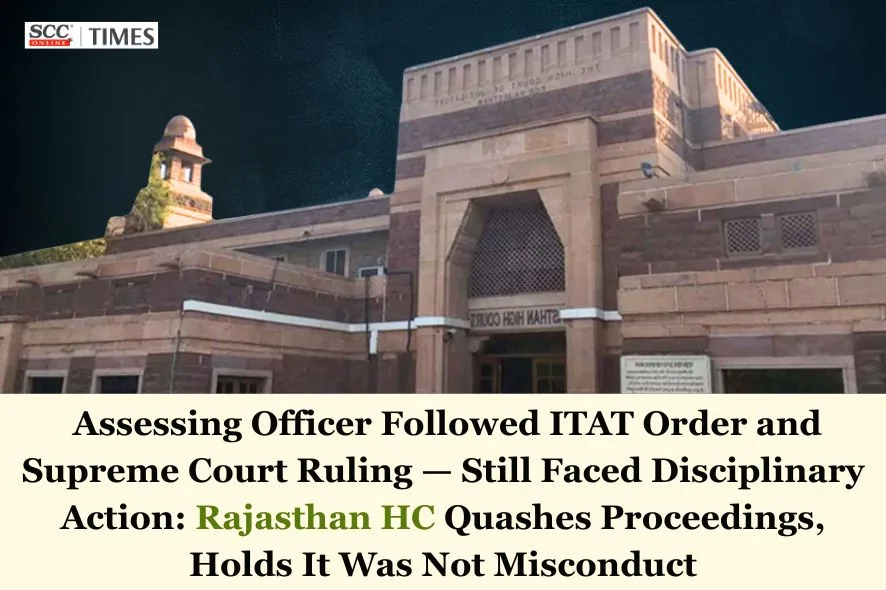
Rajasthan High Court: In a civil writ petition, where Union of India challenged the order passed by the Central Administrative Tribunal (CAT) quashing the charge-sheet and penalty order passed under Rule 11(v), Central Civil Services (Classification, Control and Appeal) Rules, 1965 [CCS (CCA) Rules], against the respondent, a Division Bench of Pushpendra Singh Bhati and Sandeep Shah*, JJ., affirmed the order, holding that the assessment order passed by the respondent under Section 143(3), Income-tax Act, 1961 (IT Act), and exemption granted under Section 10-B, IT Act, does not amount to “misconduct” but discharge of a quasi-judicial function, as it reflected bona fide application of mind supported by cogent reasons as the order was in compliance with the rulings of Supreme Court and Income Tax Appellate Tribunal (ITAT), and no ill intention or proof of personal gain or any undue advantage given by the respondent to the assessee could be proved.
The Court observed that,
“Disciplinary action against quasi-judicial orders is permissible only where decision is followed by mala fide intent with the view to grant undue benefit or where there is conscious violation and disregard to the provisions of law and merely because another view was possible, it would not amount to misconduct.”
Background
Disciplinary proceedings were initiated against the respondent, who as an assessing officer passed an assessment order granting exemption under Section 10-B, IT Act to Kwal Pro Exports (assessee) as they were found eligible for exemption as per ITAT’s order, although the order was appealed against and is pending. The assessment was made under Section 143(3), IT Act. Since in the previous assessment years, the exemption was denied to the assessee, so exemption granted by respondent, deviating from Department’s prior assessments, was considered to be “misconduct” by the petitioners.
Minor penalty of reduction of one stage in the time scale of pay for a period of 3 years was imposed on the respondent with further direction that the respondent will not earn increment of pay during the period of reduction under Rule 11(v), CCS (CCA) Rules. Aggrieved by this, he approached CAT, Jodhpur, challenging the charge-sheet and penalty order on the ground that the penalty was wrongly imposed upon him and it is a major penalty, when no misconduct was committed by him. However, the petitioners considered the act of granting exemption to assessee as misconduct, thus, justified the order passed and penalty imposed.
The Tribunal quashed the order, observing that the penalty imposed was a major one in view of CCS (CCA) Rules and that the order cannot be enforced without following procedure laid down there. Petitioners challenged the Tribunal’s order where the Court set aside the Tribunal’s order holding that the penalty imposed was actually a minor penalty.
Subsequently the respondent filed a review before the Tribunal where it was stated that the crucial element of the matter was not dealt with as to whether the misconduct was actually committed or not. So, the order was recalled and heard afresh. The Tribunal held that the respondent was functioning in quasi-judicial capacity and disciplinary proceedings were not justified in his case.
Issue
Whether the act of respondent can be termed as “misconduct” whereby he allowed the assessee’s claim of exemption under Section 10-B, IT Act?
Analysis & Decision
The Court observed that “misconduct” has not been defined under the Central Civil Services (Conduct) Rules, 1964 and the allegation pertains to the assessment order being faulty on the grounds that the assessee was allegedly not entitled to deduction under Section 10-B, and that the respondent had deviated from the consistent stand taken by the Department, causing revenue loss and weakening the case of the Department before this Court. But there was no allegation of lack of devotion to duty or integrity although the charge-sheet referred to violation of Rule 3(1)(i) and (ii), CCS (Conduct) Rules, with regard to maintaining absolute integrity and devotion to duty, however, the gravamen of the charge did not disclose any such allegation.
The Court noted that the assessment order was passed by the respondent subsequent to the decision passed by the ITAT where the stand of the Department was negatived and the assessee was found entitled to exemption under Section 10-B. Moreover, the respondent’s decision was also supported by a Supreme Court judgment, CIT v. Arihant Tiles and Marbles (P) Ltd., (2010) 2 SCC 699, emphasising that the work undertaken by the assessee would amount to a manufacturing process and hence, will be eligible for exemption as he was bound to follow the same failing which he would have exposed himself to contempt proceedings. Thus, justifying the distinction between the previous assessment years and the assessment year in question.
The Court opined that the view taken by the respondent was a plausible one and cannot be said to be taken in abstract without any supporting material. Therefore, the Court held that merely because another view was possible, the same would not amount to misconduct.
The Court further observed that the assessment order reflected bona fide application of mind supported by cogent reasons and, therefore, none of the ingredients pertaining to lack of integrity or lack of devotion towards duty are made out in the facts. The respondent was discharging quasi-judicial functions while passing the assessment order and such functions involve not just the appreciation of facts but the interpretation of law and application of judicial mind.
The Court further stated that since the assessment order was already upheld by the ITAT, so it cannot be said that assessment order was legally unsustainable.
Thus, the Court noted that assessment order passed by respondent was a quasi-judicial decision taken by him after consideration of facts and circumstances of the case. Disciplinary action against quasi-judicial orders is permissible only where decision is followed by mala fide intent with the view to grant undue benefit or where there is conscious violation and disregard to the provisions of law. The petitioners could not place on record any evidence of ill intention or proof of personal gain or any undue advantage being given by the respondent. It could not be proved that the respondent has acted in a manner unbecoming of his reputation, lack of integrity, good faith, or devotion towards duty, or had acted with gross negligence in order to grant undue favour to the assessee.
Therefore, the Court held that none of the ingredients constituting misconduct stand established and the Tribunal was justified in passing the impugned order. Thus, the writ petition was dismissed by the Court upholding the judgment of the Tribunal.
[Union of India v. N.P. Arora, 2026 SCC OnLine Raj 2966, decided on 13-5-2026]
*Judgment authored by: Justice Sandeep Shah
Advocates who appeared in this case:
For Petitioner: Sunil Bhandari
For Respondents: J.K.Kaushik