Delhi High Court: The backdrop of coordinated social media campaigns, edited videos, public speeches, and repeated allegations questioning the integrity and impartiality of a sitting Judge who rejected the prayer of the litigants, Arvind Kejriwal and others, in a proceedings arising out of the Delhi Excise Policy case, thereby attempting to achieve outside the courtroom what could not be achieved inside it, the Court was left with two choices, either to continue remaining silent despite repeated attacks upon the integrity of the Court and the judiciary, or to take notice of the conduct and examine whether it amounted to criminal contempt affecting administration of justice and public confidence in the judiciary.
The Single Judge Bench of Swarana Kanta Sharma*, J., initiated the contempt proceeding against the respondents, holding that statements and conduct of the respondents, including Arvind Kejriwal, Manish Sisodia, Durgesh Pathak, Sanjay Singh, Devesh Vishwakarma, Saurabh Bharadwaj and others, prima facie amounted to scandalising the Court, lowering its authority, and obstructing administration of justice and fell within the ambit of criminal contempt under Section 2(c), Contempt of Courts Act, 1971 (the Act).
In addition to initiating contempt proceedings the Court reflected upon the impact of social media vilification on judicial independence, the constitutional duty of courts to protect institutional integrity, the misuse of the expression “Satyagraha” in refusing to participate in proceedings, and the necessity of preserving public confidence in the justice delivery system. The Court emphasised that while Judges are expected to endure criticism with restraint, calculated attacks intended to intimidate the judiciary or erode faith in the institution cannot be permitted to pass unchecked.
“This Court neither seeks sympathy nor demands immunity from criticism. This Court does not require applause; it functions upon the constitutional trust of the people on it and would protect it when deliberate attempts are made to poison the fountain of justice.”
Public Campaigns and Attempts to Achieve Outside the Courtroom What Could Not Be Achieved Inside It
The Court stated that Respondent 18, Arvind Kejriwal and other contemnors were not ordinary litigants unfamiliar with legal procedures. They were individuals who had held or continued to hold high public offices, were legally advised, and were represented throughout by experienced counsel except when Respondent 18 argued personally during the recusal proceedings. The Court noted that the applications seeking recusal had been heard at length and rejected through a detailed judgment exceeding 100 pages, which remained open to challenge before the appropriate judicial forum.
The Court reiterated that while dismissing the recusal applications, it had clearly stated that judicial proceedings cannot be controlled through pressure tactics, public campaigns, or unfounded allegations. The Court had expressly refused to recuse merely because such allegations had been levelled publicly.
Despite having full knowledge of the legal remedies available against judicial orders, the respondents adopted an altogether different course. Instead of pursuing appeals in accordance with law, Respondent 18 publicly declared through social media and public statements that he would not appear before the Court in the present proceedings, a course which was subsequently followed by Respondents 8 and 19 as well. The Court remarked that an ordinary litigant ordinarily does not choose “a path unknown to law”.
The Court further observed that even after the dismissal of the recusal applications, the allegations and insinuations against the Court did not cease. Rather, they intensified through public letters, invocation of “Satyagraha”, press conferences, edited videos, social media campaigns, and repeated statements questioning the integrity and impartiality of the Court. Public declarations were also made that certain respondents would not participate in proceedings before this Court.
The Court held that the overall conduct revealed an attempt to achieve outside the courtroom what could not be achieved inside it through judicial proceedings and legal submissions.
Circulation of Misleading and Edited Video Relating to Lecture Delivered by this Court at Kashi
The Court described as “particularly disturbing” the circulation of a cropped and edited video relating to a lecture delivered by Justice Swarana Kanta Sharma at Mahatma Gandhi Kashi Vidyapeeth, Varanasi. The Court clarified that the speech had referred to Lord Shiva and the cultural and spiritual significance of Kashi/Varanasi. However, the video was misleadingly projected as if the Court had made statements relating to Rashtriya Swayamsevak Sangh (RSS)/ Bharatiya Janata Party (BJP) and political patronage.
The Court observed that the misleading narrative was repeatedly amplified by social media handles, YouTube channels, political functionaries, and public speakers. The allegations, according to the Court, were not isolated or casual but formed part of a sustained public campaign questioning the Court’s impartiality and credibility.
The Court remarked that this was perhaps one of the rare instances where a selectively edited video of a sitting Judge was repeatedly circulated and amplified by political actors and digital platforms to support allegations of political affiliation. Significantly, the Court noted that several news organisations and fact-checking agencies had to intervene and publish reports clarifying that the circulated narrative was false and misleading. Yet, despite these fact-check reports, the allegations continued to be repeated and amplified.
The Court concluded that the entire exercise appeared aimed at indirectly securing, through public pressure and orchestrated social media campaigns, what could not be secured through judicial arguments before the Court, namely, ensuring that the Delhi Excise Policy matter concerning discharge applications would not continue before this Bench.
Judicial Silence, Organised Vilification and Protection of the Institution
The Court thereafter reflected upon the position of Judges in constitutional democracies. It observed that Judges are historically expected to possess courage, restraint, and the ability to withstand criticism and public pressure. Judges are expected to remain calm and decide matters according to law without being disturbed by public opinion. However, when criticism crosses into organised vilification directed against the Judge presiding over a matter, the issue no longer remains one of ordinary criticism.
The Court made a striking observation that it would be unreasonable to expect Judges to be so “thick-skinned, thick-headed or insensitive” as to remain entirely unaffected by sustained humiliation and attempts to destroy the dignity of the Court. The Court reminded that “Judges are human beings and not Gods.”
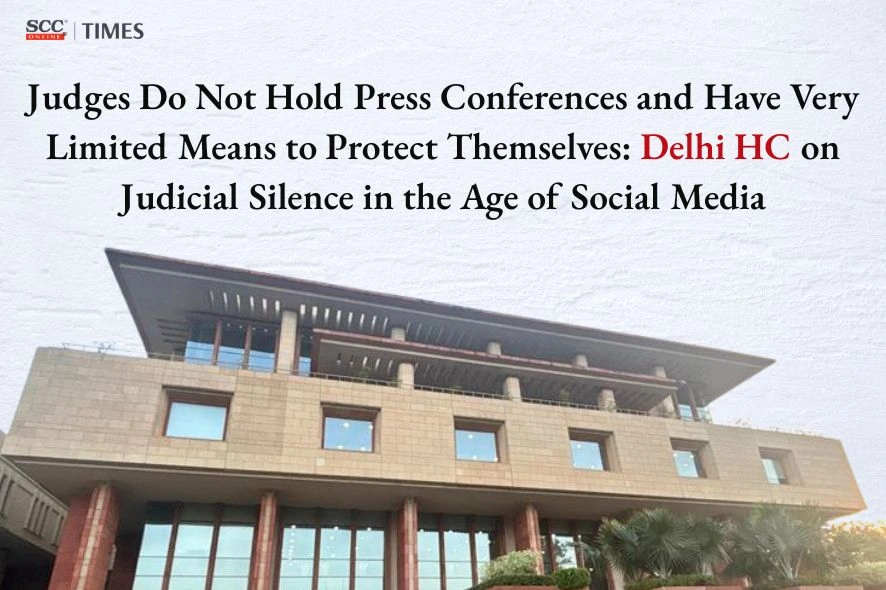
The Court noted that Judges possess very limited means of protecting themselves against such attacks. Judges do not hold press conferences and are institutionally expected to speak only through their judgments and orders. In the era of social media trials and digital campaigns, it has become extraordinarily easy to generate and circulate public narratives against Judges and courts, thereby poisoning the “fountain of justice”.
The Court opined that powerful litigants or political personalities may publicly vilify Judges, whereas Judges, bound by the discipline of judicial office, cannot enter public controversies to defend themselves. The law of contempt exists for precisely this reason, not to protect the ego of Judges but to preserve public confidence in the administration of justice.
The Court stressed that if a litigant is aggrieved by a judicial order, the law provides remedies by way of appeal or challenge before higher courts. “What law does not permit is malicious campaigns, false narratives and character assassination of Judges through social media and public platforms.”
The Court remarked that an ordinary litigant ordinarily approaches a higher court against an adverse order rather than initiating a “Satyagraha” against the Judge. It stated that Respondent 18 used his social media reach to divert public attention from the allegations against him toward the Judge and the judicial institution. The Court could not permit attempts “cleverly clothed” as Satyagraha to derail the judicial system and sow seeds of contempt among the public. No accused, however influential, should assume that the Indian judicial system can be demolished through manufactured public opinion, social media narratives, bullying tactics, or attempts to browbeat Judges by dragging their families into controversy.
Explaining the true meaning of “Satyagraha”, the Court stated that it means “satya ka agrah”, or holding firmly to truth. If a litigant genuinely believes in his truth, the constitutional course is to take that truth before a higher court through lawful remedies, not to convince the public instead of the judiciary.
“Court cannot allow this attempt which is cleverly clothed in the action called Satyagraha, through social media posts intended to derail the entire judicial system and sow seeds of such contemptuous path in the minds of the public at large.”
The Court further observed that freedom of speech remains a cherished constitutional right, but it is not absolute. Constitutional protection cannot extend to generating false narratives against courts through organised social media campaigns, nor can free speech be permitted to paralyse or obstruct administration of justice.
The Court reiterated that contempt jurisdiction is serious and must be exercised with restraint and calmness, free from anger or personal emotion. Yet, when attacks are made in a manner that scandalises the Court, lowers its authority, and obstructs justice, courts cannot remain silent spectators. Ignoring such conduct would send a dangerous message that courts can be subjected to organised public pressure and false media narratives aimed at influencing judicial proceedings.
The Court concluded that the present matter had travelled beyond mere abstention under the guise of “Satyagraha”. While absent inside the courtroom, the accused remained highly active on social media, continuously casting aspersions upon the Court through campaigns, speeches, press conferences, and edited videos. The contemnors had crossed the limits of fair criticism and sought to manufacture a public narrative after failing to secure relief through legal proceedings.
“In a court of law, neither the Judge nor the litigant is supreme. What remains supreme is the rule of law and the constitutional framework within which courts function. Judicial proceedings cannot be permitted to come to a standstill merely because one of the parties chooses not to participate after suffering an adverse order.”
The Court also noted the contradiction in Respondent 18’s conduct. While repeatedly writing in recusal proceedings that he did not doubt the integrity of the Court, he simultaneously indulged in acts which were “utterly contemptuous”. The Court remarked that while respect cannot be enforced, orders of courts can certainly be enforced, and acts of contempt invite legal consequences.
Judicial Silence or Constitutional Duty?
Considering the institutional dilemma before it, the Court observed that the contemnors were fully conscious that continuous allegations and campaigns against a sitting Judge would eventually compel the Court to consider contempt proceedings, thereby making continuation of the main matter before the same Judge difficult from the standpoint of judicial propriety.
Faced with such circumstances, the Court stated that only two options remained available:
-
continue remaining silent despite repeated public attacks and continue hearing the matter; or
-
Take notice of the conduct and examine whether it amounted to criminal contempt affecting administration of justice and public confidence in the judiciary.
The Court reiterated that it had already rejected the recusal applications through a detailed order and had clearly held that judicial proceedings cannot be dictated by public pressure or unfounded allegations. The Court had no personal interest in hearing the matter and had refused recusal solely because unfounded allegations cannot become a means to choose one’s forum or compel a Judge to step aside.
However, once acts constituting criminal contempt were committed directly against the Court itself, the situation materially changed. The Court emphasised that Constitutional Courts are not merely required to decide cases but are equally duty-bound to preserve the dignity, independence, and credibility of the institution of judiciary.
Ultimately, the Court held that the need to take cognizance of the contemptuous acts was greater than the need for the Court to continue hearing the main revision petition. The main case could always be heard by another Bench, but the acts directed against the Court and the institution could only be addressed by this Court itself.
Decision
Accordingly, the Court held that the statements and conduct of the respondents, including Arvind Kejriwal, Manish Sisodia, Durgesh Pathak, Sanjay Singh, Devesh Vishwakarma, Saurabh Bharadwaj and others, prima facie amounted to scandalising the Court, lowering its authority, and obstructing administration of justice and fell within the ambit of criminal contempt under Section 2(c), Contempt of Courts Act.
Consequently, the Court directed the Registry to assign an appropriate case title and number to the suo motu criminal contempt proceedings and place the matter before the Chief Justice on 15 May 2026 for assignment to an appropriate Bench, including issuance of show-cause notices to the proposed contemnors under the Contempt of Courts (Delhi High Court) Rules, 2025. It also directed that the main criminal revision petition be placed before the Chief Justice for assignment to another Bench.
Also Read: [Delhi Excise Liquor Policy] Supreme Court grants bail to Delhi CM Arvind Kejriwal in CBI case
[CBI v. Kuldeep Singh, RL.REV.P. 134/2026 & CRL.M.A. 6853/2026, CRL.M.A. 13409/2026, CRL.M.A. 13411/2026, CRL.M.A. 13737/2026, decided on 14-5-2026]
*Judgment authored by Justice Swarana Kanta Sharma
Advocates who appeared in this case:
Mr. Tushar Mehta, SG, Mr. S.V. Raju and Mr. D.P. Singh, ASG with Mr. Zoheb Hossain, Spl. Counsel for ED with Mr. Manu Mishra, Ms. Garima Saxena, Mr. Annam Venkatesh, Mr. Vivek Gurnani, Panel Counsels, Mr. Pranjal Tripathi, Mr. Imaan Khera, Mr. Bhuvan Kapoor, Mr. Digvijay Dam, Mr. Madhav Goel, Mr. Hitarth Raja and Mr. Digvijay Singh, Advocates with Mr. J.S. Randhawa-DIG, Mr. I.B. Pendhari-SP, Mr. Alok Shahi, ASP and Mr. Naveen, Sub-Inspector for CBI, For the Petitioner
Mr. Naveen Kumar, Mr. Tushar Agarwal, Mr. Arun Kumar, Mr. Abhishek Mahal and Ms. Rashi Choudhary, Counsel for the Respondent 1
Mr. Pradeep Rana and Mr. Tushar Rohmetra, Counsel for the Respondent 2
Mr. Shadan Farasat, Sr. Advocate with Mr. Harshit Anand and Ms. Varisha Sharma, Counsel for the Respondent 3
Mr. Sumer Singh Boparai and Mr. Surya Pratap Singh, Counsel for the Respondent 4
Mr. Nitesh Rana, Ms. Aditi Singh, Ms. Zainab Khan, Mr. Suyash Pandey, Ms. Aditi Singh and Mr. Aditya Narayan, Counsel for the Respondent 5
Mr. Shivendra Dwivedi and Ms. Onmichon Ramrar, Counsel for the Respondent 6 and 10
Mr. Dhruv Gupta and Mr. Anubhav Garg, Counsel for the Respondent 7
Mr. Adit S. Pujari, Mr. Shashwat Sarin, Mr. Shaurya Mittal and Ms. Dhanya Visweswaran, Counsel for the Respondent 9
Mr. Abhishek Singh, Mr. Talib Mustafa, Mr. Vishvendra Tomar, Ms. Shreya Singh, Mr. Ketan Kumar Roy and Mr. Shubh Mathur, Counsel for the Respondent 11
Mr. Rajat Bhardwaj, Mr. Dushyant Chaudhary, Mr. Tushar Garg and Mr. Vineet Singh, Counsel for the Respondent 12 to 15
Ms. Baani Khanna, Mr. Robin Singh, Mr. Kapil Balwani and Ms. Komal Thakkar, Counsel for the Respondent 16
Mr. Dama Seshadri Naidu, Sr. Adv. with Mr. Ramesh Allanki, Ms. Aruna Gupta and Mr. Sahil Sood, Counsel for the Respondent 17
Mr. Prabhav Ralli, Ms. Stuti Gupta, Mr. Dev Vrat Arya, Ms. Deeya Mittal and Mr. Samraat Saxena, Counsel for the Respondent 20
Mr. Gagan Minocha and Ms. Tusharika Mattoo, Counsel for the Respondent 21
Mr. Harsh Bora and Mr. Sahil Ghai, Counsel for the Respondent 22
Mr. Vikas Pahwa, Senior Advocate with Mr. Mayank Jain, Mr. Madhur Jain, Mr. Arpit Goel and Mr. Deepak Jain, Counsel for the Respondent 23
Dr. Farrukh Khan, Mr. Aditya Tyagi, Mr. Aryan Dev Pandey, Mr. Rashi Khandelwal and Mr. Amuldeep, Counsel for the Applicant in CRL.M.A. 13409/2026