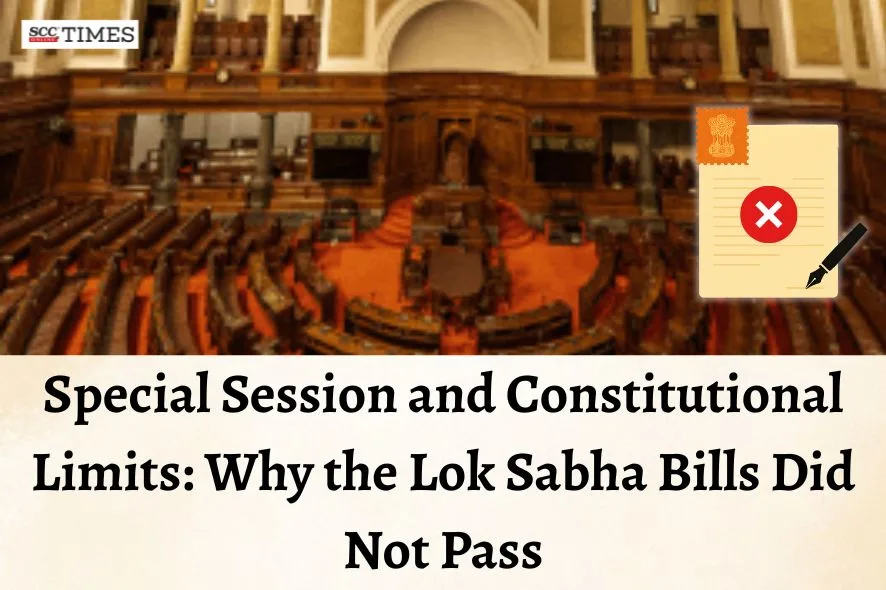
During the special session of the Lok Sabha held from 16 to 18 April 2026, the House considered a set of three interlinked legislative proposals introduced by the Government as part of a broader effort to operationalise women’s reservation in legislatures. The three Bills1 that were introduced are:
-
The Constitution (One Hundred and Thirty-First Amendment) Bill, 2026
-
The Delimitation Bill, 2026
-
The Union Territories Laws (Amendment) Bill, 2026
The fate of all three Bills was ultimately determined by the outcome of voting on the constitutional amendment Bill, which alone was taken up for division.
Voting on the Constitution (131st Amendment) Bill, 2026 was conducted through a recorded division, in accordance with constitutional requirements applicable to amendment bills.
As announced by the Lok Sabha Speaker, the result of the division was as follows:
-
Votes in favour: 298
-
Votes against: 230
The Lok Sabha Speaker, Mr. Om Birla, formally declared that the Bill did not pass, as it failed to secure the requisite special majority.2 It was further stated that, in consequence, no further action would be taken on the Delimitation Bill, 2026 and the Union Territories Laws (Amendment) Bill, 2026, both of which were expressly linked to the constitutional amendment.
Political and arithmetic impasse
The recorded division reflected an absence of the broad legislative consensus that constitutional amendments conventionally require, alongside a numerical shortfall that made passage procedurally impossible. While there was general acknowledgment across the House of the importance of enhancing women’s representation, differences persisted regarding the legislative mechanism proposed, particularly the linkage between women’s reservation, delimitation, and an increase in the total strength of the Lok Sabha. These unresolved concerns resulted in a lack of cross-party agreement necessary for securing a special majority.
From an arithmetic perspective, the Constitution (131st Amendment) Bill attracted 298 votes in favour, falling substantially short of the special-majority threshold prescribed under Article 368 of the Constitution of India, which, in practical terms, would have required approximately 360 affirmative votes given the strength of the House.
This combination of insufficient numerical support and the absence of the requisite political consensus constituted a clear arithmetic and political deadlock, rendering the passage of the Bill unattainable irrespective of further debate or appeals.
Appeal to Members of Parliament
Earlier on 17 April 2026, the Prime Minister appealed to Members across parties to support the proposed amendment to the Nari Shakti Vandan Adhiniyam3, describing it as a historic opportunity to advance women’s representation in legislatures. As outlined in his public remarks, he emphasised that deliberations on the amendment had been extensive, that concerns and misconceptions raised during debate had been addressed through detailed responses, and that additional information had been provided wherever required to clarify outstanding issues.
He further underlined the long legislative history of the issue and urged Members to take a considered and sensitive decision, invoking the broader objective of ensuring adequate representation for women who constitute half of the country’s population.
Interlinked Bills
Both the Delimitation Bill, 2026 and the Union Territories Laws (Amendment) Bill, 2026 were designed to operate only upon the successful passage of the constitutional amendment. Once the Constitution (131st Amendment) Bill failed to be adopted, the statutory and constitutional foundation necessary to proceed with the remaining Bills no longer existed. Accordingly, the government informed the House that it would not move forward with them.
Conclusion
All three bills introduced during the special session did not pass the test of the Lok Sabha. The outcome underscored the central role of special-majority requirements and legislative consensus in matters involving constitutional change. The Speaker’s declaration reflected a procedurally final determination based on voting arithmetic rather than any procedural irregularity or disruption.
The episode illustrates the Lok Sabha’s application of constitutional standards governing the legislative process.
1. https://www.pib.gov.in/PressReleasePage.aspx?PRID=2253252®=3&lang=1
2. https://www.pib.gov.in/PressReleasePage.aspx?PRID=2253254®=3&lang=1
3. https://www.pib.gov.in/PressReleasePage.aspx?PRID=2252922®=3&lang=1