
Disclaimer: This has been reported after the availability of the order of the Court and not on media reports so as to give an accurate report to our readers.
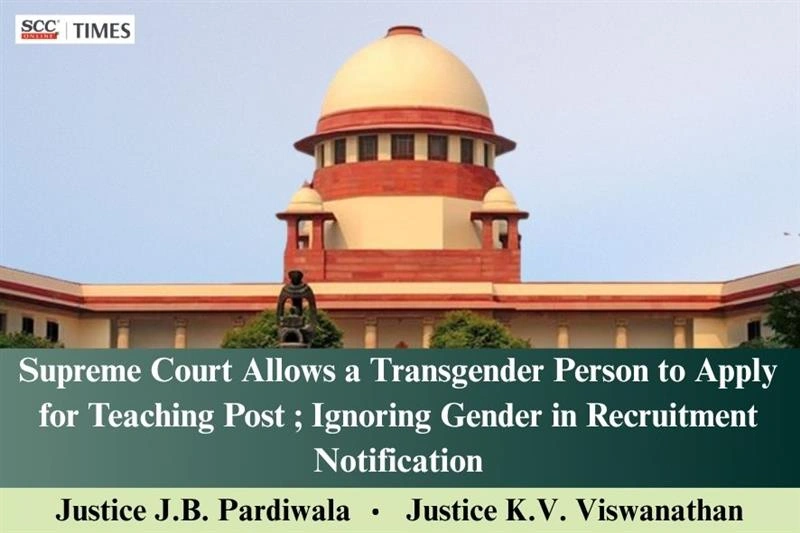
Supreme Court: In a special leave petition assailing Delhi High Court’s directions to the petitioner to approach the Advisory Committee, set up by the Supreme Court, for redressal of their grievances, based on the principle of avoidance of plurality of litigations, the Division Bench of J.B. Pardiwala and K.V. Viswanathan, JJ., prima facie held that the Advisory Committee had no powers to adjudicate; allowed the transgender person to apply for the government vacancy irrespective of the gender it was notified for.
Background
The present leave petition originated from the writ petition, which sought the framing of a policy for the recruitment of transgender persons in all public appointments for the Government of NCT of Delhi (Delhi Government). The writ petition prayed for separate vacancies for transgender persons in teaching positions in schools, including reservation and relaxation in the age and minimum qualifications. The writ petition sought implementation of the provisions of the Transgender Persons (Protection of Rights) Act, 2019 (TPPR Act) and the Transgender Persons (Protection of Rights) Rules, 2020 (TPPR Rules) in the Delhi Government.
The writ petition sought to direct the Delhi Government to consider the petitioner’s application for any vacancy in a teaching position, whether notified or to be notified by the Government, irrespective of gender.
Analysis
At the outset, the Court stated that, during the pendency of the said petition, the petitioner had previously preferred a writ petition under Article 32, Constitution of India. Consequently, the Court had delivered the judgment [Jane Kaushik (Transgender Rights Enforcement) v. Union of India, (2026) 1 SCC 336], wherein several binding directions relating to the implementation of the TPPR Act and TPPR Rules were issued. In addition to issuing binding directions, the Court constituted an Advisory Committee chaired by Justice (Retd.) Asha Menon to study and make recommendations on equal opportunity policy, gaps in the TPPR Act and Rules, reasonable accommodation in public spaces, grievance redressal mechanisms, gender and name change procedures, inclusive medical care, and protections for gender non-conforming and gender diverse persons. The Advisory Committee is presently working on the aspects within its remit, including the formulation of a model equal opportunity policy in employment and education.
The Court noted that several issues raised before the High Court have already been exhaustively addressed in Jane Kaushik (supra). Therefore, prima facie, the only issue that remained to be looked into was the lack of separate vacancies and the relaxation of the minimum requirements of employment by the Delhi Government.
Perusal of the impugned judgment revealed that the High Court disposed of the writ petition with a direction to the petitioner to approach the Advisory Committee for redressal of their grievances. The Court prima facie opined that the impugned judgment was erroneously passed, as the Advisory Committee had no adjudicatory powers.
Decision
Accordingly, the Court permitted the petitioner to apply under the category of transgender for the vacancies, ignoring the gender mentioned in the vacancy.
[Jane Kaushik v. Lieutenant Governor, 2026 SCC OnLine SC 595, order on 10-4-2026]
Advocates who appeared in this case:
For the petitioner: Amritananda Chakravorty, AOR Shreya Munoth, Asawari Sodhi and Tavleen Kaur Saluja, Advocates
For the respondents: NA