
Disclaimer: This has been reported after the availability of the order of the Court and not on media reports so as to give an accurate report to our readers.
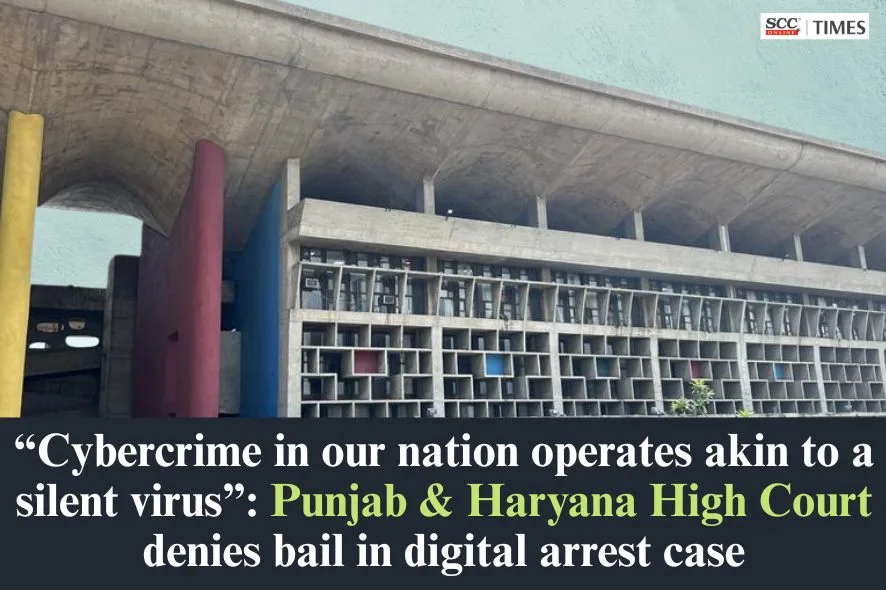
Punjab & Haryana High Court: In a petition filed under Section 482, Nagarik Suraksha Sanhita, 2023 (BNSS) for grant of pre-arrest bail to the petitioner in case registered for the offences punishable under Sections 318(4), 61(2) and 238, Nyaya Sanhita, 2023 (BNS), a Single Judge Bench of Sumeet Goel, J., held that cybercrime in our nation operates akin to a silent virus, which is insidious, disruptive, exacting a toll on society that extends far beyond mere pecuniary loss, encompassing the bedrock of trust, security, and national progress.
Accordingly, the Court denied the plea of anticipatory bail.
Background
In the present case, the FIR stated that the complainant received a call on her mobile phone from a person who claimed to be a CID Inspector from the Mumbai Crime Branch and falsely informed her that she had been arrested. Subsequently, she received a video call on her mobile phone wherein a person posing as a police officer informed her that she was an accused in the Naresh Goyal Jet Airways Money Laundering Case and that she had been placed under house arrest/digital arrest.
She was further threatened that formal orders would be issued and that she would have to pay Rs 6,80,00,000 in connection with the said case otherwise further proceedings would be conducted through WhatsApp video calls involving senior officers and a Judge. She was instructed not to disclose the matter to anyone or leave her house.
Thereafter, the complainant and her husband, by playing foul play, managed to leave the house on the pretext of taking a bath and reported the matter to the police station concerned.
Analysis and Decision
The Court stated that though the petitioner was not named in the FIR, his involvement surfaced during investigation, and at the said stage, the material collected by the investigating agency prima facie indicated his nexus with the co-accused and the alleged transactions.
Considering the petitioner’s argument that the case was based solely on disclosure statements, the Court held that as the investigation was underway, the role of each accused was required to be examined in the context of the larger conspiracy. The Court further stated that the plea of parity raised by the petitioner was also not tenable as the role attributed to the petitioner appeared to be a specific one.
The Court noted that the police had asserted that the custodial interrogation of the petitioner was indispensable for the purpose of effectively unravelling the modus operandi of the accused persons, identifying the broader nexus involved in the fraud, and recovering the siphoned amount. Thus, the Court observed that the nature and gravity of the offence, involving organised cybercrime and financial deceit, necessitated a thorough investigation, which, at the given stage, could not be conducted without the petitioner being in custody.
The Court stated that while adjudicating bail pleas, particularly in cases concerning cybercrimes and online fraud, a meticulous evaluation of several pivotal factors becomes necessary, most important being the inherent gravity and seriousness of the offence, coupled with its potential societal ramifications. The Court further stated that “The proliferation of online frauds and cybercrimes poses a significant threat, as it systematically erodes public confidence in digital financial transaction platforms. Such erosion runs counter to the aspirations of an advanced and digitally empowered “Digital Bharat” and thus warrants a heightened degree of judicial circumspection.”
Further, the Court stated that such offences are characterised by their capacity to aggrieve a multitude of victims simultaneously, often with a single act of commission and the deleterious consequences of cybercrimes transcend individual boundaries, imperiling numerous unsuspecting citizens. “The gravity of such transgressions cannot, therefore, be understated.” The Court stated that such offences not only jeopardise the financial security and trust reposed by individuals in financial payment gateways and platforms but also inherently expose the broader populace to analogous threats.
The Court emphasised that “cybercrime in our nation operates akin to a silent virus” which is insidious, disruptive, exacting a toll on society that extends far beyond mere pecuniary loss, encompassing the bedrock of trust, security, and national progress. Considering the inherent nature and profound gravity of such offences, and their wide-ranging cascading effects on both society and financial institutions, the Court found itself disinclined to grant the relief of anticipatory bail as prayed for. The Court stated that “to do otherwise would be to turn a Nelson’s eye to the profound and far-reaching detrimental impact of these digital depredations”.
The Court, thus, dismissed the petition at hand and held that at the given stage, there was no material on record to hold that prima facie case was not made out against the petitioner.
[Aayush Malhotra v. State of Haryana, CRM M No. 17541 2026, decided on 2-4-2026]
Advocates who appeared in this case :
For the Petitioner: Aman Pal, Senior Advocate, Rishabh Chaudhary, B.S. Jakhar, Vikram Singh Jakhar, Balraj Sharma and Neeraj Jakhar, Advocates
For the Respondent: Mahima Yashpal Singla, Senior DAG, Haryana