Disclaimer: This has been reported after the availability of the order of the Court and not on media reports so as to give an accurate report to our readers.
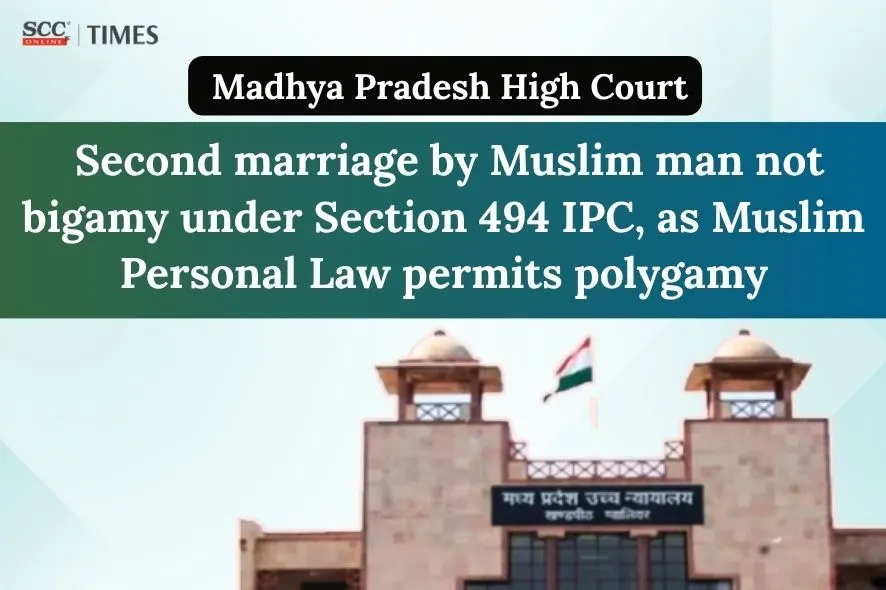
Madhya Pradesh High Court: In a petition filed by a Muslim man seeking quashing of criminal proceedings initiated against him by his first wife, the Single Judge Bench of B.P. Sharma, J., partly allowed the petition, holding that a second marriage contracted by a Muslim male would not be void under Section 494, Penal Code, 1860 (IPC) merely on the ground that the first marriage is still subsisting as Muslim personal law permits plurality of marriages.
Background
The marriage between the parties was solemnised on 27 December 2002 as per Muslim rites and rituals. 20 years later, the complainant, i.e., the first wife of the petitioner, lodged a report stating that the petitioner was threatening her life, asking her to divorce him by Khula since she could not bear a child. She also alleged that her husband used to assault and defame her. On 4 May 2022, the petitioner pronounced divorce for the first time, and a few days later, he solemnised a second marriage. Thereafter, on 2 July 2022, he pronounced divorce for the second time.
Based on the written report, a criminal case was registered under Sections 498-A, 494, 342, 323 and 506 Part II IPC against the husband at Mahila Police Station, Jabalpur. After completion of the investigation, a charge-sheet was filed before the Judicial Magistrate First Class, Jabalpur. The trial court framed charges against him under Sections 498-A, 494, 342, 323 and 506 Part II IPC via the impugned order.
Aggrieved, the husband filed the present petition under Section 528, Nagarik Suraksha Sanhita, 2023 (BNSS), seeking quashing of the impugned orders.
Analysis
At the outset, the Court clarified the limited scope of its inherent jurisdiction under Section 427, Criminal Procedure Code, 1973 (CrPC) or Section 528 BNSS. The Court stated that the said jurisdiction is required to be exercised sparingly and with great circumspection, only in cases where the allegations, even if taken at their face value, do not disclose the commission of any offence, or where continuation of the proceedings would amount to abuse of the process of law.
Upon perusal of the record, the Court noted that based on the divorce pronounced by the husband as per Muslim personal law, the Family Court, Jabalpur, vide judgment dated 14 November 2025, annulled the marriage between the parties.
Regarding Section 494 IPC, the Court stated that for the offence of bigamy to be attracted, it is essential that the second marriage must be void by reason of the subsistence of the earlier marriage. However, the applicability of Section 494 IPC is subject to the personal law governing the parties. Under Muslim personal law, a Muslim male is permitted to have more than one wife at a time, subject to the conditions recognised by the personal law.
In this regard, the Court referred to Sarla Mudgal v. Union of India, (1995) 3 SCC 635, wherein the Supreme Court noted that Muslim personal law recognises polygamy. Further, in Khursheed Ahmad Khan v. State of U.P., (2015) 8 SCC 439, the Supreme Court again observed that Muslim law permits plurality of marriages, though it may be regulated by law in certain contexts.
Accordingly, the Court held that in the present case, where the parties were governed by Muslim personal law, which permits a Muslim male to have more than one wife, even if the allegations of the first wife are accepted at face value, the husband’s act of contracting a second marriage would not satisfy the essential ingredients of Section 494 IPC. Thus, continuation of the prosecution for the said offence would amount to an abuse of the process of the Court.
“A second marriage contracted by a Muslim male during the lifetime of his first wife is not treated as void merely on the ground that the first marriage is still subsisting.”
However, regarding the other offences alleged against the husband, the Court stated that the allegations and the material collected during the investigation prima facie disclosed the commission of those offences, and they were required to be examined by the trial court in accordance with the law.
Thus, the Court partly allowed the petition.
[Mohd. Arif Ahmad Jahagir Khan v. State of M.P., 2026 SCC OnLine MP 3553]
Advocates who appeared in this case:
For the petitioner: Senior Advocate Anil Khare and Harjas Singh Chhabra
For the respondent: Deputy Government Advocate Aatmaram Bain and Naveen Vaswani
Buy Penal Code, 1860 HERE