Gauhati HC: Talaq-E-Hassan Is a Valid Form of Divorce; Registration Must Be Sought Under 2024 Act
The Gauhati High Court has held that Talaq-E-Hassan is a valid and recognised form of Talaq and is not prohibited under law.

Bringing you the Best Analytical Legal News


The Gauhati High Court has held that Talaq-E-Hassan is a valid and recognised form of Talaq and is not prohibited under law.
The Court held that Talaq-E-Hassan remains a valid form of divorce and clarified that its registration is to be considered by the competent Marriage and Divorce Registrar under the Assam Compulsory Registration of Muslim Marriages and Divorces Act, 2024.
“A second marriage contracted by a Muslim male during the lifetime of his first wife is not treated as void merely on the ground that the first marriage is still subsisting.”
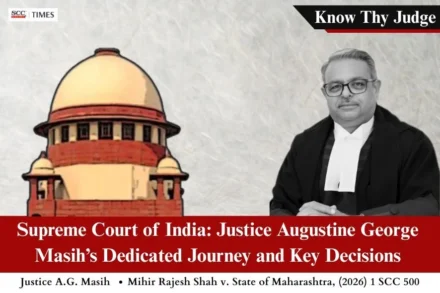
Justice Augustine George Masih served as a Judge of Punjab and Haryana High Court, and as a Chief Justice of Rajasthan High Court before being appointed as the Judge of the Supreme Court of India on 9 November 2023.
“The Court cannot ignore the feelings of the first wife and allow a Muslim man to march over her, for registering his second marriage, without notice to the first wife.”
A quick legal roundup to cover important stories from all High Courts this week.
“A child below 18 years cannot obviously give consent. So this expression “consent” must be understood as ascertaining its wishes.”
“When parties to the Muslim marriage come to an agreement to mutually dissolve their Nikah, they are at liberty to do so, and by virtue of this mutual agreement (Mubaraat), the Nikah stands dissolved.”
“Flouting interim orders passed by the Court will not disentitle the appellant-mother from retaining custody of the minor child. While exercising parens-patriae jurisdiction, the wish of the minor as well as attending circumstances need to be considered”.
Kerala High Court said that the marriage under the customary or personal law, which is otherwise valid, has to be treated as valid between parties to that marriage for all practical purposes, unless and until it is challenged by any of the parties to that marriage, and declared void on any valid grounds.
A quick legal roundup to cover important stories from all High Courts this week.
As per the provisions of Muslim law and the DV Act, the Court opined that the present petitioner being father-in-law of respondent, cannot be compelled to give maintenance to the respondent.
“The Prohibition of Child Marriage Act, 2006 prohibits child marriage, it supersedes the Muslim personal law, and every citizen of this country is subject to the law of the land, which is Act 2006, irrespective of his or her religion”
In the case at hand, the husband had argued that in view of the Muslim Women (Protection of Rights on Divorce) Act, 1986, a divorced Muslim woman is not entitled to maintain a petition under Section 125 of the CrPC and has to proceed under the provisions of the 1986 Act.
In the case at hand, the husband had argued that in view of the Muslim Women (Protection of Rights on Divorce) Act, 1986, a divorced Muslim woman is not entitled to maintain a petition under Section 125 of the CrPC and has to proceed under the provisions of the 1986 Act.
“It is not the case of petitioners that in case if marriage is not performed, then they are still interested to live in live-in relationship. It is also not the case of petitioners that petitioner No.1 would accept Muslim religion.”
The Court noted that what is not expressly recognised in Shariat law is not necessarily something which is forbidden. It may still be in tune with the philosophy of the Quran.
Madras High Court while quashing the Khula certificate issued by the Shariat Council, held that while it is open for a Muslim woman to exercise her inalienable rights to dissolve the marriage by Khula recognised under the Muslim Personal Law (Shariat) Application Act, 1937 by approaching a Family Court, it cannot be before Shariat Council.