
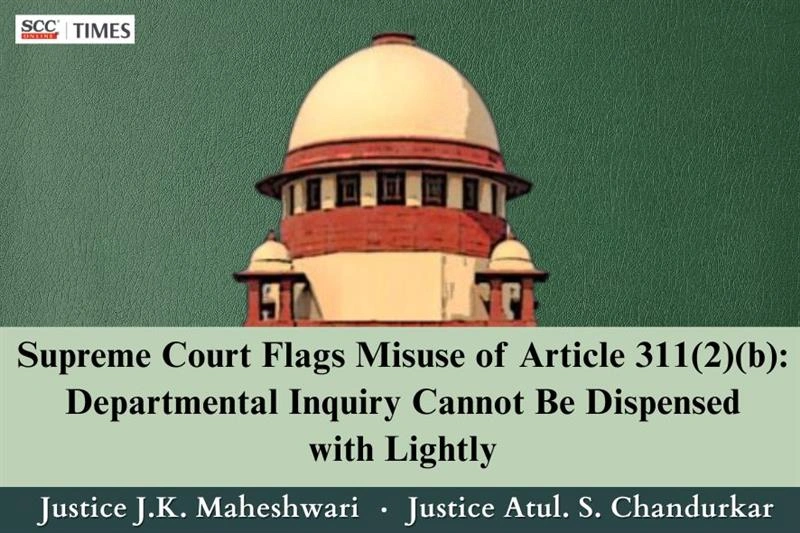
Supreme Court: Examining the legality of a dismissal order passed by invoking Article 311(2)(b) of the Constitution without holding a departmental inquiry, the Division Bench of J.K. Maheshwari* & Atul. S. Chandurkar, JJ., quashed the order of the Delhi High Court which had affirmed the order of dismissal of service against the appellant, issued by exercising power under Article 311 of Constitution without conducting the departmental inquiry under Article 311(2). The Court held that the reasoning assigned by the disciplinary authority, while issuing an order of dismissal from service under clause (b) of Second Proviso to Article 311(2), for dispensing with an inquiry ought to be relevant and shall be recorded in writing.
Background
The appellant was dismissed from service by the Deputy Commissioner of Police through an order dated 18 July 2017, exercising power under clause(b) of Second Proviso to Article 311(2) of the Constitution, without conducting any departmental inquiry. The regular procedure prescribed under the Delhi Police (Punishment and Appeal) Rules, 1980 was not followed as the preliminary enquiry revealed that it would not be ‘reasonably practicable’ to conduct a regular departmental enquiry on account of reasonable belief of threat, intimidation and inducement to the victim and thereby creating the possibility of tampering with the vital evidence.
The appeal against the said order was dismissed by Special Commissioner of Police vide order dated 30July 2018, accepting the same reasons. This led to the filing of OA No. 744 of 2020 before CAT to get both the orders quashed which was again dismissed vide order dated 29 November 2022. A Writ Petition was filed before Delhi High Court which was again dismissed on the same reasoning. Hence, the present appeal was filed against the same.
Issues for Consideration
Whether the dismissal order passed by the Authority and affirmed by CAT and High Court is legally sustainable or not on the ground of dispensing with departmental inquiry as it was found to be “not reasonably practicable” to conduct the inquiry exercising power under clause(b) of Second Proviso to Article 311(2)?
Court’s Analysis
The Court referred to Section 21 and Section 22, Delhi Police Act, 1978 and observed that these provisions are subject to Article 311 of the Constitution. Section 21(1) confers power upon the authorities prescribed therein to impose various punishments mentioned in clauses (a) to (g) and Section 22 governs the procedure for awarding the punishment of dismissal, removal and reduction of rank and casts obligation upon the officer passing an order of punishment to record the reasons for such order in accordance with the Rules 5, 6 14 & 16, the Delhi Police (Punishment and Appeal) Rules, 1980.
The order of dismissal was passed in exercise of the power under clause (b) of second proviso to Article 311(2) of the Constitution, which is an exception to clause (2) and mentions that the mandatory inquiry mentioned in clause (2) can be dispensed with if the authority is satisfied that it is not reasonably practicable to hold such inquiry, so the Court observed that the second proviso restricts application of Article 311(2) only under Clauses (a), (b) and (c) of the second proviso.
Explaining Clause(b), the Court emphasized that “not reasonably practicable” would mean that the requirement to hold an inquiry is not practicable in the opinion of a reasonable man taking a reasonable view of the situation. Court further observed that it is a matter of assessment to be made by the disciplinary authority holding the post.
The Court held that the disciplinary authority should record its reasons in writing for its satisfaction that holding an inquiry is not reasonably practicable or the order dispensing with the inquiry and the order of penalty flowing therefrom would be void and unconstitutional. Moreover, the reasoning assigned by the disciplinary authority ought to be relevant for dispensing with an inquiry. Court added that where the administrative discretion is exercised, the matter is subject to judicial review.
Dissatisfied by the reasoning provided by the disciplinary authority for dispensing with inquiry in the case at hand, the Court held that an employee holding a post in Union or State ought not to be dismissed or removed by an authority subordinate to the one by which he was appointed and should be done only after an inquiry supplying the charges and giving a reasonable opportunity of being heard in respect of those charges.
The Court clarified that the applicability of clause(b) is restricted in a situation wherein his conduct led to his conviction on criminal charges or where the authority records reason in writing upon satisfaction that it is not ‘reasonably practicable’ to hold an enquiry against him. Otherwise, dispensing with the enquiry is not permissible in law.
Thus, the Court held that the order dispensing with the regular procedure of inquiry is arbitrary and consequently the order of dismissal of the appellant is liable to be quashed.
[Manohar Lal v. Commissioner of Police, civil appeal no. 13860 of 2024, decided on 12-3-2026]
Advocates who appeared in this case:
For Appelant: Sandeep Choudhary
For Respondents: Mukesh Kumar Maroria
Buy Constitution of India HERE