
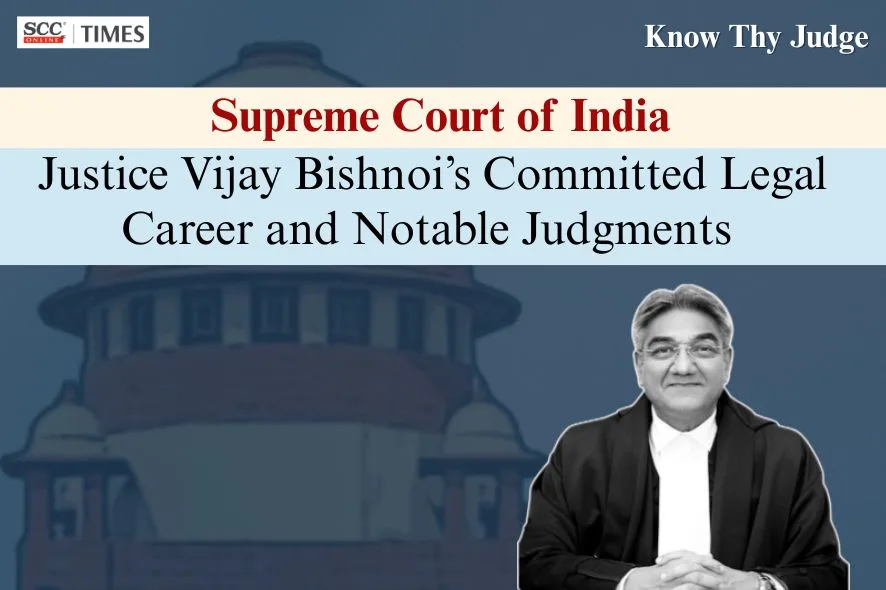
Born on 26 March 1964, Justice Vijay Bishnoi embarked on a journey marked by dedication and academic pursuits. Having entered the legal profession in 1989, Justice Bishnoi subsequently ascended to higher echelons of judiciary, thereby traversing a commendable trajectory in the corridors of justice.
Education and Career Trajectory of Justice Vijay Bishnoi1
Career as an Advocate
Justice Vijay Bishnoi’s educational journey culminated with the attainment of LL. B. degree, thereby laying the foundation for a remarkable career in law.
Having enrolled as an Advocate on 8 July 1989, Justice Bishnoi practiced mostly at Rajasthan High Court and Central Administrative Tribunal, Jodhpur. He specialised in Constitutional Law, Criminal Law, and Election Law, and his journey prior to elevation as Judge was marked by multifaceted roles and commendable accomplishments. He served as Counsel for a myriad of esteemed entities including government departments such as Rural Development & Panchayat Raj, Stamps & Registration, Co-operative, Labour, Transport, and Excise Departments.
Justice Bishnoi’s expertise extended to representing notable bodies like the National Highway Authority of India Limited (NHAI), Rajasthan State Electricity Board, and Bharat Sanchar Nigam Limited (BSNL). His tenure as counsel also saw him advocating for educational institutions such as Maharana Pratap University of Agriculture & Technology Udaipur and Jai Narayan Vyas University Jodhpur, along with various Central Co-operative Banks. Additionally, his role as Counsel for the Bar Council of India & Bar Council of Rajasthan at Rajasthan High Court, Jodhpur, underscored his commitment to legal governance. Through these endeavors, he solidified his reputation as a legal luminary, poised for further contributions to the realm of law.
As a testament to Justice Bishnoi’s extensive experience in varied fields of law, he was given the responsibility to serve as Additional Central Govt. Standing Counsel during the years 2000-2004.
Judgeship
In recognition of his stellar career and experience as an Advocate, Justice Vijay Bishnoi was appointed as Additional Judge of the Rajasthan High Court on 8 January 2013. He was later elevated as a Permanent Judge of the Rajasthan High Court on 7 January 2015.2
The Supreme Court Collegium vide resolution dated 27 December 20233 recommended Justice Vijay Bishnoi as the Chief Justice of Gauhati High Court and he was sworn in on 5 February 2024.4
The Supreme Court while recommending Justice Bishnoi as Chief Justice stated5–
“The Collegium recommends the appointment of Justice Vijay Bishnoi as the Chief Justice of the Gauhati High Court. Justice Vijay Bishnoi was appointed as a Judge of the Rajasthan High Court on 08-01-2013 and has been functioning there as a senior puisne Judge. Before his elevation as a Judge of the High Court, he practiced at the Rajasthan High Court and the Central Administrative Tribunal at Jodhpur. (…) While recommending his name, the Collegium has taken into consideration the fact that at present the Rajasthan High Court which is parent High Court of Justice Bishnoi is not represented among the Chief Justices of the High Courts.”
During his stewardship as Chief Justice, the Gauhati High Court on March 2024, notified the adoption of Practice Directions for proceedings (Criminal Appeals/Revisions or Criminal Petitions) filed under the POCSO Act in Gauhati High Court and the Outlying Benches. Under these Practice Directions, it became mandatory to implead the victim/guardian/support person, as the case may be. While impleading, the identity of the victim shall be properly screened strictly adhering to the mandate of Section 33(7) of POCSO Act and a formal notice of such impleading shall be issued to the victim/guardian/support person by the I.O. or the Officer-in-Charge.
Subsequently, the Collegium on 26 May 2025 recommended Justice Bishnoi’s elevation to the Supreme Court and in a display of speedy action i.e. in 3 days’ time, the Ministry of Law and Justice confirmed his elevation on 29 May 2025. The very next day, i.e., on 30 May 2025, Justice Vijay Bishnoi was sworn in as the Judge of Supreme Court of India along with two other Judges.
-
Did you know? During his tenure as Judge of the Rajasthan High Court, Justice Vijay Bishnoi authored around 652 reported judgments.6
Important Judgments by Justice Vijay Bishnoi7
Justice Vijay Bishnoi is renowned for his commitment to upholding constitutional principles and ensuring procedural fairness. His notable judgments, including inclusivity in compassionate appointments and advocacy for modern crime-fighting techniques, underscore his dedication to justice and legal governance.
In an appeal against Madras High Court’s judgment whereby, while upholding the conviction of the accused for offences under Sections 307, 326 and 324, Penal Code, 1860 (IPC), the sentence of 3 years’ rigorous imprisonment imposed by the Trial Court and affirmed in appeal, was reduced to the period already undergone, coupled with enhancement of fine and payment of compensation to the victim’s wife, the Division Bench of Rajesh Bindal and Vijay Bishnoi,* JJ. were called upon to determine whether such reduction of sentence in exercise of revisional jurisdiction was legally sustainable.
[Parameshwari v. State of T.N., 2026 SCC OnLine SC 209]
Post-bail conduct of accused not relevant in appeal against grant of bail; becomes relevant in proceedings for cancellation of bail: Supreme Court
In an appeal challenging the Madhya Pradesh High Court’s order dated 19 January 2024, wherein the High Court disposed of the third anticipatory bail application filed by Respondent 2-accused while directing the accused to surrender before the trial Court and move an application for regular bail and further directed the trial Court to grant bail on the same day after imposing adequate conditions, a Division Bench of J.B. Pardiwala and Vijay Bishnoi,* JJ., set aside the impugned order and direct the accused to surrender before the Court concerned. The Court held that post-bail conduct is never a valid consideration while dealing with an appeal against grant of bail, and such conduct is only relevant in an application for cancellation of bail.
[Balmukund Singh Gautam v. State of M.P., 2026 SCC OnLine SC 205]
Police/investigating agency, after submitting final report, cannot conduct further investigation without leave of the Magistrate/Court: Supreme Court
In an appeal challenging the Allahabad High Court’s order dated 20 November 2023, wherein the appellant’s writ petition and refused to quash a communication dated 06 June 2019, issued by Under Secretary to the State of U.P. to the Director, Crime Branch, Crime Investigation Department, Lucknow, Uttar Pradesh (Respondent 1) and order dated 26 April 2021 passed by the Superintendent of Police, Agra, Crime Branch, AAD, Uttar Pradesh Lucknow (Respondent. 4 herein), Division bench of Rajesh Bindal and Vijay Bishnoi,* JJ., set aside the impugned judgment and quashed and set aside the communication order passed by the Respondent 1 and Respondent 4, respectively.
The Court held that after submitting a final report under Section 173(2) of the Criminal Procedure Code, 1973 (CrPC) (equivalent to Section 193(3) of the Bharatiya Nagarik Suraksha Sanhita, 2023 (BNSS)), the police/investigating agency cannot conduct further investigation under Section 173(8) of CrPC (equivalent to Section 193(9) of BNSS) without obtaining the leave of the Magistrate/Court concerned
[Pramod Kumar v. State of U.P., 2026 SCC OnLine SC 156]
In a Special Leave Petition (SPL) arising out of a long-standing property dispute between a brother and his sisters concerning a prime property in Hyderabad, a Division Bench of J.B. Pardiwala and Vijay Bishnoi, JJ., appointed Justice Sudhanshu Dhulia, former Judge of the Supreme Court, to act as Mediator between the parties and oversee the settlement.
[R. Ravindranath v. Greater Hyderabad Municipal Corpn., 2026 SCC OnLine SC 150]
Taking suo motu cognizance of two tragic road accidents that occurred within consecutive days in Rajasthan and Telangana, claiming a total of 34 lives and leaving several others injured, the bench of JK Maheshwari and Vijay Bishnoi, JJ., directed the National Highways Authority of India and the Ministry of Road, Transport and Highways, Government of India, to conduct a survey and submit following reports in particular, with respect to the two Highways where the accidents have taken place:
-
Number of dhabas situated alongside the highways in the area which is not notified for the facility area.
-
Road conditions and the norms followed by the contractors during the period of maintenance.
[IN RE: PHALODI ACCIDENT, 2025 SCC OnLine SC 2428]
Know why Supreme Court directed seizure of the steno book of a High Court Judge’s secretary
While considering a Special Leave Petition (SLP) revolving around non-uploading of the impugned order rejecting grant of anticipatory bail on the website of Punjab and Haryana High Court as per previous directions of the Supreme Court, the Division Bench of J.K. Maheshwari and Vijay Bishnoi, JJ., directed that the steno book of the High Court Judge’s Secretary to be seized in order to find that on which date the impugned order was typed and corrected on P.C. The Court also directed to hold a discreet inquiry, and the report of P.C., regarding typing and uploading from NIC to be collected and the details filed on the affidavit.
[Ajay Maini v. State of Haryana, 2025 SCC OnLine SC 1884]
Supreme Court stays Rajasthan High Court’s directions containing adverse remarks against POCSO Judge
In a Special Leave Petition filed not to challenge the conviction but solely to seek expunction of adverse remarks made against the trial judge and to quash any disciplinary or consequential proceedings arising from those remarks, the Division Bench of J.K. Maheshwari and Vijay Bishnoi, JJ. granted a stay on the operation of the Rajasthan High Court’s order, wherein the High Court had passed strictures and made adverse observations against a judicial officer serving as Special Judge, POCSO Court.
[Sonika Purohit. v State of Rajasthan, 2025 SCC OnLine SC 1885]
State of Rajasthan’s reduction of NEET percentile by 10% and further by 5% to fill vacant BDS seats, illegal: Supreme Court
In a batch of civil appeals concerning the legality of admissions granted to the Bachelor of Dental Surgery (BDS) course in the State of Rajasthan for the academic year 2016-17 after lowering the minimum percentile prescribed for NEET-UG. The appeals arose from the Rajasthan High Court’s judgment dated 4 May 2023 affirming the Single Judge’s order which had partly regularised certain admissions and directed discharge of students admitted beyond the permissible relaxation. Emphasising that NEET was the only permissible method for admission to medical and dental courses, and the regulations must be strictly followed to maintain uniform standards, the Division Bench of J.K. Maheshwari and Vijay Bishnoi,* JJ., held that the reduction of percentile by the State of Rajasthan by 10% and thereafter by an additional 5% was manifestly illegal, and admissions made pursuant to such reduction could not be treated as valid in law. However, the Court also examined the practical consequences of cancelling admissions after several years, especially where students had already completed their course or invested substantial time in their education.
[Siddhant Mahajan v. State of Rajasthan, 2025 SCC OnLine SC 2864]
Fire insurance claim cannot be repudiated merely because theft preceded fire when fire is a covered peril under the policy: Supreme Court
The instant civil appeal was filed to challenge the National Consumer Disputes Redressal Commission’s judgment whereby the complaint of the insured was dismissed and the insurance claim was denied. While examining the scope of a Standard Fire and Special Perils Policy and the applicability of exclusion clauses when fire damage is preceded by theft, the Division Bench of J.K. Maheshwari and Vijay Bishnoi,* JJ., held that where a fire insurance policy covers loss by fire and the policy does not expressly exclude fire caused by theft or burglary, the insurer cannot repudiate the claim merely because theft preceded the fire. The cause of fire is immaterial unless the policy specifically excludes such cause or fraud by the insured is established. The Court set aside the repudiation letter dated 4 January 2008 and NCDRC’s judgment and remitted the matter back to the NCDRC for assessment of the loss.
[Cement Corpn. of India v. ICICI Lombard General Insurance Co. Ltd., 2025 SCC OnLine SC 2821]
High Courts not to entertain service matter writ petitions where an effective remedy lies before the Administrative Tribunal: Supreme Court
In a batch of civil appeals arising out of several Special Leave Petitions challenging the judgment dated 12 October 2023 passed by the Division Bench of the Karnataka High Court concerning recruitment to the post of Graduate Primary Teachers, whereby the parties were relegated to the Karnataka State Administrative Tribunal on the ground of availability of an alternative statutory remedy, the Division Bench of J.K. Maheshwari and Vijay Bishnoi,* JJ., held that held that the Constitution Bench decision in L. Chandra Kumar v. Union of India, (1997) 3 SCC 261, clearly lays down that Tribunals created under Articles 323-A and 323-B should function as courts of first instance in service matters, and litigants cannot bypass the tribunal and directly approach the High Court.
The Court dismissed the batch of appeals, affirmed the Division Bench’s judgment, and directed that the dispute be decided by the Karnataka State Administrative Tribunal. The Court made the interim directions earlier issued by the High Court absolute, and the Tribunal was requested to decide the matter expeditiously, preferably within six months.
[Leelavathi N. v. State of Karnataka, 2025 SCC OnLine SC 2253]
Training examination can’t be equated with departmental examination for absorption in Railway service: Supreme Court
The instant appeal challenged the Patna High Court’s judgment, whereby the High Court allowed the writ petition filed by the respondent and set aside the termination of his services, holding that no departmental examination was prescribed for confirmation to the post of Senior Section Engineer and directed that the respondent be granted service and monetary benefits. The Division Bench of J.K. Maheshwari and Vijay Bishnoi,* JJ., noted that the Master Circular specifically required that at the end of the initial training, there must be a written test, and the candidates must be warned that their retention in service would depend on passing the test, therefore the High Court erred in concluding that no examination was prescribed. The Court held that the training examination cannot be equated with a departmental examination, as departmental examinations are meant for promotion, whereas the present examination was part of the training required for direct recruitment.
The Court allowed the appeal, set aside the impugned judgment of the High Court, and upheld the termination of the respondent’s services. However, the Court set aside the recovery of stipend, observing that the payment had been made due to administrative inadvertence and not due to any fraud or misrepresentation on the part of the respondent, and therefore recovery was not justified.
[Union of India v. Alok Kumar, 2025 SCC OnLine SC 1937]
Courts/Tribunal can’t act as appellate authorities to re-appreciate evidence and interfere with disciplinary proceedings, when Domestic Enquiry held to be fair: Supreme Court
While deciding the controversy concerning the scope of judicial review in disciplinary proceedings, particularly whether the Tribunal could re-appreciate evidence and interfere with the punishment after holding that the enquiry was valid, a Division Bench of J.K. Maheshwari and Vijay Bishnoi,* JJ., reiterated that the scope of judicial review is limited to examining whether the enquiry was conducted by a competent authority, whether principles of natural justice were followed, and whether the findings are based on some evidence. Courts and tribunals cannot act as appellate authorities to re-appreciate evidence. The Court allowed the appeal, set aside the judgment of the High Court and the Award of the Tribunal, and restored the punishment of compulsory retirement imposed by the Disciplinary Authority.
[Canara Bank v. Ganganarasimhaiah, 2025 SCC OnLine SC 1939]
When misconduct independently justifies dismissal, mere reference to past conduct in dismissal order doesn’t invalidate punishment: Supreme Court
In an appeal challenging the dismissal order on the ground that it was vitiated because the disciplinary authority referred to the past conduct of the employee without mentioning it in the show-cause notice, a Division Bench of J.K. Maheshwari and Vijay Bishnoi,* JJ., reiterated that it is desirable to inform the delinquent if past conduct is to be the basis of punishment, but where the misconduct itself is grave and independently justifies dismissal, the authority may refer to past conduct merely to reinforce the decision. However, failure to mention past conduct in the charge-sheet does not invalidate the punishment. The Court allowed the appeal, set aside the judgment of the High Court, and restored the orders of the disciplinary authority and the courts below.
[State of Punjab v. C. Satpal Singh, 2025 SCC OnLine SC 1848]
In a PIL filed regarding non-compliance of the State of Assam with the Supreme Court’s directions of establishing online portals for all High Courts, the Division Bench of Vijay Bishnoi, CJ*., and Unni Krishnan Nair, J., disposed of the petition, holding that more or less all the issues raised by the petitioner had been resolved. The Court also directed the State to complete the enrolment process of the Public Information Officers and other Departments and also make every endeavour to implement the mandate of Section 4 of the Right to Information Act, 2005(‘RTI Act’).
[Reetam Singh v. State of Assam, 2025 SCC OnLine Gau 1066]
Gauhati High Court directs Assam to survey & protect Ahom Dynasty historical monuments
In a suo motu public interest litigation (‘PIL’) registered by the Court due to a newspaper report regarding illegal activities being carried out by coal smugglers in the Tipam Hills area destroying the historic Tipam Hills, the Division Bench of Vijay Bishnoi,* CJ., and Suman Shyam, J., disposed the PIL while directing the State to complete the archaeological exercise and protect the Ahom Dynasty historical monuments and continuously monitor the Tipam Hills for coal smugglers doing illegal mining.
[X1 v. State of Assam, 2025 SCC OnLine Gau 374]
On 28-01-2025, the Division Bench of Vijay Bishnoi*, CJ., and Kaushik Goswami, J., took suo motu cognizance of the coal mine tragedy that took place in Umrangso, Dima Hasao, Assam and directed the State to file a status report on the actions taken by it for curbing rat hole mining in Assam by 07-02-2025. The Court took notice of various reports which suggested that more than 200 rat-hole mines were operating in the Umrangso area. The Court also noted that in the Karbi Anglong district, rat-hole mining was rampant, and it was either going unnoticed or the authorities were not taking any action to stop or close them despite having knowledge.
[Dima Hasao Tragedy NA v. State of Assam, 2025 SCC OnLine Gau 221]
Gauhati HC asks DGP Assam to issue directions to police stations to not register cases under S. 106(2) BNS 2023 as provision has not come into force yet
In a PIL filed before this Court, wherein petitioner challenged the validity of Section 106(2) of the Nyaya Sanhita, 2023 (‘BNS, 2023’), the Division Bench of Vijay Bishnoi*, CJ., and Kaushik Goswami, J., disposed of the PIL and stated that the Director General of Police, Assam (‘DGP, Assam’), should issue necessary directions to the police stations under his jurisdiction to not register any case under Section 106(2) of BNS, 2023, as the said provision had not come into force till date.
[Ritumani Deka v. Union of India, 2024 SCC OnLine Gau 1997]
The present appeal was filed against the impugned judgment and order dated 24-03-2014 passed by the Single Judge in a case, whereby the prayer of petitioners for setting aside the impugned declaration of the Christian Cemetery in question as a Heritage site was rejected. The Division Bench of Vijay Bishnoi, CJ., and Kaushik Goswami*, J., opined that there was no record to show that any enquiry was conducted by the Superintendent as to the antiquity and age of the Cemetery and procedures as laid down under Section 3 of the Assam Ancient Monuments and Records Act, 1959 (‘the 1959 Act’) read with Rules 3 and 4 of the Assam Ancient Monuments and Record Rules, 1964 (‘the 1964 Rules’) were not undertaken by the State Government. The Court held that the impugned declaration of the Christian Cemetery by the jurisdictional District Magistrate was ultra vires, per-se illegal, null and void. Therefore, the impugned judgment and order dated 24-03-2014 passed by the Single Judge and the impugned orders dated 25-10-2005 and 27-11-2006 issued by the District Magistrate, Kamrup (M) were set aside.
[Father Marcus Lakra Parishy Priest v. State of Assam, 2024 SCC OnLine Gau 1969]
The present writ petition was filed by petitioner, Zofa Welfare Organization (ZWO), Mizoram, praying to issue direction to the State of Mizoram to set up the State Human Rights Commission (SHRC) as per the provisions of the Protection of Human Rights Act, 1993 (1993 Act). The Division Bench of Vijay Bishnoi, CJ*., and Michael Zothankhuma, J., in the interest of justice, granted last opportunity of two months to the State of Mizoram to set up SHRC as per the provisions of the 1993 Act and as per the directions issued by the Supreme Court in D.K. Basu v. State of W.B., (2015) 8 SCC 744.
[Zofa Welfare Organization (ZWO) v. State of Mizoram, 2024 SCC OnLine Gau 1509]
The Division Bench of Vijay Bishnoi, CJ., and Kardak Ete, J., after noting that till date no response had been filed on behalf of the Departments on the problem of water logging in the Guwahati city, granted one more opportunity, in the interest of justice, to the Departments to file their response with the condition that each Department shall pay a cost of Rs 1,000.
[North East Eco Development Society v. State of Assam, 2024 SCC OnLine Gau 952]
The present writ petitions were filed to challenge the constitutional validity of Article 11 of Schedule 1 of the Court Fees Act, 1870 (Assam Amendment) brought into effect by the Assam Court Fees (Amendment) Act, 1950 in respect of levy of Court fee for grant of probate or letter of administration. The fee is imposed at the rate of 7% ad valorem (levied at a rate percent of value) where the value of properties exceeds Rs 5,00,000 without there being any upper fixed limit. The Division Bench of Vijay Bishnoi, CJ*., and N. Unni Krishnan Nair, J., declared the impugned article to be ultra vires and violative of Article 14 of the Constitution.
[Prafulla Govinda Baruah v. State of Assam, 2024 SCC OnLine Gau 524]
Excluding married daughters from compassionate appointment violative of Art. 14, 15 and 16 of the Constitution; Rajasthan High Court overrules judgments supporting exclusion
The present petition challenges the position of law prior to the amendment of Rule 2(c) of Rajasthan Compassionate Appointment of Dependents of Deceased Government Servant Rules, 1996, which excludes the married daughter from the definition of ‘dependent’, for the purpose of compassionate appointment vide Notification dated 28-10-2021, a 3-Judge-Bench of Sandeep Mehta, Vijay Bishnoi and Arun Bhansali, JJ. held that the provision of Rule 2(c) of Rajasthan Compassionate Appointment of Dependents of Deceased Government Servant Rules, 1996, which exclude the married daughter from definition of dependent prior to its amendment vide notification dated 28.10.2021, is discriminatory and violative of Articles 14 to 16 of the Constitution of India and as such, the word ‘unmarried’ from the definition of ‘dependent’, is struck down. Further, in Rule 5 of Rajasthan Compassionate Appointment of Dependents of Deceased Government Servant Rules, 1996 also the word unmarried daughters/adopted unmarried daughter, shall be read as daughters/adopted daughter.
[Priyanka Shrimali v. State of Rajasthan, 2022 SCC OnLine Raj 1479]
The petitioner challenged the order passed by the Appellate Authority, Commercial Tax, Jodhpur wherein the GST registration of the firm (Petitioner) was cancelled on the ground of non-filing of GST return. While exercising its civil writ jurisdiction, the division bench of Vijay Bishnoi and Praveer Bhatnagar J.J. held that the assessee was entitled to lodge an Income Tax Claim when the department considered the issue of revocation of GST registration cancellation.
[R.K. Jewelers v. Union of India, 2023 SCC OnLine Raj 737]
A Single-Judge Bench of Vijay Bishnoi, J., held the appeal filed by District Magistrate before Divisional Commissioner under Section 18 of Arms Act, 1959 challenging the issuance of arms license in favour of the petitioner who was the holder of license, as non — maintainable.
[Ramesh Chandra Patel v. State of Rajasthan, 2022 SCC OnLine Raj 1209]
Rajasthan High Court | Court allows compromise entered by parties since offences under NI Act are compoundable offences
A Single-Judge Bench of Vijay Bishnoi, J., allowed a criminal revision petition seeking to set aside judgments convicting the petitioner about offences under the Negotiable Instruments Act.
[Jasmel Singh v. State of Rajasthan, 2020 SCC OnLine Raj 334]
A Single-Judge Bench of Vijay Bishnoi, J., allowed bail application filed by persons who were arrested for illegal possession of poppy straw; on the ground that the seizing officers did not follow the guidelines issued by Narcotics Control Bureau in regard of seizure, sampling and testing of the contraband.
[Om Praksh Bishnoi v. Union of India, 2019 SCC OnLine Raj 1280]
A Single Judge Bench comprising of Vijay Bishnoi J., while allowing to take the voice sample of the accused pronounced that “when the criminals are using the modern technologies to commit the crime, it is not justified to restrain the police or investigating agency to counter it”.
[State of Rajasthan v. Vikramjeet Singh, 2018 SCC OnLine Raj 1343]
Rajasthan High Court | No separate category for physically handicapped in reservation
Dismissing a petition, a division bench comprising of Amitava Roy, CJ and Vijay Bishnoi, J concluded that there should be no separate category of the physically handicapped persons for the purpose of reservation.
[Vikram Singh Chouhan v. State of Rajasthan, 2014 SCC OnLine Raj 1277]
Rajasthan High Court limits bonus marks to 15% experience weightage, preserving meritocracy in recruitment
Rajasthan High Court: A petition was filed challenging the second proviso to Rule 273 of Rajasthan Panchayati Raj (Amendment) Rules, 2013 stating that the grant of bonus marks against the experience is an “unconstitutional action of the State while making direct recruitment to the Rajasthan Panchayat Samiti and Zila Parishad Service. A division bench of Govind Mathur and Vijay Bishnoi, JJ., held that the respondents did not commit any wrong while extending weightage in the form of bonus marks against the service experience as per proviso to Rule 23 of the Rules of 1998 and such grant of weightage in no manner is in contravention of law. However, it clarified that the grant of bonus marks to the extent of 30 marks is unjust, arbitrary and unfair, hence, was declared illegal and quashed and the State Government may grant the weightage in the form of bonus marks against service experience within the cap of 15 marks.
[Archana v. State of Rajasthan, 2013 SCC OnLine Raj 2759]
Rajasthan High Court upholds provisions of Rajasthan Agriculture Credit Operations (Removal of Difficulties) Act, 1974; Directs Bank to determine interest on Loan
Rajasthan High Court: A petition was filed by the petitioner for consideration that whether declaring Sections 13 and 14 of the Rajasthan Agriculture Credit Operations (Removal of Difficulties) Act, 1974 unconstitutional will be violative of Articles 14 and 21. A division bench of Amitava Roy, CJ., and Vijay Bishnoi, J., held that the challenge of the petitioner to the provisions of the Act of 1974 particularly to sections 13 and 14 fails and to that extent, the writ petition was dismissed.
[Harwinder Kaur v, State Bank of India, 2014 SCC OnLine Raj 6503]
Rajasthan High Court dismisses petition challenging delimitation process in Nagar Palika Nokha
A petition was filed challenging the delimitation of wards in Nagar Palika Nokha, along with the consequential voters list, on the grounds of non-compliance with statutory provisions and guidelines. A division bench of Sunil Ambwani and Vijay Bishnoi, JJ., held that the petitioner’s failure to file objections during the stipulated period, coupled with the constitutional bar on judicial interference in electoral matters as per Article 243ZG, warranted dismissal of the petition warranting no interference.
[Kanhaiya Lal Jhanwar v. State of Rajasthan, 2015 SCC OnLine Raj 8631]
2. Gauhati High Court | Former CJs who were elevated to the Supreme Court
3. Supreme Court Collegium Notification
4. Vijay Bishnoi sworn in as Chief Justice of Gauhati High Court, The Hindu
5. Supreme Court Collegium Resolution