Disclaimer: This has been reported after the availability of the order of the Court and not on media reports so as to give an accurate report to our readers.
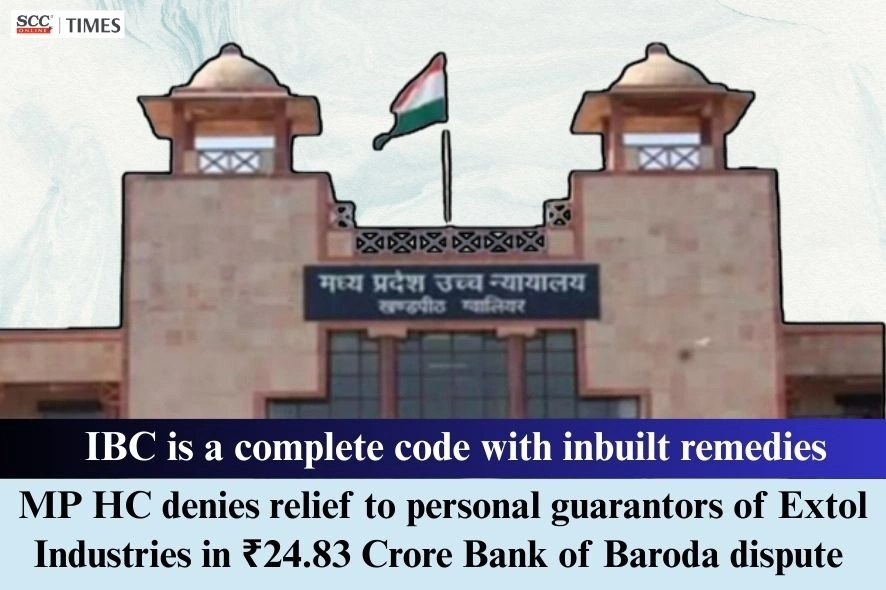
Madhya Pradesh High Court: In a writ petition filed by the personal guarantors of Extol Industries (“the Company”), the Single Judge Bench of Vishal Mishra, J., dismissed the appeal thereby denying relief to personal guarantors of Extol Industries against the Bank of Baroda, holding that the petitioners could file appropriate application against the demand notice before the National Company Law Appellate Tribunal (“NCLAT”) or the Supreme Court in the pending matters.
Background
The Company, which manufactures wind turbines, received a loan from the respondent, Bank of Baroda (“the Bank”), in 2011. The said credit facility was restructured twice. The Company claimed that they paid the installments promptly, and a certificate was issued by the Bank on 16-01-2016, clearly stating that there were no dues regarding the said amount. However, on 28-04-2016, the Bank issued a notice classifying the account as a Non-Performing Asset (“NPA”).
Aggrieved, the Company preferred a writ petition before the Court challenging their account’s classification as NPA, and an interim order was granted staying the effect and operation of the impugned Bank notice. The Court further directed that no adverse or consequential coercive steps in pursuance of the same shall be undertaken against the Company by the Bank. Ultimately, the writ petition was disposed of with the direction that the Bank shall consider and decide the Company’s objection, and the interim order shall continue till that decision is taken.
However, the Bank rejected the Company’s representation, which led to the Company filing another Writ Petition, but it was withdrawn with the liberty to raise all pending grounds before the Debt Recovery Tribunal (“DRT”).
Thereafter, the Bank published a demand notice in the newspaper in 2018 demanding a sum of Rs. 24.83 Crores. On receipt of the said notice, the Company filed a representation under Section 13(3-A) of the Securitization and Reconstruction of Financial Assets and Enforcement of Security Interest Act, 2002 (“SARFAESI Act”), but the Bank rejected their objections. The Bank issued a possession notice, which was assailed by the Company and the petitioners, personal guarantors of the Company, by filing a second appeal. Vide judgment dated 09-12-2024, the DRT allowed the appeal and set aside the demand notice and the NPA classification. Aggrieved, the Bank preferred an appeal before the Debt Recovery Appellate Tribunal, which is pending adjudication.
The Bank filed a petition under Section 7 of the Insolvency and Bankruptcy Code, 2016 (“IBC”) against the Company before the National Company Law Tribunal (“NCLT”), which was admitted by an ex parte order. The Company sought a recall of the said order; however, the same was dismissed, against which the Company preferred an appeal, which was also dismissed. Aggrieved, the Company preferred a special leave petition against the said order, which is pending adjudication. Thereafter, the Bank issued another demand notice on 17-10-2025.
Hence, the present petition.
Analysis
At the outset, the Court noted that insolvency proceedings had been initiated by the Bank against the Company and admitted by the NCLT. The Tribunal considered all the factual circumstances and documents and recorded that there was a “debt” against the Company; therefore, the proceedings under the IBC are maintainable. The Court further noted that the order admitting the IBC proceedings was challenged before the NCLAT, but the proceedings were held valid. The petitioners also filed an appeal before the NCLAT.
Noting the aforesaid, the Court stated that despite filing an appeal, the petitioners filed the present writ petition challenging the demand notice issued by the Bank. The petitioners, if aggrieved, could challenge the issuance of the demand notice in the pending appeal before the NCLAT.
The Court further noted that the petitioners approached the Supreme Court by filing civil appeals, which were pending adjudication. Noting this, the Court stated that until and unless the proceedings of NCLAT are stayed, they continue as per the IBC.
The Court added that the challenge to the demand notice issued by the Bank was only based on the fact that the previous NPA proceedings initiated by the Bank were quashed by the DRT. However, the fact remained that the matter was still pending adjudication before the NCLAT.
Agreeing with the contention that the IBC is a complete code in itself, having remedial measures inbuilt, the Court stated that the Bank had already proceeded under the IBC before the NCLT, and the insolvency proceedings had been admitted and upheld. Additionally, the petitioners had approached the Supreme Court by filing civil appeals, which were pending.
Therefore, the Court refrained from entertaining the present writ petition against the demand notice issued by the Bank, holding that the petitioners could file an appropriate application against the demand notice before the NCLAT or the Supreme Court in the pending matters.
Accordingly, the petition was dismissed, stating that no relief could be extended to the petitioners.
[Aditya Bhatnagar v. Bank of Baroda, 2025 SCC OnLine MP 10639, decided on 14-11-2025]
Advocates who appeared in this case:
For the petitioners: Senior Advocate Brian D’ Silva, S.S. Oberai, and Aditya Khandekar
For the respondent: Shreyas Dubey