NCLT Targets Case Backlog with Single-Judge Benches—What Changes Now
The National Company Law Tribunal has issued an order streamlining proceedings by empowering Single Judicial Member Benches to hear defined classes of matters across all benches.
The Court noted that despite filing an appeal before the NCLAT, the petitioners filed the present writ petition challenging the demand notice issued by the Bank.
This roundup highlights key 2025 corporate and commercial law developments from Adani’s HDIL resolution and Vedanta’s demerger setback to SEBI’s insider trading penalties, Google’s CCI settlement, and the pump-and-dump ban involving actor Arshad Warsi.
“It made no difference whether the NI Act proceedings were initiated prior to initiation of IBC proceeding or thereafter as it was a settled principle that natural persons could not escape from their personal liability under Section 138 of the NI Act.”
The case raises a critical legal intersection between debt recovery prosecutions and the insolvency resolution framework. A ruling that could reshape how courts handle cheque dishonour and payment-related offences against financially distressed individuals who are already undergoing insolvency proceedings, thereby preventing procedural overlap from undermining the statutory “fresh start” promised by the IBC.
Recalling the previous judgment dated 2-5-2025, the Court found that this was a fit case warranting exercise of review jurisdiction vested in the Supreme Court.
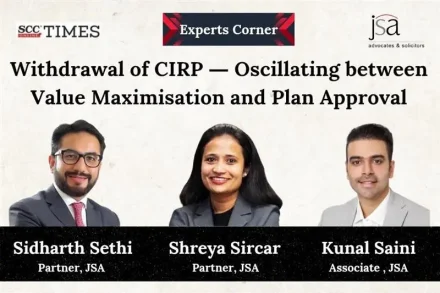
by Sidharth Sethi*, Shreya Sircar** and Kunal Saini***
“Legislative intent behind inserting the proviso to Section 31(4) of the IBC would suggest that prior approval of the CCI was specifically mandated and it should not be seen as a flexible provision to be ignored in certain exigencies.”
“Decision taken by the CoC for liquidation in commercial wisdom of the CoC should not be interfered with by the Adjudicating Authority.”
The present appeal raises substantial questions about the legal framework governing the withdrawal of a CIRP; the settlement of claims after the admission of an application instituted by a debtor; and the scope of the inherent powers vested in the NCLAT under Rule 11 of the NCLAT Rules.
The bank has acted in an arbitrary and illegal manner by claiming that the entire bid amount shall be deposited by the petitioner, while on the other hand, avoiding the question of the supervening legal impossibility, which debarred them from issuing Sale Certificate or handing over the physical possession of the property to petitioner.
“The term “personal guarantor” is defined under Section 5(22) of the IBC as “personal guarantor” means an individual who is the surety in a contract of guarantee to a corporate debtor.”
by Kartikey Mahajan, Siddhant Sharma and Jatan Rodrigues
Cite as: 2022 SCC OnLine Blog Exp 87
An order of attachment when made under the PMLA does not result in the corporate debtor or the Resolution Professional facing a fait accompli.
Supreme Court: The bench of Indira Banerjee* and JK Maheshwari, JJ has held that if there are two borrowers or if two
“A claim may not be barred by limitation. It is the remedy for realisation of the claim, which gets barred by limitation.”
Supreme Court: The bench of Indira Banerjee* and JK Maheshwari, JJ has rejected the view of NCLT and NCLAT that once it
National Company Law Tribunal, Mumbai: The coram of H.V. Subba Rao, Judicial Member and Chandra Bhan Singh, Technical Member, declared that the
Supreme Court: The bench of L. Nageswara Rao and BR Gavai*, JJ has held that the proceedings under the Securitisation and Reconstruction
National Company Law Appellate Tribunal (NCLAT), New Delhi: In a matter with regard to fees of resolution professional, the Coram of Justice