








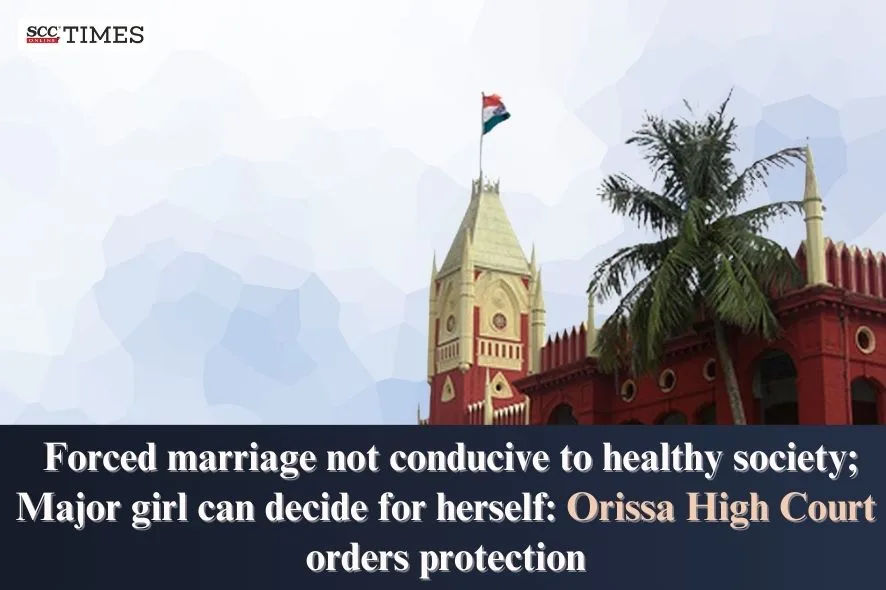
Orissa High Court: In writ jurisdiction under Article 226 of the Constitution, the Court considered the issue of a major girl being compelled into marriage without her consent. The Division Bench of Harish Tandon, CJ., and M.S. Raman, J., held that the decision of the girl is paramount and her consent must be respected. The Court emphasised that when a girl is not ready for marriage, giving her in marriage by using extraneous force is not conducive for a healthy society. Accordingly, the writ petition was disposed of with directions to ensure her safety and freedom.
Pursuant to an earlier order, the girl was produced before the Court by the police authorities. On interaction, she disclosed that because of the forced marriage, she felt difficulty in living in her matrimonial house and therefore left of her own. She clearly stated that she did not intend to live with her husband nor with her parents, as she is in gainful employment and earns her livelihood. Being a major, she asserted her capability of taking her own decisions.
The Court observed that a time has come when the society would introspect when the girls are forced to marry by the parents. It was emphasised that the decision of the girl is paramount and her consent should be obtained before any such decision is taken. The Court noted that when a girl is not ready for marriage, giving her in marriage by using extraneous force is not conducive for a healthy society.
The Court highlighted that sensitisation programmes should be conducted by the administration eradicating any sense of imposing own decision on the children by the parents. Since the girl had already been produced physically before the Court, it was observed that no purpose would be subserved in keeping the writ petition pending.
The Court directed the police authorities to ensure the smooth return of the girl to her respective place and to see that no interference or obstruction is created from any corner, including the parents and the so called husband. The Court further directed that the police shall ensure the safety and security of the girl at her place of abode and shall immediately take steps in the event any incident is reported.
Accordingly, the Court disposed of the writ petition.
[Ajay Kumar Sahoo v. State of Orissa, 2026 SCC OnLine Ori 101, decided on 06-01-2026]
Advocates who appeared in this case:
For the Petitioner: Amiya Kumar Mohanty, Advocate
For the Respondent: Sanjay Rath, A.G.A







0 replies