








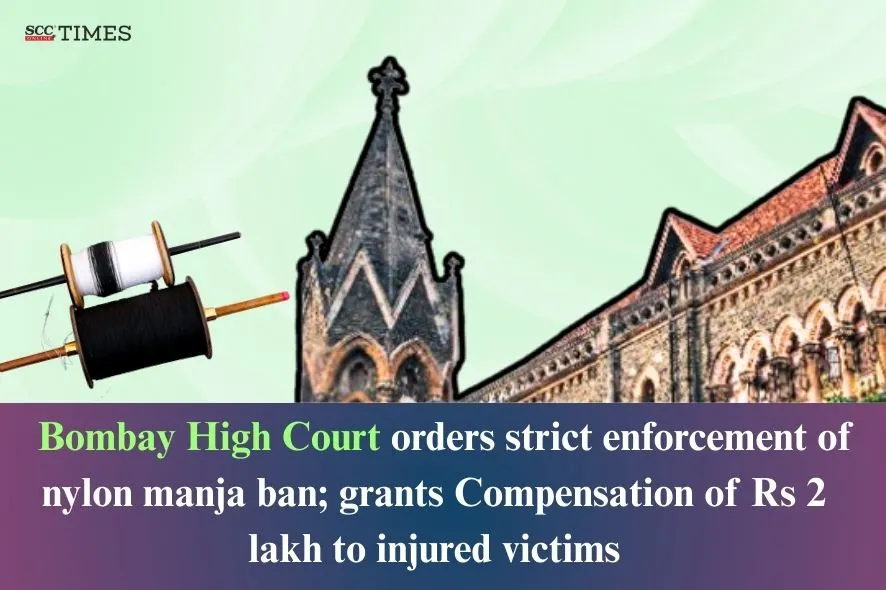
Bombay High Court: In a Public Interest Litigation (PIL) concerning the menace of nylon manja, the Division Bench of Vibha Kankanwadi and Hiten S. Venegavkar*, JJ., held that despite an express statutory and executive prohibition, nylon manja continues to be freely available and widely used, resulting in grievous injuries and deaths. The Court emphasised that enforcement had been episodic and ritualistic, and directed constitution of a Special Task Force (‘STF’), intelligence-driven enforcement, monitoring of online platforms, and interim compensation to victims.
Background:
The matter, pending since 2020, stemmed from repeated incidents of grievous injuries caused by nylon manja, including a minor child who required twenty stitches and a motorcyclist who sustained serious wounds. Affidavits filed by the State Government, police authorities, and municipal corporations revealed that enforcement efforts were confined to “special drives” undertaken only when the case was listed before the Court, thereafter, lapsing into inertia.
Submissions before the Court underscored that nylon manja continued to be freely available in markets and on online platforms despite the statutory ban. It was emphasised that the State bore a constitutional obligation to safeguard life and the environment. While government representatives assured compliance, they failed to demonstrate any sustained, intelligence-driven, or technology-enabled enforcement. The respondents contended that measures were being taken, however, the Court found their affidavits repetitive, generic, and lacking in substantive or concrete action.
Analysis and Decision:
While expressing serious dissatisfaction with the manner in which the authorities had addressed the issue, the Court noted that enforcement was episodic, reactive, and ritualistic. It was emphasised that such an approach was wholly inconsistent with constitutional obligations. The Court highlighted that the continued failure of governance directly impacts the right to life under Article 21 of the Constitution and also violates the constitutional mandate under Articles 48-A and 51-A(g) of the Constitution.
The Court noted that the incidents placed on record, including grievous injuries to children and motorcyclists, cannot be dismissed as isolated occurrences. The Court asserted that in their judicial experience such reported cases represent only a fraction of the actual harm caused. It was observed that merely prosecuting petty vendors or users does not discharge the State’s obligation, and what was conspicuously absent was any serious attempt to dismantle the illegal supply chain.
The Court further emphasised that in an era dominated by digital commerce, enforcement which ignores the online dimension is plainly ineffective. The Court asserted that the State cannot plead helplessness on the ground of technological complexity, rather, it must proactively deploy technical expertise and exercise its statutory powers against intermediaries operating within its jurisdiction.
The Court issued following directions –
1. Constitution of a STF headed by a senior police officer, intelligence-based enforcement against manufacturers and financiers, inter-departmental coordination, inspections by municipal corporations, monitoring of e-commerce platforms, sustained public awareness measures, and victim compensation,
2. Payment of interim compensation of Rs 2,00,000/- each to the victims
3. Creation of a victim compensation fund,
4. Mandated compliance affidavits from senior officers. \
5. Continued non-compliance or cosmetic compliance would invite stringent orders, including fixation of personal accountability of senior officers.
6. Listed the matter for further consideration after eight weeks.
[Registrar Judicial v. State of Maharashtra, 2026 SCC OnLine Bom 114, decided on 09-01-2026]
*Judgment authored by: Justice Hiten S. Venegavkar
Advocates who appeared in this case:
For the Petitioner: Satyajeet S. Bora, Amicus Curiae
For the Respondents: S.K. Tambe, Addl. G.P., A.G. Talhar, Dy. Solicitor General of India, A.P. Bhandari, Advocate, K.N. Lokhande, Advocate
Buy Constitution of India HERE






0 replies