








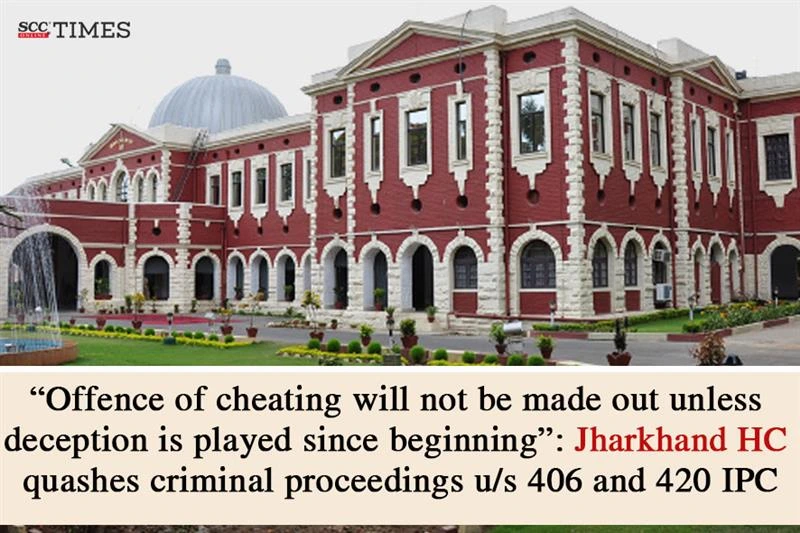
Jharkhand High Court: In a criminal miscellaneous petition seeking to set aside the entire criminal proceedings as well as the order passed by the Chief Judicial Magistrate, Koderma for offences punishable under Sections 406 or 420 of the Penal Code 1860 (‘IPC’), a Single Judge Bench of Anil Kumar Choudhary J* stated that unless the accused person played deception since the beginning of the transaction between the parties, the offence of cheating punishable under Section 420 of the IPC would not be made out. Thus, the Court stated that continuation of the criminal proceedings against the petitioner would amount to abuse of the process of law and accordingly, set aside the impugned order and quashed the criminal proceedings.
Background
The complainant entered into an agreement with the petitioner for the sale of land for Rs.14,00,000/-. The complainant paid an advance of Rs.1,00,000/- but the petitioner got his land sold to someone else and did not return the money.
The petitioner contended that a mere breach of promise, agreement or contract does not, ipso facto, constitute the offence of the criminal breach of trust contained in Section 405 of the IPC, without there being a clear case of entrustment and submits that in that case. The opposite party, on the other hand, opposed the same, contending that it was a clear case of cheating.
Analysis and Decision
The Court considered Radheyshyam v. State of Rajasthan, 2024 SCC OnLine SC 2311, wherein ut was held that the amount paid towards consideration cannot be said to have been entrusted with the accused persons and a mere breach of contract does not constitute the offence of cheating or breach of trust. Further, considering Uma Shankar Gopalika v. State of Bihar, (2005) 10 SCC 336, the Court viewed that it is a settled principle of law that unless the accused person played deception since the beginning of the transaction between the parties, the offence of cheating punishable under Section 420 of the IPC would not be made out.
The Court observed that even if the entire allegations made against the petitioner were true in their entirety, still the offence punishable under Section 420 of the IPC could not be made out against him. Considering that there was no allegation of any entrustment of money to the petitioner, nor was there any allegation of dishonest misappropriation of the entrusted property, the Court held that offence punishable under Section 406 of the IPC was also not made out against the petitioner.
Thus, quashing the criminal proceedings and setting aside the order, the Court stated that the continuation of the criminal proceeding against the petitioner would amount to abuse of process of law.
[Maya Rani v. State of Jharkhand, 2025 SCC OnLine Jhar 2950, decided on 21-7-2025]
*Judgment by Justice Anil Kumar Choudhary
Advocates who appeared in this case:
For the Petitioner: Arwind Kumar, Advocate
For the Opposite Party: Lily Sahay, Additional Public Prosecutor, Ashok Kr. Sinha, Advocate and Anshuman Kumar, Advocate.
Buy Penal Code, 1860 HERE









0 replies