








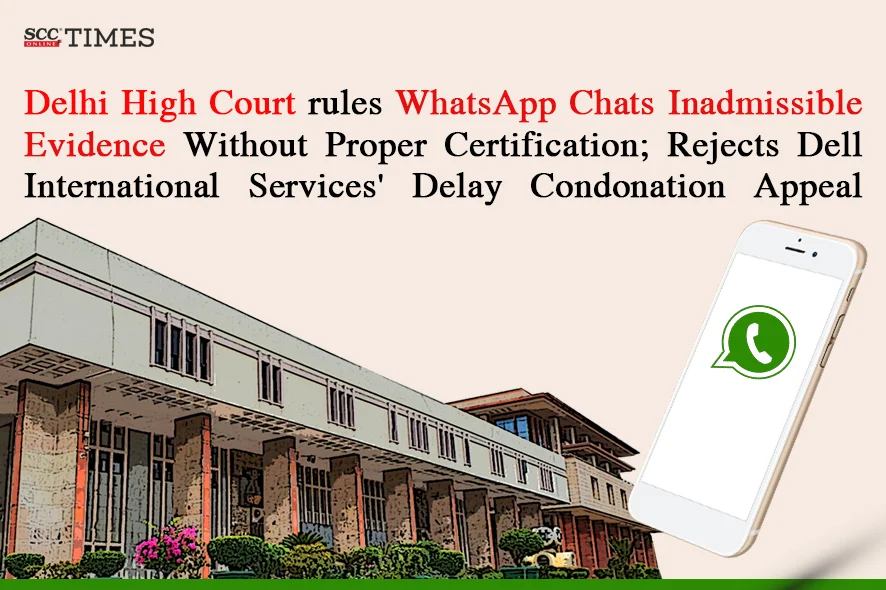
Delhi High Court: The petition was filed by Dell International Services Private Limited (the petitioner) under Articles 226 and 227, challenging the order dated 12-12-2023 passed by the Delhi State Consumer Dispute Redressal Commission. This order upheld a previous decision from 04-07-2023 by the District Commission, which refused to accept the petitioner’s written statement on the grounds that it was filed beyond the statutory time limit. Subramonium Prasad, J., held that it does not find any reason to hold that the reason given by the District Commission in refusing to condone the delay in filing the written submission is erroneous given the petitioner’s failure to provide the complete set of documents timely and the lack of proper certification for the WhatsApp conversations presented as electronic evidence.
The petitioner approached the High Court under Articles 226 and 227 challenging the Order dated 12-12-2023, passed by the Delhi State Consumer Dispute Redressal Commission (State Commission) in Revision Petition. The State Commission upheld the Order dated 04-07-2023, issued by the Consumer Dispute Redressal Commission (District Commission) in the the Complaint Case. The petitioner, whose written statement was rejected for being filed beyond the prescribed period, presented WhatsApp conversations to support the claim that the documents were incomplete. In this case, the petitioner attempted to use WhatsApp chats to demonstrate that the complete set of documents was not received with the summons. The WhatsApp conversations were intended to substantiate the claim that the written statement’s delay was justifiable due to the late receipt of necessary documents.
The Court observed that in the present case filed under Articles 226 and 227 of the Constitution of India, it is examining the present matter as an Appellate Authority and is exercising its power of superintendence. Even though the present Writ Petition is not a Writ of Certiorari, it is well established that even assuming that the instant case is one under writ of certiorari, then also the High Court does not sit as a Court of appeal and the Court is only concerned with the question as to whether the Tribunal has or has not acted without jurisdiction or contravened the principles of natural justice in the exercise of its jurisdiction. The Court does not substitute its decision to the one arrived at by the authorities below just because another view is possible. Unless the view taken by the forum below is perverse or arbitrary, the Court does not interfere with the decision of the forum below under Article 226 of the Constitution of India.
The Court remarked that “The screen shot of WhatsApp conversations cannot be taken into account by this Court while dealing with a Writ Petition under Article 226 of the Constitution of India, more so, when there is nothing to show that the conversations were produced before the State Commission as this Court does not find any reference of the same in the present Writ Petition. Further, there is no discussion of the same in the Order of the State Commission. In any event, the Whatsapp conversations cannot be read as evidence without there being a proper certificate as mandated under the Evidence Act, 1872.”
Thus, the Court concluded that under the Evidence Act, 1872, electronic records such as WhatsApp chats require a certificate under Section 65B to be admissible in Court. This certificate must affirm that the electronic record was produced by a reliable computer system and is an accurate representation of the information contained within. In this case, the petitioner failed to provide the necessary Section 65B certification. Consequently, The Court ruled that the WhatsApp chats cannot be considered valid evidence.
The Court further concluded that the petitioner did not present these WhatsApp chats before the State Commission, and there was no mention of them in the State Commission’s order. Therefore, introducing new evidence at the High Court level, without it being part of the earlier proceedings and without proper certification, undermines the judicial process and procedural fairness. The absence of proper certification for the WhatsApp conversations rendered them inadmissible.
Thus, the Court dismissed the petition, upholding the decisions of the District and State Commissions as the petitioner’s failure to justify the procedural delays under the statutory timelines provided were sufficient grounds for dismissal. The petitioner’s attempt to introduce uncertified evidence was rejected, and the findings of the lower commissions were deemed appropriate and legally sound.
[Dell International Services Private Limited v. Adeel Feroze, 2024 SCC OnLine Del 4576, decided on 02-07-2024]
Advocates who appeared in this case:
Mr. Pratyush Miglani and Mr. Hrithik Yadav, Advocates for petitioner
Buy Constitution of India HERE







Unfortunetly several Lower courts judges in Karnataka has never ready to accept this, I too opposed so many cases but due to lack of the knowledge marking the documents without fulfillment of the said requirements.