








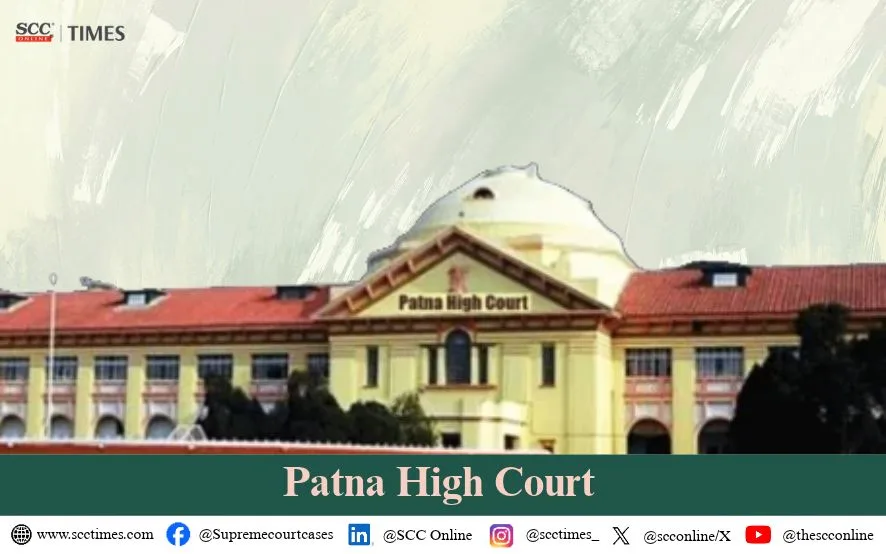
Patna High Court: In a writ petition seeking modification of an award passed by the Permanent Lok Adalat, Sasaram, Rohtas, to incorporate a portion of land allegedly omitted due to a typographical mistake, a Single Judge Bench of G. Anupama Chakravarthy, J., held that a Permanent Lok Adalat has no jurisdiction to record a compromise in respect of a land dispute. The Court observed that under Sections 22-A and 22-B(1), Legal Services Authorities Act, 1987 (1987 Act), Permanent Lok Adalats are established for adjudicating disputes pertaining to public utility services. Consequently, the Court declared the award dated 7 July 2011 void ab initio and set it aside, granting liberty to the parties to approach the competent civil court or the District Legal Services Authority (DLSA) for recording their compromise.
Background
The petitioner filed the present writ petition seeking a direction to the Members of the Permanent Lok Adalat, Sasaram, Rohtas, to modify the award dated 7 July 2011. The petitioner sought incorporation of a plot measuring 1½ decimals, in Schedule C of the compromise, contending that the details had been inadvertently omitted due to a bona fide typographical mistake. According to the petitioner, the compromise petition dated 9 May 2011 formed an integral part of the award.
The dispute originated when the father of Respondents 11 to 14 instituted before the Permanent Lok Adalat, Rohtas, Sasaram, on 14 September 2010, seeking a 1/4th share in the land mentioned in Schedule A of the plaint through partition by metes and bounds, with the assistance of a survey-knowing advocate, along with other reliefs. The father of Respondents 11 to 14 claimed that his ancestor had 3 sons. While one son died issueless, the other had 4 sons. The petitioner and other parties concerned were impleaded as defendants in the proceedings. The parties subsequently arrived at a compromise, pursuant to which the Permanent Lok Adalat passed an award concerning the disputed land.
The petitioner contended that certain details relating to a portion of the land had been inadvertently omitted from the award due to a typographical mistake on the part of the typist. He, therefore, approached the Court seeking incorporation of the omitted land particulars. Opposing the petition, the respondents contended that the Permanent Lok Adalat had no jurisdiction to review its own award and, therefore, no review could be undertaken even if a mistake had occurred in the award.
Analysis and Decision
The Court noted that Section 22-A, 1987 Act deals with definitions relevant to Chapter VI-A, including the definition of a Permanent Lok Adalat and public utility services. Section 22-B(1), 1987 Act provides for the establishment of Permanent Lok Adalats by the Central Authority or the State authority for exercising jurisdiction in respect of one or more public utility services and for such areas as may be specified in the notification. Upon examining these provisions, the Court held that it is evident that a Permanent Lok Adalat is established for adjudicating disputes pertaining to public utility services and it has no jurisdiction to record a compromise in respect of a land dispute.
Applying the provisions of Sections 22-A and 22-B(1), 1987 Act to the facts of the case, the Court held that the Permanent Lok Adalat, Sasaram, Rohtas, lacked jurisdiction to record the compromise concerning the disputed land.
Consequently, the Court declared that the award dated 7 July 2011 passed by the Permanent Lok Adalat was void ab initio. The Court, therefore, set aside the award and granted liberty to the parties, if they so intended, to approach the competent civil court for recording their compromise or to file an application before DLSA, Sasaram, by way of a pre-litigation case for recording the compromise.
With these observations and directions, the writ petition was disposed of.
[Bigan Shah v. State of Bihar, Civil Writ Jurisdiction Case No. 20288 of 2025, 2-11-2026]
Advocates who appeared in this case :
For the Petitioner: Smriti Kumari, Maya Shankar Mishra and Sneha Ranjan
For the Respondents: Bajarangi Lal, Priya Ranjan Kumar and Onkar Kumar





0 replies