








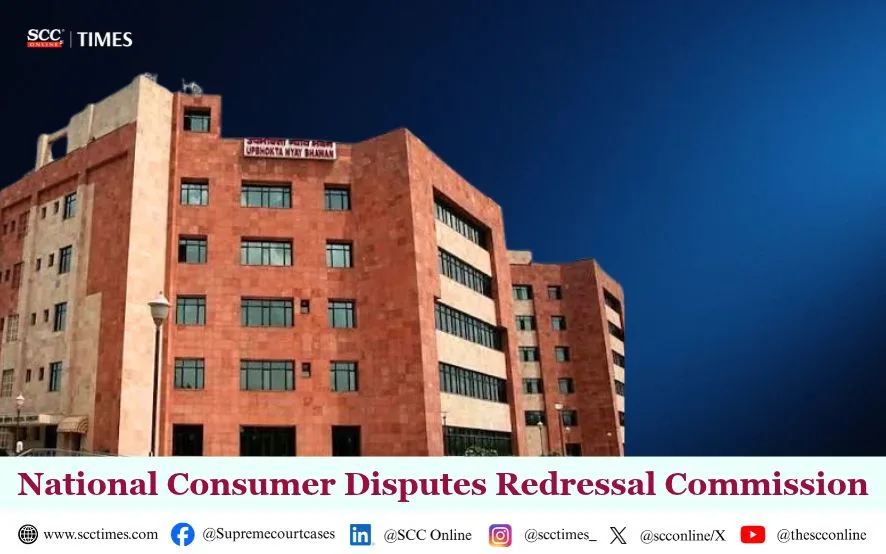
National Consumer Disputes Redressal Commission: The complaint sought refund of the amounts paid for Flat No. 502 in “Wisteria Tower” of the project “Enrico Heights” at Somalwada, Wardha Road, Nagpur, along with interest/compensation alleging that the builder failed to deliver possession in terms of the agreement for construction and sale dated 12 April 2013. A Bench of Justice Sudip Ahluwalia (Presiding Member) and Dr Sadhna Shanker (Member) partly allowed the complaint and held that the complainant’s entitlement to refund could not be defeated merely by the offer of possession dated 18 July 2019. The Commission directed the opposite party to refund ₹1,26,44,365.97 with interest at 9 per cent p.a., and to pay ₹1,00,000 as litigation expenses.
Background
The complainant booked a flat in the “Wisteria” tower on 21 November 2011 by paying ₹11,00,000. An allotment confirmation dated 20 September 2012 followed for a flat for a total consideration of approximately ₹1,70,74,500. On 12 April 2013, after receiving payments of about ₹60,00,350, the opposite party executed the agreement for construction and sale. A tripartite agreement was executed on 30 December 2014 between the complainant, the opposite party and Canara Bank for the housing loan availed for the purchase.
The complainant alleged that despite receiving substantial amounts, the opposite party failed to complete the project and deliver possession in habitable condition within the stipulated period. He referred to the offer of possession dated 18 July 2019 and stated that on inspecting the flat on 12 August 2019, he found it incomplete and unfit for occupation. He also alleged deficiencies in the area and in the amenities and facilities represented to be available. As originally filed, the complaint sought refund of ₹1,82,55,626 and compensation of ₹2,49,49,392, calculated up to September 2019 at 24 per cent p.a.
The opposite party disputed the allegations and questioned maintainability, alleging suppression of material facts. Relying on the agreement and the tripartite agreement, it alleged that the complainant had defaulted in repayment of the loan, leading Canara Bank to initiate recovery proceedings, including under the Securitisation and Reconstruction of Financial Assets and Enforcement of Security Interest Act, 2002 (SARFAESI Act) and steps to take possession of the flat. The complainant filed a rejoinder denying these averments.
The opposite party later moved an interim application to place an additional reply on record on account of subsequent events which was allowed. It referred to proceedings before the Debts Recovery Tribunal, Nagpur, regarding the Bank’s SARFAESI action, and to its steps to settle the Bank’s dues so as to discharge its obligations under the tripartite agreement and protect the flat from auction. The complainant opposed this and asserted that the opposite party’s dealings with the Bank did not extinguish its liability to refund. The opposite party also filed an interim application seeking permission to sell the flat, stating that the complainant sought a refund and was no longer interested in retaining it. The complainant opposed this, asserting that his claim for refund with interest remained outstanding.
By order dated 5 January 2026, the Commission directed the complainant to file an affidavit on the repayment of the housing loan and the SARFAESI proceedings. In his affidavit the complainant stated that:
-
He paid the EMIs from 1 January 2015 till 25 November 2019, the last EMI of ₹83,689 being debited on 25 November 2019.
-
Instalments unpaid from 28 July 2016 to 29 June 2017 were regularised in 2017 itself.
-
Canara Bank issued a notice under Section 13(2), SARFAESI Act on 21 January 2020, followed by proceedings under Sections 13(4) and 14, SARFAESI Act.
-
The opposite party had challenged the SARFAESI proceedings.
-
No valid completion certificate or occupation certificate for the flat and the project had been obtained or placed on record.
Issue, Analysis and Decision
The issue under consideration was whether the complainant was justified in seeking refund notwithstanding the offer of possession dated 18 July 2019, and, if so, the amount refundable and the appropriate rate of interest.
On the aspect of delay and the offer of possession: The opposite party contended that possession was offered on 18 July 2019 and the complainant declined it, that the flat was complete and fit for occupation, that other purchasers had taken possession, and that the complaint was filed to avoid contractual obligations. The Commission noted that, as per Clause 29 of the Agreement, construction was to be completed within 30 months, i.e. by 12 October 2015. The opposite party itself referred to 12 April 2016 as the date by which possession ought to have been delivered, including the grace period. Even on that date, the offer was made only on 18 July 2019, after a further lapse of more than 3 years. The opposite party’s explanation, namely, the construction of the Nagpur Metro and the adjoining highway and a shortage of labour, was not shown to justify the entire period of delay or to absolve it of its obligation.
The Commission further noted that the complainant had specifically disputed that the flat was ready for occupation and stated that no valid completion certificate or occupation certificate had been obtained or placed on record. It held that the mere issuance of an offer of possession does not establish that the flat was legally and actually ready for occupation. The assertion that other purchasers had occupied their units did not, without the requisite documentary material concerning the subject flat and the project, conclusively establish the validity of the offer.
Thus, the Commission held that the delay in offering possession, together with the complainant’s contemporaneous objection about the flat’s condition and the absence of a completion or occupation certificate, could not be disregarded. The complainant had already approached the Commission seeking a refund in 2019. The opposite party’s subsequent steps, including its application seeking permission to sell the flat, did not by themselves extinguish the complainant’s claim.
On the aspect of amount refundable: The opposite party’s tabulation showed receipt of ₹1,62,85,670 towards sale consideration and ₹19,69,956 towards taxes, stamp duty and other charges, aggregating ₹1,82,55,626. It disputed refund of taxes and other charges, relying on Clause 30 of the Agreement and on remedies for refund of certain taxes under applicable tax laws.
The opposite party also claimed that ₹1,31,20,000 paid by it to Canara Bank (₹1,28,00,000 on 13 December 2021 and ₹3,20,000 on 18 December 2021) in full and final settlement of the loan account should be adjusted against any refund. The Commission examined Clauses 16 and 17 of the Tripartite Agreement. Clause 16 provides that, on the builder’s failure to complete the project, the entire amount advanced by the Bank on the borrower’s account shall be refunded by the builder to the Bank. If that amount is insufficient to close the loan account, the borrower must arrange the deficit. If the builder fails to make the repayment, the borrower remains liable under the loan agreement. Clause 17 provides that the builder shall not refund any advance or contribution made by the borrower without the Bank’s written consent.
On a conjoint reading, the Commission held that the builder’s obligation to refund the Bank was not dependent on the borrower first discharging the entire loan liability. The Bank acknowledged closure of the loan account and cancellation of the tripartite agreement by letters dated 20 December 2021, so the opposite party’s obligation towards the Bank stood discharged and the complainant was relieved of further liability under the loan account.
The Commission rejected the contention that ₹1,31,20,000 should be deducted. The payment was made to the Bank, not to the complainant, in discharge of the opposite party’s own obligation under Clause 16. It could not be treated as a refund or reimbursement of what the complainant himself paid, and closure of the loan account did not extinguish his independent claim.
The complainant maintained that he paid ₹75,39,882 directly to the opposite party and ₹51,04,483.97 by way of EMIs to Canara Bank, aggregating ₹1,26,44,365.97. He relied on the Bank statements and his affidavit dated 13 April 2026. The opposite party did not dispute its payment to the Bank. The Commission held that the EMIs paid by the complainant could not be ignored and held him entitled to refund of ₹1,26,44,365, subject to the amounts being supported by payment records already on record.
On the aspect of interest and compensation: The claim for 24 per cent p.a. was not accepted merely because the agreement stipulated a rate of interest for delayed payments by the purchaser. Citing Kolkata West International City, the Commission noted that a one-sided contractual stipulation does not preclude a purchaser from claiming reasonable interest or compensation. It held 24 per cent to be excessive in the facts of the case, as interest is meant to compensate the complainant for being deprived of the use of his money. Having regard to the period of delay, the amounts involved and the principles in Kolkata West International City (P) Ltd. v. Devasis Rudra, (2020) 18 SCC 613 and Experion Developers (P) Ltd. v. Sushma Ashok Shiroor, (2022) 6 SCC 638, it held that 9 per cent p.a. would meet the ends of justice.
On compensation, the Commission observed that the prolonged delay, the complainant’s uncertainty regarding the flat and the Bank’s SARFAESI proceedings had caused inconvenience and hardship. It held that the interest awarded would substantially compensate him for the financial deprivation, but that he was also entitled to reasonable compensation towards mental agony and litigation expenses.
Thus, the complaint was partly allowed, and the Commission directed the opposite party to refund ₹1,26,44,365.97, being the amount paid by the complainant directly to the opposite party and by way of EMIs towards the housing loan, together with interest at 9 per cent p.a. from the respective dates of payment till realisation. The opposite party was further directed to pay ₹1,00,000 to the complainant towards litigation expenses. The aforesaid amounts are to be paid within 8 weeks from the date of the order, failing which the amount payable under the first direction shall carry interest at 12 per cent p.a. for the period of default.
[Pratap Premchand Agarwal v. Universal Drinks (P) Ltd., Consumer Complaint No. NC/CC/2043/2019, decided on 18-11-2026]
Order authored by Justice Sudip Ahluwalia, Presiding Member
Advocates who appeared in this case:
For the Complainant: Ms. Ishita and Mr. Pranjal Mishra, Advocates.
For the Opposite Party: Mr. Ravi Kumar Aggarwal and Mr. Ishaan Aggarwal, Advocates.







0 replies