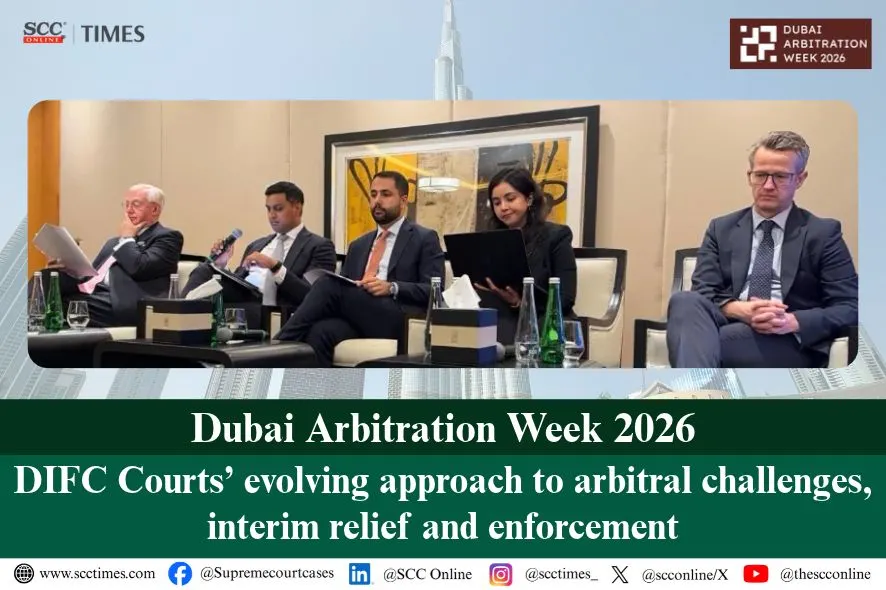
Dubai Arbitration Week 2026 brought together members of the international arbitration community in Dubai from 9 to 13 November 2026, organised by the Dubai International Arbitration Centre (DIAC). Among the sessions held during the week was “From the Coalface: A New Era for Enforcement, Freezing Orders and Award Challenges in the DIFC?”, hosted by Three Verulam Buildings (3VB) on 10 November 2026.

[In picture from left to right: Justice Mark Pelling, Mr. Yash Bheroo, Mr. Ravi Jackson, Ms. Chinmay Sharma and Mr. Tom Montagu-Smith KC]
The session explored significant developments in the Dubai International Financial Centre (DIFC) Courts’ approach to arbitration-related disputes, particularly the exercise of their supervisory, interim and enforcement jurisdictions. Drawing on recent judicial decisions, the panellists examined the grounds for setting aside arbitral awards, the availability of interim measures in support of foreign-seated arbitrations, the use of freezing orders and the enforcement of judgments and arbitral awards across jurisdictions. They also considered proposed amendments to the DIFC Arbitration Law and their potential implications for arbitration proceedings, parties and tribunals.
Justice Mark Pelling chaired the discussion, joined by Mr. Yash Bheroo, Mr. Tom Montagu-Smith KC, Mr. Ravi Jackson and Ms. Chinmay Sharma, barristers at 3VB. Through an examination of recent case law and proposed legislative reforms, the panellists considered how the DIFC Courts’ evolving approach continues to shape the jurisdiction’s position as a forum for international arbitration and cross-border enforcement.
DIFC Courts’ approach to setting aside arbitral awards
Opening the discussion, Justice Mark Pelling invited Mr. Yash Bheroo to consider whether the setting aside of two DIFC-seated arbitral awards, namely in Ohio Bank v. Parker1 and Princeton v. Persephone2, indicated a shift in the courts’ approach or merely reflected the application of existing legal principles to particular cases.
Mr. Bheroo observed that although the legal threshold for setting aside an arbitral award had not necessarily changed, the surrounding circumstances and the manner in which the courts were applying the law had evolved. He referred to the increasing number of applications before the DIFC Courts, noting that the number had risen from five in 2018 to 53 in the previous year, with approximately 45 applications already recorded in the current year at the time of the session. He also noted that the DIFC legislature was preparing to reform the arbitration legislation. Discussing the Court of Appeal’s decision in Ohio Bank, Mr. Bheroo explained that the dispute arose from a bank’s involvement in a proposed ship-financing arrangement. The bank had been asked to take custody of two bonds against which an individual intended to borrow. After conducting its checks, the bank required an indemnity from Parker before accepting the bonds. It subsequently emerged that the bonds had little value and that other banks were unwilling to lend against them. Parker brought several claims against the bank, including deceit, negligence and alleged breaches of regulatory duties. The matter proceeded to arbitration, involving a hearing, cross-examination, closing submissions and post-hearing briefs. The central difficulty arose when Parker introduced a new regulatory allegation in a paragraph of the post-hearing brief. The allegation concerned the bank’s purported duty to explain clearly why it required the indemnity and to ensure that its explanation was not misleading.
Mr. Bheroo highlighted that the allegation had not been pleaded. The bank was therefore faced with a difficult choice: respond to the new claim and potentially accept that it fell within the scope of the dispute, or object to its introduction and risk an adverse decision on an issue it had not answered. The bank decided to object. It identified approximately 20 new allegations in an annex to its post-hearing brief, explained why it considered itself deprived of an opportunity to meet the case and requested directions from the tribunal. It suggested that, if the tribunal considered the new issue to be in play, the appropriate course would be to permit supplementary submissions. However, the tribunal did not respond to the request.
The resulting award dismissed all pleaded claims unanimously but upheld the new, unpleaded allegation by majority. The third arbitrator dissented both on the decision to entertain the new claim and on its merits. In an addendum responding to the dissent, the majority maintained that the issue had been in play and that the bank had been given an opportunity to address it during the cross-examination of Parker. The bank challenged the award. Although its application was unsuccessful at first instance, it obtained permission to appeal. The Court of Appeal directed the parties to address authorities from other common law jurisdictions, leading to consideration of decisions from jurisdictions including Australia and Ireland.
On appeal, the bank relied on two grounds under Article 41 of the DIFC Law No.1 of 2008 (“Arbitration Law”): that the tribunal had decided a matter outside the scope of submission to arbitration and that the bank had been unable to present its case. The bank succeeded on the latter ground, while its challenge based on the scope of submission was rejected.
Mr. Bheroo explained that the distinction between these grounds was central to the Court of Appeal’s reasoning. In examining whether the issue fell within the scope of submission, the Court considered five sources: the pleadings, the list of issues, the submissions, the evidence and the closing arguments. It preferred the more flexible approach adopted in Hong Kong over the stricter approach associated with Singapore, which places greater emphasis on pleadings as the primary source for identifying the dispute. As Mr. Bheroo explained:
“…pleadings are a starting point but they’re not necessarily the finishing point”.
The Court concluded that, on the material before it, the indemnity issue had been sufficiently in play for the purposes of the scope-of-submission ground. The Court, however, reached a different conclusion on the bank’s inability to present its case. Mr. Bheroo emphasised that the bank could not have been expected to address an allegation that had not been clearly identified. The fact that it had cross-examined Parker about the indemnity did not necessarily mean that it had been given a reasonable opportunity to meet the distinct regulatory allegation subsequently advanced. Drawing attention to the Court of Appeal’s reasoning, he observed:
“You cannot aim at a case you have not yet been shown.”
Mr. Bheroo explained that a party challenging an award was not required to establish that the outcome would certainly have been different had it been given an opportunity to respond. It was sufficient to demonstrate that the submissions it could reasonably have advanced might have made a difference to the outcome. He also considered the bank’s written objection significant. By identifying the new allegations, explaining why it could not answer them and requesting directions, the bank had made its position clear to the tribunal. Had it simply remained silent, the Court might have viewed its conduct differently. The decision, he observed, offered an important practical lesson for both parties and tribunals. Where new arguments are introduced at a late stage, parties should consider whether to answer them or formally object and seek directions. Tribunals, in turn, should address such objections rather than leave them unresolved.
The “in play” test and the limits of judicial intervention
Mr. Bheroo clarified that the decision in Ohio Bank did not lower the threshold for setting aside an arbitral award. The principle of finality remained intact, as did the courts’ refusal to entertain challenges that were, in substance, attempts to appeal against the merits of an award. He nevertheless identified two important consequences of the recent decisions. First, they demonstrated that the threshold under Article 41 of the Arbitration Law was a real one. Although the courts had consistently described the threshold as high, the fact that earlier reported applications had failed did not mean that a challenge could never succeed.
Second, the Court of Appeal’s detailed consideration of authorities from other common law jurisdictions marked a development in the method of analysis. Its preference for the Hong Kong approach to identifying the issues in play provided an important point of reference for future cases. However, Mr. Bheroo cautioned that the precise boundaries of the test remained unsettled. The cases decided so far had involved relatively contained records. In Ohio Bank, the arbitration had included a full hearing and witness evidence, but the material was comparatively limited.
In Princeton, the dispute had ultimately been decided on four documents: two pleadings and two emails. The more difficult situation, he suggested, would arise in arbitrations lasting several years and involving extensive pleadings, applications, submissions and voluminous memorials. An argument might appear only in passing or in a footnote in a lengthy submission. Under the broader Hong Kong approach, such material might nevertheless be considered when determining what was in play before the tribunal. This could place a substantial burden on tribunals to address every point that had appeared somewhere in the record. It might also create an incentive for parties to introduce additional arguments during proceedings in order to preserve them for subsequent reliance. Mr. Bheroo therefore considered the application of the test in more complex arbitrations an important question for future decisions. Nevertheless, he rejected the suggestion that the recent developments had made the DIFC Courts less supportive of arbitration. He distinguished between support for arbitration and unquestioning deference to arbitral decisions, observing:
“…friendliness to arbitrations is not the same thing as deference to arbitrations.”
In his view, the courts continued to respect the finality of arbitral awards while retaining the responsibility to intervene where the statutory standard for setting aside an award was met.
Subsequent decisions on arbitral award challenges
Justice Mark Pelling next invited Mr. Ravi Jackson to examine the first-instance decisions delivered following Ohio Bank and consider whether they indicated a broader shift in the DIFC Courts’ approach to setting aside arbitral awards. Mr. Jackson cautioned that the two successful challenges should not be interpreted as evidence that the statutory threshold for setting aside awards had been lowered. Rather, the subsequent decisions demonstrated that the legal framework restated in Ohio Bank was being applied rigorously, both in favour of applicants who could establish a procedural irregularity and against those whose challenges failed to satisfy the statutory requirements.
Mr. Jackson referred to Princeton, a decision delivered by Justice Mark Pelling, in which an arbitral award was set aside in its entirety. The arbitration had been conducted entirely on documents, with the parties submitting pleadings and responses to questions from the tribunal. The party that had succeeded in the arbitration had advanced a narrow contractual case. It accepted that a breach of contract had occurred but argued that the other party was not entitled to terminate the agreement because the relevant contractual terms operated as a condition. The majority of the tribunal, however, went beyond the case advanced by the parties and made findings suggesting that the breach had been waived or that no breach of contract had occurred in the first place.
Mr. Jackson explained that the Court considered the tribunal’s reasoning to have moved substantially beyond the arguments presented during the arbitration. Applying the principles established in Ohio Bank, the Court set aside the award. The decision illustrated the importance of ensuring that arbitral tribunals determine disputes within the framework of the cases advanced by the parties and provide them with a reasonable opportunity to address the issues on which their decisions are based. It also demonstrated that the DIFC Courts would intervene where a genuine procedural irregularity satisfied the statutory grounds for setting aside an award. Mr. Jackson emphasised that the courts’ approach should not be understood as a relaxation of the threshold for award challenges. Rather, the decisions demonstrated that applications would continue to be assessed on their individual facts. The DIFC Courts would intervene where the statutory requirements were met but would not permit parties to use procedural grounds as a means of reopening the merits of an arbitral dispute.
The distinction, he observed, was between a genuine procedural irregularity and dissatisfaction with the tribunal’s reasoning. The court was not required to determine whether another judge or arbitrator would have explained the issue differently or at greater length. Taken together, the decisions illustrated that award challenges would be assessed on their individual facts. The courts would intervene where the statutory threshold was met but would not permit parties to use procedural grounds as a means of reopening the merits of an arbitral dispute.
Time limits and security for costs in setting aside proceedings
Mr. Jackson also discussed two decisions dealing with procedural requirements applicable to applications to set aside arbitral awards. The first concerned Okeke v. Obike3, in which an application to challenge an arbitral award was filed one business day after the expiry of the three-month period prescribed under the Arbitration Law. The deadline fell on a Friday, but the application was filed the following Monday. The Court, presided over by Justice Shamlan Al Sawalehi, adopted a strict approach and dismissed the application as time barred. It also rejected arguments seeking to draw an analogy with the time-limit provisions under the Rules of the DIFC Courts (RDC). Mr. Jackson explained that the three-month period was a mandatory statutory limit intended to prevent delayed challenges and preserve the efficiency and finality of arbitral proceedings. The decision demonstrated that parties could not assume that the Court would extend the statutory period merely because the delay was limited to one business day.
The second decision4 concerned security for costs. A party seeking to set aside an arbitral award had been ordered to provide security but failed to comply with the order. It subsequently sought an extension of approximately 90 days. The evidence indicated that the challenging party had only around AED 25 in its bank accounts, creating a substantial risk that the award creditor would be unable to recover its costs if it successfully defended the challenge. The Court adopted a firm approach, requiring the security to be provided within seven days, failing which the challenge would be dismissed. Mr. Jackson considered that both decisions reflected the DIFC Courts’ robust approach to procedural compliance. While the Courts would take properly constituted challenges to arbitral awards seriously, parties could not expect procedural indulgence where they failed to comply with statutory deadlines or court orders.
Practical considerations for parties, tribunals and applicants
Drawing on the decisions, Mr. Jackson identified practical considerations for three groups involved in arbitration: parties presenting their cases, members of arbitral tribunals and parties considering an application to set aside an award.
For parties to arbitration, he emphasised the importance of setting out their entire case, including alternative arguments and defences. A defence that had been pleaded but not developed in detail could become relevant if the tribunal subsequently decided an issue in a way that deprived the party of a reasonable opportunity to advance that defence. He also advised parties to consider carefully whether to object when new arguments are introduced at a late stage. The appropriate response would depend on the circumstances, including the number and nature of the new arguments. In Ohio Bank, the bank had identified numerous new allegations and formally explained why it could not reasonably be expected to answer them. A written objection could therefore become important if the resulting award were later challenged.
For tribunals, Mr. Jackson suggested that where they were considering deciding an issue that might have been raised late or not raised at all, they should hear the parties before proceeding. Seeking further submissions or evidence could cause some delay but might prevent a subsequent challenge to the award. He also advised tribunals to exercise particular caution in proceedings conducted entirely on paper, where the limits of the arguments and the opportunity to address them may be less apparent.
For parties contemplating a challenge, he stressed the need to identify the relevant ground with precision. A disagreement with the tribunal’s reasoning would not be sufficient. The applicant would need to identify the procedural irregularity, explain how it occurred and demonstrate why it was material to the outcome.
He also highlighted the importance of examining the essential building blocks of the argument on which the tribunal had relied. Breaking an argument down into its constituent elements could help establish whether it had genuinely been raised during the arbitration and whether the challenging party had a reasonable opportunity to address it. Finally, he drew attention to the practical significance of security for costs. For an award creditor, an application for security could be an important means of protecting against the costs of defending a challenge that might ultimately fail.
Proposed amendments to the DIFC Arbitration Law
The discussion then turned to the consultation paper published by the DIFC in June 20265, which proposed wide-ranging reforms to the existing Arbitration Law. Ms. Chinmay Sharma described the proposals as the most significant set of changes contemplated since the legislation was enacted approximately 18 years ago. She emphasised that the proposals remained at the draft stage and that it was not yet clear which changes would ultimately be adopted or when they would come into force. The proposed transitional arrangements contemplated that, unless the parties agreed otherwise, the amended framework would apply to arbitration proceedings commenced and awards issued after the commencement date specified in the eventual legislation. Ms. Sharma noted that the proposals drew on developments in several jurisdictions, including England, Australia, Singapore and Hong Kong. She then focused on the amendments most relevant to the issues discussed during the session.
Proposed reduction in the time limit for challenging awards
The first proposal concerned reducing the period for challenging an arbitral award from three months to 30 days. Under the existing Article 41(3) of the Arbitration Law, an application to set aside an arbitral award must be made within three months of the date on which the applicant received the award or, where a request under Article 40 of the Arbitration Law has been made, from the date on which that request was disposed of by the tribunal. The draft proposed amending Article 41(3) of the Arbitration Law to reduce this period to 30 days. Ms. Sharma explained that the consultation paper identified the use of award challenges as a delaying tactic as one of the reasons for proposing a shorter period. The proposal also sought to bring the DIFC framework closer to jurisdictions prescribing shorter challenge periods, including England and the UAE Federal Arbitration Law. For parties, the proposed reduction would mean that preparations for a potential challenge would have to begin much earlier. In document-heavy disputes, parties might need to consider the possibility of challenging an award even before receiving it, so that they could act within the proposed period.
Ms. Sharma nevertheless identified an important qualification in the draft: parties would remain free to agree in writing to a longer period for challenging an award. Further, the provisions concerning requests for correction or interpretation of an award under Article 40 of the Arbitration Law would continue to affect the calculation of the challenge period in accordance with the proposed statutory framework.
Replacing “full opportunity” with “reasonable opportunity”
The second proposal concerned Article 25 of the Arbitration Law, which deals with the equal treatment of parties and their opportunity to present their respective cases. The draft proposed replacing the existing requirement that parties be given a “full opportunity” to present their case with a requirement that they be given a “reasonable opportunity”. Ms. Sharma explained that the proposed wording was relevant to Article 41(2)(a)(ii) of the Arbitration Law, which provides a ground for setting aside an arbitral award where a party has been unable to present its case. Although the consultation paper had considered directly amending Article 41 of the Arbitration Law, the proposed approach was to revise the language of Article 25 of the Arbitration Law, thereby aligning the procedural standard with the relevant ground for setting aside an award under Article 41(2)(a)(ii) of the Arbitration Law. She cautioned that the proposed change should not necessarily be understood as lowering the threshold for setting aside an award. The reasonable-opportunity standard had already been applied by the DIFC Courts, including in the recent decisions discussed during the panel. Describing the proposal, she observed:
“This really just seems to be a matter of statute catching up with practice.”
In her view, the amendment would align the statutory language with the existing judicial approach. It would also support a more robust approach to procedural management, consistent with the objective of preventing parties from using procedural requirements to delay or obstruct arbitral proceedings.
Clarifying the power to grant interim measures
The third proposal sought to resolve an existing tension between Articles 24(3) and 7 of the Arbitration Law. Ms. Sharma explained that Article 24(3) of the Arbitration Law, on its face, appeared to confer on the DIFC Courts the power to grant interim measures in relation to arbitration irrespective of the place of arbitration. However, Article 7 of the Arbitration Law governed the territorial application of the Arbitration Law to DIFC-seated and non-DIFC-seated arbitrations, and the relevant exceptions did not expressly include Article 24 of the Arbitration Law.
This tension had arisen in litigation concerning the DIFC Courts’ jurisdiction to grant interim relief in support of arbitrations seated outside the DIFC. The proposed amendment sought to address the issue by relocating the relevant provision from Article 24 to Article 15 of the Arbitration Law, thereby placing the court’s power to grant interim measures within a different part of the statutory framework and clarifying its interaction with Article 7 of the Arbitration Law. Ms. Sharma considered this a helpful clarification, although she identified a possible remaining ambiguity: Article 15 of the Arbitration Law continued to refer to the “place of arbitration” rather than using the expression “seat” found in Article 7 of the Arbitration Law. She anticipated that the courts would interpret the provisions consistently but considered that the wording could still be refined.
Other proposed changes to tribunal powers
Ms. Sharma briefly outlined further proposals intended to strengthen arbitral tribunals’ procedural powers and improve the efficiency of arbitral proceedings. These included removing the requirement to give parties notice of every application made to the tribunal, permitting tribunals to make summary determinations and issue provisional or emergency awards, and expressly allowing emergency arbitrators to make peremptory orders. She clarified that the proposal concerning notice of applications did not necessarily create an independent power to grant ex parte relief. Rather, it would leave room for parties to agree on the relevant procedural arrangements. She also noted that the proposal did not go as far as some institutional arbitration rules that expressly provide emergency arbitrators with powers to grant such relief.
Concluding her discussion of the reforms, Ms. Sharma identified three broad effects that the proposals could have. First, arbitral awards could become final more quickly, requiring parties to prepare for potential challenges at an earlier stage. Second, tribunals would have clearer statutory powers to manage proceedings and address procedural abuse. Third, the reforms would provide greater clarity on procedural matters that parties could agree between themselves, including longer challenge periods and arrangements for interim relief.
The DIFC Courts’ jurisdiction to support foreign-seated arbitrations
The discussion then moved from the DIFC Courts’ supervisory jurisdiction over arbitral proceedings to their role in supporting arbitration through interim measures and injunctions. Justice Mark Pelling invited Mr. Tom Montagu-Smith KC to examine the extent of the DIFC Courts’ powers, particularly in relation to arbitrations seated outside the DIFC. Mr. Tom began by distinguishing between DIFC-seated arbitrations and foreign-seated proceedings. In the case of a DIFC-seated arbitration, the position was comparatively straightforward because Article 24(3) of the Arbitration Law conferred on the DIFC Courts the same powers to issue interim measures in relation to arbitration proceedings as they exercised in ordinary court proceedings.
The more difficult question arose where a party sought assistance from the DIFC Courts in support of an arbitration seated elsewhere. Mr. Tom explained that the difficulty stemmed from the interaction between Article 24(3) and Article 7 of the Arbitration Law, which governed the territorial application of the statutory provisions. He referred to Amarjeet Singh Dhir v. Waterfront Property Investment Ltd.6, in which Deputy Chief Justice Michael Hwang considered the interpretation of the expression “place of arbitration” under Article 24(3) of the Arbitration Law. The Court distinguished between the legal seat of arbitration and the physical venue at which the arbitration proceedings were conducted, holding that the reference to the “place” of arbitration did not necessarily extend the DIFC Courts’ interim-measures jurisdiction to foreign-seated arbitrations. This interpretation was subsequently considered in Brookfield Multiplex Constructions LLC v. DIFC Investments LLC and Dubai International Financial Centre Authority7.
Mr. Tom expressed the view that a different interpretation of the provisions was also possible. In his assessment, Article 24(3) of the Arbitration Law could have been treated as a further exception to the territorial limitations under Article 7 of the Arbitration Law, rather than interpreting the term “place” by reference to the physical location of the arbitration proceedings. He considered that the wording of Article 24(3), read alongside the drafting history of the United Nations Commission on International Trade Law (UNCITRAL) Model Law on International Commercial Arbitration, supported an interpretation under which the DIFC Courts could grant interim relief irrespective of the legal seat of the arbitration. Nevertheless, he acknowledged that the existing judicial interpretation had restricted the exercise of this power in support of foreign-seated arbitrations.
He then explained that the DIFC Courts’ jurisdiction to support foreign proceedings had developed through different legal routes. One such route arose where a dispute involved a DIFC establishment, thereby providing a statutory basis for the courts to exercise jurisdiction. In this context, he referred to Brookfield Multiplex Constructions LLC, which concerned an application for an anti-suit injunction to protect the parties’ arbitration agreement. The involvement of DIFC entities provided the necessary jurisdictional connection for the Court to consider the relief sought.
Another route involved the DIFC Courts’ ability to grant interim relief to protect their prospective jurisdiction to recognise and enforce foreign judgments and arbitral awards. Mr. Tom referred to the reasoning underlying Carmon Reestrutura-engenharia E Serviços Técnios Especiais, (Su) LDA v. Antonio Joao Catete Lopes Cuenda8, in which the Court of Appeal considered the relationship between the DIFC Courts’ enforcement jurisdiction and their powers to grant freezing orders in support of foreign proceedings. The decision recognised that the courts could grant interim relief to protect the effectiveness of their prospective enforcement jurisdiction.
Mr. Tom also referred to Oran and Oaken v. Oved9, which concerned an application for an anti-suit injunction. The Court of Appeal discharged the injunction and upheld the objection to jurisdiction, rejecting the proposition that the DIFC Courts possessed an unrestricted, freestanding jurisdiction to issue injunctions against any person anywhere in the world. The decision illustrated the limits of relying solely on the courts’ general injunctive powers under the DIFC Courts Law 2004 to establish jurisdiction in support of foreign proceedings.
However, Mr. Tom cautioned against treating the courts’ general powers to grant injunctions as creating an unlimited jurisdiction to issue orders against any person anywhere in the world. The existence of jurisdiction and the exercise of judicial discretion were separate matters. Even where a jurisdictional basis could be established, the Court would still consider whether it was appropriate to intervene in support of foreign proceedings. He explained that the DIFC Courts would ordinarily have a stronger interest in supporting arbitrations seated within the DIFC. In relation to foreign-seated arbitrations, the circumstances would need to justify the Court’s intervention, particularly where the foreign court or arbitral tribunal was capable of granting the necessary relief. Mr. Tom also emphasised that the DIFC Courts could grant orders intended to preserve the position until an arbitral tribunal was constituted or able to act.
Freezing orders and reciprocal enforcement of court orders
Mr. Tom next considered the use of freezing orders in support of foreign proceedings, particularly where parties sought to secure assets located outside the DIFC. He referred to the Trafigura (P) Ltd. and Trafigura India (P) Ltd. v. Prateek Gupta.10 In that case, the Court of Appeal confirmed that the DIFC Courts could grant a UAE-wide freezing order even where the applicants had not established the existence of assets within the DIFC. The Court recognised that the DIFC Courts could grant in personam injunctive relief in respect of assets situated elsewhere in the UAE. The decision demonstrated the importance of the DIFC Courts’ jurisdiction in supporting foreign proceedings and facilitating the eventual enforcement of foreign judgments.
Mr. Tom explained how the reciprocal enforcement mechanism between the DIFC Courts and the onshore Dubai Courts could operate in practice. A party might approach the DIFC Courts for a freezing order and subsequently seek assistance from the onshore courts to secure assets situated in Dubai. In appropriate circumstances, the applicant could request that service of the freezing order be delayed while it pursued the necessary enforcement steps. This could be important because immediate notification might alert the opposing party before the relevant assets or bank accounts had been secured. He noted that the approach of delaying service to facilitate effective enforcement had been endorsed in the Trafigura proceedings.
However, Mr. Tom drew attention to a subsequent order in the same proceedings, delivered by Justice Robert French on 9 September 2026. The order raised an important question concerning whether a freezing order could be enforced through the reciprocal enforcement mechanism. Justice French observed that a freezing order was an interim remedy rather than a final and executory order and, consequently, questioned whether it satisfied the statutory requirements for enforcement through that mechanism.
Mr. Tom explained that this observation raised concerns for practitioners who had historically relied on reciprocal enforcement between the DIFC Courts and the onshore Dubai Courts. He traced the issue to the earlier enforcement protocol between the two courts, which required orders to be final and executory. Nevertheless, freezing orders had historically been treated as falling within the scope of the relevant enforcement arrangements.
He considered that the central question was how the expression final and executory should be interpreted. In his view, the relevant test should be whether the order was capable of being enforced in the jurisdiction in which it had been issued, rather than whether it would ordinarily be characterised as a final order under common-law principles. As he explained:
“The real test is can that judgment be enforced now in the jurisdiction in which it was issued.”
Mr. Tom considered this an important issue because obtaining immediate protection over assets was often the principal reason parties approached the DIFC Courts for freezing relief. He acknowledged that the issue raised a significant question for practitioners and would require further judicial consideration.
Enforcement of foreign judgments and arbitral awards under the new DIFC Courts Law
In the final part of his presentation, Mr. Tom examined the effect of the new DIFC Courts Law on the recognition, enforcement and execution of foreign judgments and arbitral awards. He observed that the new legislation had prompted a series of arguments suggesting that changes in statutory wording necessarily resulted in a different approach to the courts’ jurisdiction. However, he did not consider that these developments fundamentally affected the DIFC Courts’ jurisdiction to recognise and enforce foreign arbitral awards, given the specific provisions governing that subject. Mr. Tom distinguished between two stages of the enforcement process. The first involved the recognition and enforcement of a foreign judgment or arbitral award. The second concerned execution, namely the measures taken by the courts to assist a successful party in recovering the money or property to which it was entitled.
In his assessment, much of the disagreement involving the Conflict of Jurisdiction Tribunal (CJT) concerned the latter stage, particularly whether the DIFC Courts could use their execution mechanisms in relation to assets situated outside the DIFC. He identified two mechanisms that had been used in practice. The first was Part 50 of the RDC, which allows judgment creditors to seek orders requiring judgment debtors or, in the case of corporate debtors, their officers to attend court and provide information concerning the debtor’s financial position and assets. Mr. Tom referred to instances in which foreign arbitral awards had first been recognised and enforced by the DIFC Courts, following which company directors based in Singapore or Malaysia had been summoned under Part 50 of the RDC.
The second mechanism involved receivership orders. Mr. Tom explained that receivership orders had been obtained in proceedings based on English judgments and had also been used in cases involving property situated outside the DIFC. Such orders could provide an additional means of execution by appointing a receiver to take control of relevant property and facilitate the enforcement process. He noted that the DIFC Courts had adopted a robust position concerning the extent of their execution powers. However, he identified a potential conflict between the DIFC Courts’ approach and decisions of the CJT, which had arguably taken a contrary position on the territorial reach of the DIFC Courts’ execution mechanisms. This raised a further question concerning Article 9 of the decree establishing the CJT, which provides for the binding effect of the Committee’s judicial precedents.
Mr. Tom questioned the extent to which the CJT should become involved in determining the powers available to the DIFC Courts to execute their own judgments. He noted that the CJT’s jurisdiction was concerned with resolving conflicts of jurisdiction, whereas the enforcement of a judgment in more than one jurisdiction had not historically been treated as necessarily giving rise to such a conflict. He considered the issue constitutionally significant because of the importance of judicial independence within the DIFC framework. He emphasised that the concern was not a comparison between the quality of the judiciary in different jurisdictions, but rather the importance of independent and appointed judges to parties and international investors. As Mr. Tom observed:
“…it’s not about quality…it’s about the attitude of external investment.”
He explained that investors valued the assurance of independent judicial decision-making and that this was an important feature of the DIFC’s position as an international financial centre. The tension between the DIFC Courts’ interpretation of their execution powers and the CJT’s approach therefore raised questions extending beyond the immediate enforcement disputes.
Conclusion
The discussions at Dubai Arbitration Week 2026 highlighted the evolving role of the DIFC Courts in international arbitration, particularly in relation to challenges to arbitral awards, interim relief and the enforcement of foreign judgments and arbitral awards. The panellists examined how recent judicial decisions had clarified the application of procedural fairness while reaffirming the statutory threshold for setting aside arbitral awards. They also emphasised the importance of procedural discipline, effective case management and ensuring that parties are afforded a reasonable opportunity to present their cases. The proposed amendments to the DIFC Arbitration Law could bring further changes to this framework, particularly through the proposed reduction of the time limit for challenging awards, clarification of the standard governing parties’ opportunity to present their cases and expansion of tribunals’ procedural powers. Meanwhile, questions surrounding the availability of freezing orders, reciprocal enforcement of court orders and the territorial scope of the DIFC Courts’ execution powers demonstrate that important aspects of the enforcement framework remain subject to judicial consideration.
Ultimately, the session highlighted that the DIFC’s position as an international arbitration and enforcement jurisdiction will continue to be shaped by the interaction between legislative reform and judicial developments. The courts’ ability to provide procedural certainty, effective interim protection and workable enforcement mechanisms will remain central to maintaining confidence in the DIFC dispute resolution framework.
-
SCC Times is the Official Information & Documentation Partner for Dubai Arbitration Week 2026. Stay tuned for comprehensive coverage, key insights and highlights from the event!
1. [2025] DIFC CA 006
2. DIFC ARB 015, 027/2026
3. [2026] DIFC ARB 039
4. Pedro v. Paula, ARB 034 of 2026
5. DIFC Consultation Paper No. 2 of 2026 – Amended Arbitration Law (DIFC Law of 2008), published on 11 June 2026 by the Dubai International Financial Centre
6. [2009] DIFC CFI 011
7. [2016] DIFC CFI 020
8. [2024] DIFC CA 003
9. [2025] DIFC CA 004
10. [2025] DIFC CA 001