1. Kindly introduce yourself and highlight the key experiences that shaped your career in international law and commerce.
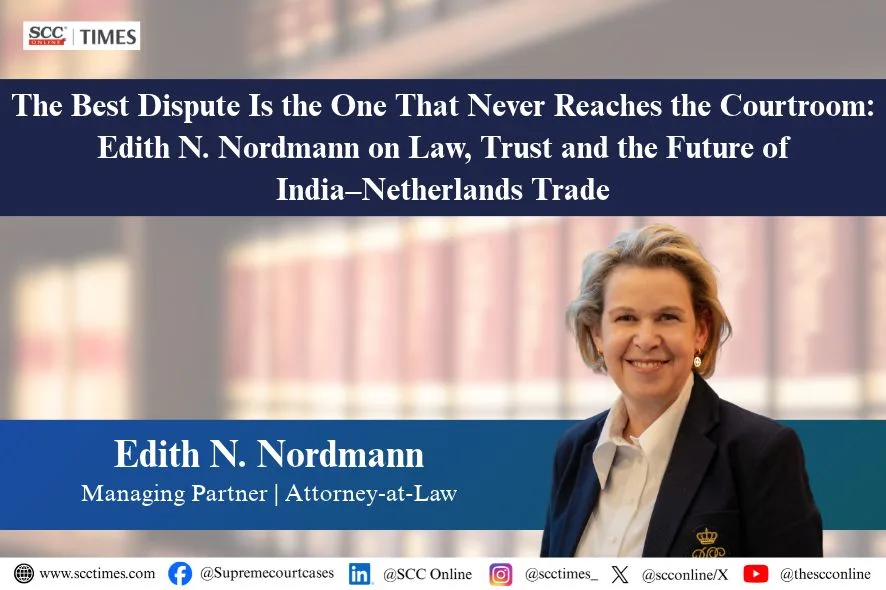
I am a Swiss-born lawyer who has lived and worked in the Netherlands for more than 35 years. I am the Managing Partner of ACG International, an Amsterdam-based law firm, Chairman of the Netherlands-India Chamber of Commerce & Trade (NICCT), and President of the Swiss-Dutch Business Council.
Looking back, I do not think I ever consciously decided to pursue an international career. It developed quite naturally. Growing up in Switzerland, where different languages and cultures coexist, probably gave me an early appreciation of the importance of understanding different perspectives. Moving to the Netherlands added another dimension to that experience.
I speak five languages, which has certainly been an advantage throughout my career. Beyond the practical benefits, I have always found that speaking someone’s language opens doors and creates a different level of understanding. Language is so closely connected to culture, and I genuinely enjoy that aspect of international practice.
My legal practice focuses on international commercial disputes, corporate matters and employment law. Over the years, I have worked with clients and colleagues from many different jurisdictions, often dealing with cases in which legal questions are closely intertwined with commercial interests, cultural expectations and personal relationships.
What I particularly enjoy about international practice is that no two cases are ever quite the same. A dispute involving parties from different countries is rarely just a question of applying the correct law. You need to understand how the businesses operate, what drives the people involved and what they are ultimately trying to achieve.
My involvement in international organisations, particularly the International Bar Association, has been equally important in shaping my professional life. These networks have brought me into contact with extraordinary lawyers from around the world, many of whom have become close friends. I have always believed that international networks are built through genuine relationships, mutual respect and trust.
More recently, I have also ventured into a rather different form of storytelling. In September 2026, I published my first legal thriller, Between Hearings: The Oath, under the pen name Nancy Nordmann. The novel draws inspiration from the fascinating, sometimes unpredictable world of legal practice and civil and commercial litigation, where the human stories behind the cases can be just as compelling as the legal arguments themselves. Writing fiction has been a wonderful experience, allowing me to share a glimpse of a world that most people only see from the outside.
My roles within NICCT and the Swiss-Dutch Business Council are, in many ways, a natural extension of my legal practice. They allow me to bring together people from different professional and cultural backgrounds and help create opportunities that might otherwise never arise.
I consider myself very fortunate to have a profession that continues to challenge, inspire and surprise me, and that now even provides inspiration for a new chapter as an author.
2. As Chairman of the Netherlands-India Chamber of Commerce and Trade, how do you understand your role, and what are your principal priorities?
I see my role primarily as that of a bridge-builder.
The Netherlands and India have much to offer each other, but successful international cooperation does not happen simply because opportunities exist. It requires people who are willing to connect businesses, institutions and individuals, identify common interests and help turn initial conversations into lasting relationships.
At NICCT, our ambition is to facilitate precisely that process.
One of my priorities is to make the relationship between India and the Netherlands more accessible, particularly for small and medium-sized enterprises. Large multinational corporations generally have the resources and international networks to navigate foreign markets. For smaller businesses, however, finding the right partners, understanding the regulatory environment and establishing trust can be considerably more challenging.
Another important priority is bringing together the next generation of entrepreneurs, professionals and innovators. India has an extraordinarily dynamic entrepreneurial ecosystem, while the Netherlands offers a highly international business environment, advanced infrastructure and considerable expertise in technology, logistics and sustainability.
I am also particularly interested in strengthening cooperation between legal professionals and business organisations in both countries. Lawyers can play an important role in facilitating investment and preventing disputes, rather than becoming involved only when something has gone wrong.
Ultimately, I believe that a chamber of commerce should be more than a networking organisation. It should be a platform where meaningful connections lead to concrete opportunities and, perhaps most importantly, where people enjoy working together.
3. The Netherlands and India possess complementary strengths in areas including technology, logistics, sustainability, infrastructure, agriculture, and life sciences. What opportunities do you see for strengthening commercial and legal cooperation between the Netherlands and India?
I believe the opportunities are substantial, particularly because the strengths of our two countries are often complementary rather than competing.
The Netherlands has developed internationally recognised expertise in logistics, water management, agricultural technology, life sciences, semiconductor technology and sustainable infrastructure. India brings an enormous pool of talent, a rapidly developing technological ecosystem, significant manufacturing capabilities and an increasingly sophisticated innovation environment.
Consider the agricultural sector. The Netherlands is one of the world’s leading agricultural exporters despite its relatively small geographical size. Much of that success is driven by technology, research and highly efficient production methods. There is considerable potential for cooperation with India in areas such as precision agriculture, water efficiency, food processing and sustainable production.
Similarly, in technology and digital services, Indian expertise in software development and digital infrastructure can complement Dutch strengths in advanced manufacturing, semiconductor technology and applied innovation.
I also see important opportunities in healthcare and life sciences, particularly in medical technology, digital health and cross-border research collaboration.
From a legal perspective, successful cooperation requires more than identifying commercial opportunities. Businesses need predictable contractual arrangements, effective intellectual property protection, appropriate regulatory compliance and reliable mechanisms for resolving disputes.
This is where lawyers can make a genuine contribution to economic development.
I would particularly welcome more cooperation between Dutch and Indian law firms, universities, professional organisations and business associations. Commercial relationships are strengthened when the professionals supporting them understand each other’s legal systems and business environments.
4. How can businesses and lawyers effectively manage differences in legal systems, business culture, and regulatory expectations between the two countries?
The first step is recognising that differences exist, without assuming that one system or approach is necessarily better than another.
The Netherlands and India both have sophisticated legal systems, but their legal traditions, procedural frameworks and business practices differ considerably.
Dutch commercial practice is strongly influenced by civil law traditions, European Union (EU) legislation and a relatively direct approach to communication. India’s legal system is rooted in the common law tradition, with its own statutory framework, regulatory structures and judicial practices.
Those differences can become particularly relevant in contract negotiations, corporate governance, employment matters and dispute resolution.
Cultural understanding is just as important as legal knowledge. The Dutch are known for being direct, sometimes remarkably so. In India, personal relationships, hierarchy and the way in which trust develops may play a different role in commercial negotiations.
Neither approach is inherently superior. The challenge is to understand the expectations of the other party.
My advice to businesses is therefore relatively straightforward: involve experienced local counsel at an early stage, invest time in understanding your commercial partners and never assume that a contractual provision will necessarily have the same legal consequences in another jurisdiction.
For lawyers, this requires a degree of humility. Even after many years in international practice, I regularly encounter situations that remind me how much there is still to learn.
One of the greatest advantages of belonging to an international legal network is having colleagues whom you can call and ask: “How would this actually work in your jurisdiction?”
That kind of practical exchange is invaluable.
5. In cross-border disputes, how should parties decide between litigation, mediation, and arbitration effectively across the Dutch and Indian legal and business environments?
Perhaps I should begin with a confession: I am a litigator at heart. I enjoy the intellectual challenge of litigation, developing a strategy, presenting arguments and navigating complex procedural questions.
But being a litigator does not mean that I believe every dispute belongs in a courtroom. Quite the contrary.
One of the most important things I have learned over the years is that winning a case and achieving the best result for your client are not necessarily the same thing.
When advising clients on international disputes, I always begin by asking what they actually want to achieve. Is the objective to recover money, protect intellectual property, preserve a commercial relationship, obtain urgent relief or establish an important legal principle?
The answer often determines the most appropriate approach.
Litigation offers the authority and procedural framework of national courts. The Dutch courts have extensive experience in international commercial matters, and the Netherlands has a well-developed system of civil justice.
However, cross-border litigation raises important questions of international jurisdiction, applicable law, service of proceedings and, ultimately, recognition and enforcement.
These questions are particularly relevant in the relationship between the Netherlands and India. Under India’s Civil Procedure Code, 1908, the recognition and enforcement of foreign judgments are governed by specific requirements, particularly Sections 13, 14 and 44-A. Direct execution under Section 44-A is available only for qualifying judgments from courts in territories formally designated as reciprocating territories. Businesses should therefore not assume that a Dutch court judgment can automatically be enforced in India. The applicable recognition and enforcement procedure should be considered before proceedings are commenced.
Arbitration can offer advantages, particularly where parties are established in different jurisdictions and require a neutral forum. Both India and the Netherlands are parties to the New York Convention, which provides an international framework for the recognition and enforcement of foreign arbitral awards. In India, enforcement is governed by Part II of the Arbitration and Conciliation Act, 1996, including the requirements and grounds for refusing enforcement under Sections 44 to 49. While this framework can make arbitration particularly attractive for cross-border commercial disputes, enforceability must always be assessed in light of the applicable legal requirements.
Mediation, meanwhile, is often underestimated.
I have seen disputes in which the legal positions seemed irreconcilable, yet a commercially sensible solution became possible once the parties started discussing their underlying interests rather than merely repeating their legal arguments.
In international business relationships, preserving trust and future cooperation can sometimes be far more valuable than obtaining a judgment after years of proceedings.
I am therefore a strong believer in choosing the appropriate mechanism for the particular dispute, rather than automatically resorting to litigation or arbitration.
The time to think seriously about dispute resolution is when the parties are still enthusiastic about working together.
A carefully drafted dispute resolution clause, including the appropriate governing law, forum, arbitration seat where relevant, and possibly a structured negotiation or mediation stage, can prevent enormous difficulties later.
Ultimately, our responsibility as lawyers is not to generate proceedings. It is to help our clients find the most effective solution to their problems.
6. What legal and practical factors are most important when drafting agreements intended to prevent or resolve international commercial disputes?
A good international contract should not merely describe what happens when everything goes according to plan. It should anticipate what happens when things go wrong.
That may sound obvious, but in practice, parties are often so enthusiastic about a new commercial relationship that they devote insufficient attention to potential difficulties.
The first essential element is clarity. Rights, obligations, performance standards, payment terms, delivery conditions and termination provisions should be drafted in language that leaves as little room for interpretation as reasonably possible.
Equally important are the choice of governing law and the dispute resolution clause.
Parties sometimes assume that selecting Dutch law or Indian law automatically determines which courts will have jurisdiction. Of course, these are separate questions.
In cross-border contracts, I would also pay particular attention to intellectual property rights, confidentiality, liability limitations, force majeure, sanctions compliance, data protection and the consequences of regulatory changes.
For technology-related transactions, ownership of data, cybersecurity obligations and the allocation of responsibility for digital services are becoming increasingly important.
There is another aspect that is sometimes overlooked: the contract must be commercially workable.
I have seen beautifully drafted agreements that were almost impossible to implement in practice because the lawyers had not sufficiently understood how the underlying business actually operated.
Good legal drafting requires a genuine understanding of the commercial transaction.
Finally, I am a strong advocate of including practical escalation mechanisms. Requiring senior management to discuss a dispute before commencing formal proceedings, or providing for an initial mediation attempt, can sometimes prevent a manageable disagreement from becoming an expensive international conflict.
The best dispute is often the one that never reaches the courtroom.
7. How are geopolitical developments, digital commerce, sustainability requirements, and regulatory changes transforming cross-border trade?
We are witnessing a fundamental transformation of international trade. For many years, the emphasis was primarily on globalisation, efficiency and reducing barriers to international commerce. Today, businesses must also consider geopolitical stability, supply-chain resilience, cybersecurity, sustainability and increasingly complex regulatory requirements.
The result is that international trade has become more legally demanding, but also more strategically interesting.
Companies are reconsidering their dependence on individual markets and looking for reliable international partners. In that context, I believe India and the EU have an important opportunity to deepen their economic relationship.
The conclusion of the EU—India Free Trade Agreement negotiations on 27 January 2026 was a particularly important milestone. On 11 September 2026, the European Commission submitted its proposals for the agreement’s signature and conclusion to the Council. The agreement is now progressing through the necessary approval procedures and has not yet entered into force. Once implemented, it should create significant opportunities for businesses in both countries by improving market access, reducing trade barriers and providing a more predictable framework for commercial cooperation.
For businesses in both countries, the prospect of a more structured trading relationship offers opportunities, but also requires preparation.
Digital commerce is another major development. Cross-border transactions increasingly involve data, technology, digital platforms and intangible assets rather than simply the physical movement of goods.
At the same time, sustainability and responsible business conduct have become central considerations in international supply chains.
For lawyers, these developments mean that traditional commercial expertise must increasingly be combined with knowledge of regulatory compliance, technology, environmental obligations and international trade rules.
I also believe that we should not underestimate the importance of maintaining dialogue in an increasingly fragmented world.
International commerce creates economic opportunities, but it also builds relationships and mutual understanding.
That is one of the reasons I find my work with NICCT so rewarding. We are not merely facilitating transactions. We are helping to strengthen connections between two countries that have much to gain from working together.
8. Does artificial intelligence represent more of an opportunity or a risk for lawyers and international businesses, and what safeguards should govern its use?
I see artificial intelligence (AI) primarily as an opportunity, provided we remain fully aware of its limitations and our responsibilities.
AI is already changing the way lawyers work. Legal research, document review, contract analysis and the organisation of large volumes of information can be performed much more efficiently with the assistance of appropriate AI tools.
For international businesses, the opportunities are equally significant, particularly in logistics, healthcare, manufacturing, financial services and cross-border operations.
However, efficiency should never be confused with reliability. One of the greatest risks is that AI systems can produce answers that appear entirely convincing but are factually or legally incorrect. In legal practice, that is particularly dangerous.
A lawyer cannot simply rely on an AI-generated reference to legislation or case law without independently verifying its accuracy. Nor can we disregard our professional obligations concerning confidentiality, data protection and the protection of client interests.
We are also seeing a rather interesting development in our daily practice. Increasingly, clients come to us with answers generated by AI, essentially looking for confirmation that what their AI tool has told them is correct.
My response is usually quite simple: “I am delighted that you are thinking along with us. We can do one of two things. I can review what your AI tool has produced, explain what is correct and what is not, and charge for the time involved. Or I can first listen to you, assess your situation and give you my legal advice. You can then always ask your AI tool what it thinks of my advice.”
That usually works remarkably well!
We are even seeing disputes in which parties bombard each other with AI-generated legal arguments and lengthy correspondence. Sometimes it seems that nobody is actually thinking about the underlying problem anymore. They simply feed each other’s responses into their respective AI tools, producing yet another round of arguments. What started as a legal dispute turns into an AI battle, often without bringing the parties any closer to a solution.
I find this development fascinating, but also somewhat concerning. AI can be an excellent tool, provided we continue to think for ourselves. As lawyers, our responsibility is not simply to produce more text or more arguments. It is to exercise judgment, understand the real issues and help our clients resolve them.
The European Union’s AI Act represents an important development in establishing a regulatory framework for AI, with obligations applying in phases according to the type of system and the relevant risks. But regulation alone is not enough. Professional judgment, human oversight, transparency and accountability must remain central.
I follow developments in AI very closely and am genuinely fascinated by the possibilities it offers our profession. At the same time, I firmly believe in the importance of traditional mentoring. At our firm, we have young lawyers whom we deliberately train and mentor in what some might call the old-fashioned way: working closely together, discussing cases, challenging each other’s arguments and learning through practical experience.
I believe there is enormous value in that personal interaction. You cannot learn professional judgment, responsibility or how to deal with clients simply by asking an AI system the right questions. Those skills develop through experience, guidance and, occasionally, making mistakes.
For me, the future of our profession lies in combining the opportunities offered by new technology with the experience and human judgment that are passed on from one generation of lawyers to the next.
9. What advice would you offer to young lawyers seeking careers in international practice, and how do you view the future of trade and commerce between the Netherlands and India?
Be curious. Be courageous. And never stop learning.
If I could give young lawyers one piece of advice, it would be not to limit themselves too early in their careers.
Learn about other legal systems, develop an interest in international affairs, travel, learn languages and take opportunities to meet people whose backgrounds and experiences are different from your own.
And please, do not underestimate the importance of personal relationships.
I have been involved in international legal organisations for many years, and some of my most rewarding professional experiences have grown out of conversations that had absolutely no commercial purpose at the time.
A discussion over coffee at a conference, an exchange of ideas after a panel or a dinner with colleagues from another jurisdiction can develop into a professional relationship lasting decades.
That is one of the reasons I am such a strong supporter of international legal networks and of encouraging younger colleagues to become actively involved.
Another part of my professional life that I particularly enjoy is teaching at the Faculty of Law of the University of Bologna in Italy and at CHRIST University, School of Law, in Bangalore, India. I find working with students immensely rewarding. Their curiosity, enthusiasm and sometimes wonderfully challenging questions keep me on my toes. I always come away from these encounters feeling that I have learned just as much as I have taught.
Teaching in India is particularly special to me. The energy, ambition and eagerness to engage with international legal issues that I encounter among Indian law students are truly inspiring. It also gives me an opportunity to share practical experiences from international legal practice and hopefully encourage students to look beyond the borders of their own legal system.
I would also encourage young lawyers to develop their own judgment. Technology, including AI, will undoubtedly change our profession. But the ability to listen carefully, think independently, understand people and exercise sound professional judgment will remain essential.
And do not be afraid to make mistakes. You will make them. We all do. What matters is what you learn from them.
As for the future of trade between India and the Netherlands, I see enormous potential.
India has an extraordinary combination of entrepreneurial energy, technological talent and ambition. The Netherlands, despite its relatively small size, has a remarkable international outlook and considerable expertise in innovation, logistics, sustainability and advanced technology.
The EU—India Free Trade Agreement, once it enters into force, should provide additional opportunities for businesses on both sides. But agreements alone do not create successful commercial relationships. People do.
Through NICCT, I would particularly like to see more cooperation between young entrepreneurs, legal professionals, universities and innovative businesses from both countries.
There is also something I find particularly inspiring about the younger generation of Indian lawyers and entrepreneurs. Their international outlook, ambition and willingness to explore new opportunities create tremendous possibilities for future collaboration.
In a world that sometimes seems more divided than connected, international cooperation is not simply about trade figures, investment flows or legal agreements.
It is about creating understanding, building trust and recognising that we often have much more in common than we initially realise.
If we can encourage the next generation to approach international cooperation with curiosity, integrity and genuine respect for one another, I believe we will have achieved something far more valuable than any individual commercial transaction.
1. Managing Partner, ACG International; Chairman, Netherlands India Chamber of Commerce & Trade (NICCT); President, Swiss-Dutch Business Council.
2. Foreign Student Ambassador, SCC_Online.