
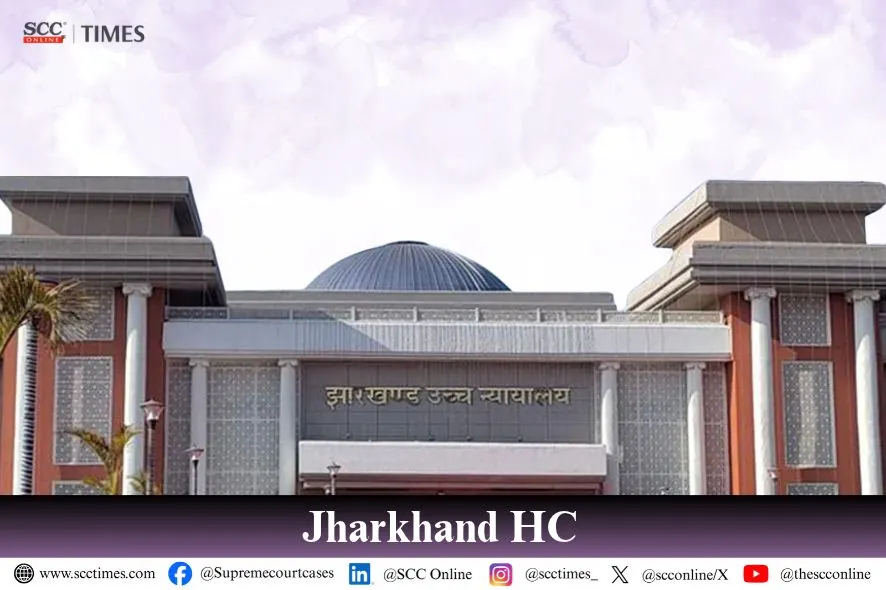
Jharkhand High Court: In a writ petition challenging the cancellation of Goods and Services Tax (GST) registration for failure to file GST returns for the Assessment Years 2024—2025 and 2025—2026, the Division Bench of M.S. Sonak, C.J., and Manoj Prasad, J., considered the petitioner’s willingness to file the pending returns and pay the GST dues. The Court directed the petitioner to pay the admitted GST dues of ₹27,44,107.50, after adjusting ₹5,13,958, if indeed paid, within 2 months and file returns for the Assessment Years 2024—2025 and 2025—2026 within 1 month. The Court further directed the respondents concerned to assess such returns and, within 1 month thereafter, make and serve an assessment order along with any demand for payment upon the petitioner. The Court directed that, if the petitioner pays the demanded amounts, the respondents must restore the petitioner’s GST registration within a maximum period of 2 weeks from the date of receipt of the amount paid by the petitioner, without prejudice and under protest.
Background
The petitioner challenged the cancellation of its GST registration for failure to file GST returns for the Assessment Years 2024—2025 and 2025—2026. The petitioner proposed to file GST returns for the above 2 years and pay GST dues to the respondents. It was submitted that cancellation of registration was equivalent to civil death since the petitioner would have serious difficulties in undertaking the business that it was carrying out. On 14 May 2026, the Court passed an order enabling the petitioner to file an additional affidavit along with draft returns for the relevant period indicating the amounts payable towards GST. Pursuant to the above order, the petitioner filed a supplementary affidavit with a draft statement showing period-wise turnover and GST liability. Some other documents were also placed on record. In the supplementary affidavit, the petitioner stated that it was ready and willing to file all pending returns immediately upon restoration of registration and subject to the directions of the Court.
The petitioner admitted that it had a GST liability of approximately 27,44,107.50, out of which it claimed to have paid ₹5,13,958 by GST challan dated 27 February 2026. In the draft statement, the petitioner undertook to file all pending GST returns and discharge the remaining lawful tax liabilities, together with applicable interest, late fee and other statutory dues, if any, upon restoration of the registration and subject to the orders of the Court. The petitioner also referred to the Court’s order dated 24 August 2026, where, by consent, leave was granted to file returns, subject to the petitioner’s undertaking to pay the assessed amounts within 2 weeks. By consent, the Court had directed that the GST registration would be restored upon payment of the GST dues, including penalty and interest, within a maximum period of 2 weeks of such payment.
However, the respondents stated that the statement prepared by the petitioner was only tentative and that, since no returns were filed, no assessment had been made by the departmental authorities. However, they submitted that, if all dues, including interest and penalty, were paid, the department would not be averse to restoring the petitioner’s registration.
Analysis and Decision
The Court directed the petitioner to pay the admitted dues of ₹27,44,107.50, after adjusting the amount of ₹5,13,958, if indeed paid by the petitioner to Respondents 3—5, within 2 months from the date of the order without seeking any extension. The petitioner was further directed to file returns for the Assessment Years 2024—2025 and 2025—2026 within 1 month from the date of the order, if necessary in physical form, with the respondents concerned.
The respondents concerned were directed to assess such returns and, within 1 month thereafter, make and serve an assessment order, along with any demand for payment, upon the petitioner. If the petitioner pays the demanded amounts, without prejudice to the petitioner’s right to question the demand in accordance with law, the respondents must restore the petitioner’s GST registration within a maximum period of 2 weeks from the date of receipt of the amount paid by the petitioner, without prejudice and under protest.
The Court further directed that the respondents concerned need not assess the petitioner’s returns if the petitioner fails to pay the admitted amounts within 2 months from the date of the order. This would not prevent the respondents concerned from taking such steps as are available under the law for the recovery of the GST dues, along with penalty and interest.
The petition and the rule therein are disposed of without any order for costs.
[Ram Ramshrayashil Constructions (P) Ltd. v. Union of India, W.P.(T) No. 3588 of 2026, decided on 2-11-2026]
*Judgment authored by: Chief Justice M.S. Sonak
Advocates who appeared in this case :
For the Petitioner: Shivam Mishra and Rahul Ranjan, Advocates.
For the Respondent: Sunil Kumar, Senior Panel Counsel, Ashok Kumar Yadav, Senior S.C.-I., P.A.S. Pati, Advocate.