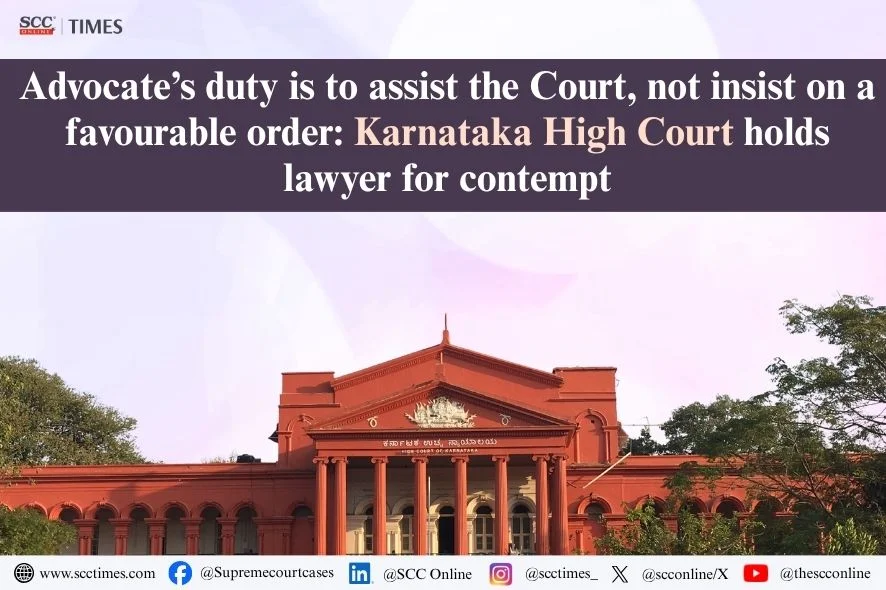
Karnataka High Court: In a criminal petition filed under Section 482, Criminal Procedure Code, 1973 (CrPC), the petitioner sought quashment of FIR for the offences punishable under Sections 120-B, 200, 404, 419, 420, 421, 423, 424, 426, 464, 467 and 468, Penal Code, 1860 (IPC), a Single Judge Bench of H.P. Sandesh, J., while considering the matter, deprecated the conduct of the petitioner’s counsel for repeatedly insisting that the Court pass an order in his favour despite being directed to bring the legal representatives of the deceased complainant on record.
Thus, the Court initiated suo motu criminal contempt proceedings against the counsel for his conduct before the Court.
Background
In the present case, the Court had issued notice against the complainant pursuant to which it was reported that he had died in 2021 and copy of the death certificate was placed on record. Thus, the Court granted one week’s time to take necessary steps. Subsequently, the petitioner’s counsel sought 2 days’ time to file the necessary application, which was accordingly granted. When the matter was listed on the scheduled date, the counsel again sought time to file necessary applications, and the Cout granted the same.
However, when the matter was listed again and no application had been filed to bring the legal representatives of the complainant on record, the petitioner’s counsel submitted that there was no need to file such an application, contending that the Court had insisted on filing the application despite there being no provision under the CrPC for the same.
In the prayer, quashing of the FIR was sought and after perusal of the complaint, the trial court passed an order referring the matter under Section 156(3) CrPC. However, no such order of the trial court was before the Court while filing the petition.
The petitioner’s counsel produced a copy of the trial court’s order sheet, wherein it was observed that the allegations made in the complaint required investigation by the police. Accordingly, the matter was referred to the Station House Officer (SHO) for investigation under Section 156(3) CrPC, constituting a pre-cognizance order.
Specific accusations were made against the petitioner and offences under Sections 200, 423, 404, 424, 120-B, 421, 419, 426, 468, 467, 464 and 420 IPC had been invoked, some of which were cognizable offences. Despite the complainant’s death, the petitioner’s counsel submitted that the matter could be disposed of without bringing the legal heirs of the complainant on record, contending that there was no such provision under the CrPC.
The counsel reiterated the submission despite being advised to bring the legal heirs on record, while raising his voice and making submissions in a tenor that was not submissive.
Analysis and Decision
The Court relied on Chand Devi Daga v. Manju K. Humatani, (2018) 1 SCC 71 wherein it was held that the legal heirs of a deceased complainant have the right to continue the prosecution in a criminal complaint relating to a warrant case. The Court noted that in Chand Devi Daga, the Supreme Court had referred to Jimmy Jahangir Madan v. Bolly Cariyappa Hindley, (2004) 12 SCC 509 (where, on the complainant’s death, his mother was allowed to continue the prosecution under the corresponding provision of the 1898 Code, either herself or through a pleader), and had observed that the heirs themselves had not filed the applications to continue the prosecution, rather the same was filed by their power of attorney holders.
Hence, the Court clarified that in a warrant case, on the death of the complainant during the proceedings, the legal heirs of the deceased complainant have the right to continue the prosecution, and that counsel’s submission to the contrary could not be accepted. The Court stated that despite that, the Court granted three adjournments to make an application and yet the petitioner’s counsel submitted that there was no need to file such application and in raised voice stated that only this Court has insisted to bring the legal heirs of the complainant. The Court highlighted that he was not ready to even hear the advice of the Court and questioned its authority.
The Court opined that the very conduct of the counsel was deprecated. Further, the Court held that despite sufficient opportunities, the petitioner’s counsel was not ready to file the necessary application to bring the legal representatives of the complainant on record. Thus, the counsel’s submission that the matter be considered on merits could not be accepted, as the legal heirs had to be given an opportunity to continue the prosecution following the complainant’s death.
The Court observed that no proceedings could be continued without arraigning the legal representatives of the complainant and, accordingly, no ground was made out to consider the matter on merits. The Court further noted that the petitioner’s counsel expressed his dissatisfaction in a rude manner.
Thus, the Court dismissed the petition.
The Court deprecated the conduct of the petitioner’s counsel for continuing to insist that the Court should not pass such an order despite a detailed order having been passed. The Court observed that “he cannot expect an order as he likes, and duty of the advocate is to assist the Court and cannot insist the Court to pass an order in his favour“. Thus, the Court held that the counsel’s conduct warranted initiation of criminal contempt proceedings to protect the dignity of the institution.
The Court further observed that the counsel had behaved rudely and questioned the authority of the Court despite the order being passed in reliance on the judgments of the Supreme Court. Accordingly, the Court directed the Registrar General to initiate suo motu criminal contempt proceedings against the petitioner’s counsel for his conduct before the Court.
[V.M. Kumarswamy v. State of Karnataka, CRL.P No. 7531 of 2020, decided on 17-10-2026]
Advocates who appeared in this case:
For the Petitioner: M. Shashidhara, Advocate
For the Respondent: Suhas Gowda M., HCGP