Top Legal Developments [12-18 Oct 2026]: AIBE-XXII syllabus, IBC appeal limitation, same arbitrator in 4,155 cases, and other Key verdicts and Policy Updates
A quick roundup to cover all the important legal developments and cases this week.

Bringing you the Best Analytical Legal News


A quick roundup to cover all the important legal developments and cases this week.
The lawyers were fined ₹2,000 and directed to pay ₹50,000 costs each, with a Bar Council referral for action.
The proceedings arose out of a public speech delivered by Congress MP Kumbakudi Sudhakaran on 3 August 2019. During the speech, he made remarks concerning the Judges who had rendered the judgment.

The Delhi High Court, in a criminal contempt petition under Article 215, held that freedom of speech does not protect scandalous and unsubstantiated allegations of corruption and criminality against a sitting Judge, as such publications undermine the administration of justice.
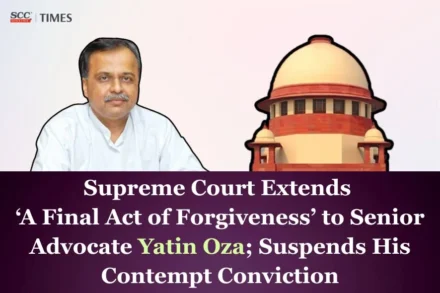
“The Court wields considerable authority, yet the true essence of judicial magnanimity lies in restraint. Measured reprimand and corrective guidance remain the wiser course over sheer penal consequence.”

“Instead of expressing regret or tendering an apology, he persisted with such allegations and even called upon the Court to tender an apology.”

“In view of the fact that unconditional apology has been tendered by the Contemnor, which seems to be heartfelt, we accept the same and direct the closure of the proceedings.”

“If he will be allowed to go scot free, message will go in the society that anything can be stopped to be delivered by a Judge for if such type of hooliganism is made in the open Court.”

“Any news, in respect of Courts and its working, made with a motive of degrading the judicial institution or lowering its prestige in the eyes of general public, eroded the public trust in the Courts and must be viewed as an ill-motivated interference in the administration of justice.”

“Judicial independence is a basic feature of the Constitution. We Judges have taken oath to discharge our judicial duties not only without favour but also without fear.”
The contemnor has scandalised and lowered down the authority of the Court, which amounts to interference in the administration of justice.
The cause of action to file the present petition arose when respondent 1 failed to pay the balance amount to the petitioner by 31-12-2012 as per clause (vi) of the compromise agreement based on which the consent decree dated 01-06-2009 was passed.

“The affidavit raising the preliminary objection stated- That as the two Judges of Larger Bench have already disagreed with the view of the earlier Division Bench, their presence in the Full Bench will be a hindrance for an independent and open mind hearing. The point of law/question of law referred to be determined cannot be fair and unbiased. That, in this premises, the view of a third Judge will be immaterial as the disagreed view of the two judges will prevail. It is just like loosing of the case by the sole respondent is preordained.”
“Criminal contempt is primarily a matter between the Court and the contemner and not a matter between a citizen and the contemner”.
The contemnor used the filing of the writ petition as another weapon in his armour to try and get the price reduced for the land. Such conduct of any person to abuse the judicial process cannot be ignored or left unpunished.

This report covers the Supreme Court’s Never Reported Judgment dating back to the year 1953 on contempt of court.
The Court stated that the contempt jurisdiction should not be exercised lightly at the drop of a hat. It ought to be invoked only in rare or exceptional cases where there is interference with administration of justice or such action amounts to scandalizing or lowering the authority of the Court.
“Petitioner appears to have taken a wrong end of law, aggrieved against adverse orders passed by the Judicial Officers of the District Courts as well as this Court and cannot be permitted to cross the red line, thereby making personal attack on the Judges which undermines the integrity of the Institution.”

“An advocate has to fearlessly uphold the interest of his client by all fair and honourable means without regard to any unpleasant consequences to himself or any other, but he must exercise restraint in using intemperate language during arguments in the Court.”
“Instances of this kind pose a serious challenge to the very functioning of the judicial system and the incident has to be viewed seriously”