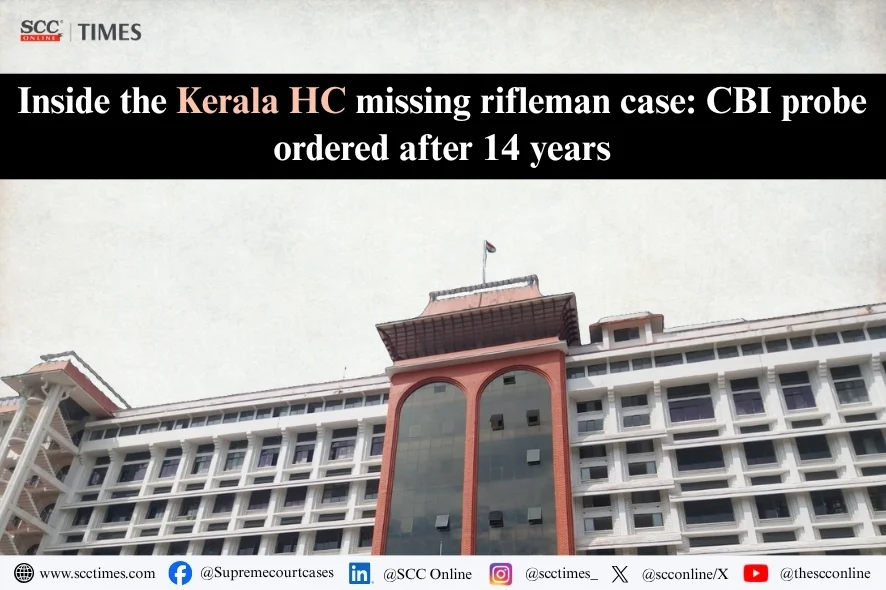
Kerala High Court: While considering a writ petition seeking effective steps to trace a missing rifleman of the Tripura State Rifles and a direction for Central Bureau of Investigation (CBI) investigation, a Single Judge Bench of G. Girish, J., held that the disappearance of the jawan during the course of a train journey from Ernakulam to Guwahati brought the matter within the Court’s jurisdiction and that the case constituted one of the rarest cases necessitating exercise of powers under Article 226 of the Constitution. Accordingly, the Court directed CBI probe into disappearance of the rifleman missing for over 14 years.
Also Read: P&H HC: War injury pension to 1971 Indo-Pak war soldier
Background
The case arose from the disappearance of a rifleman serving in the Tripura State Rifles, who went missing since 4 April 2012 while on return train journey from Kerala to Guwahati, after enjoying a month’s leave at his native place at Vengoor. According to the petitioner, who was the father of the missing jawan, a telephone call was received from an unfamiliar mobile number on the following day informing him that the train had reached Visakhapatnam and that the rifleman was not feeling well. The rifleman, however, conveyed that there was no cause for concern and that he would be able to travel up to his place of work.
Subsequently, on 10 April 2012, the Commandant informed the petitioner that the rifleman had not reported back for duty on completion of leave. The petitioner thereafter approached the Railway Police Station, Ernakulam, and various authorities including senior police officials and governmental authorities seeking assistance in tracing his missing son, but no information regarding his whereabouts could be obtained.
The writ petition was instituted on 29 October 2012 seeking appropriate directions for tracing the missing rifleman. Pursuant to directions of the Court, enquiries were conducted through the Railway Police Authorities at Visakhapatnam and reports were also called for from the Battalion concerned of the Tripura State Rifles. However, the Visakhapatnam Police ultimately closed the investigation as undetected, and no breakthrough was achieved by any agency. After more than 14 years of unsuccessful efforts, the petitioner sought transfer of investigation to the CBI as a last resort to ascertain what had happened to his son.
The State Government submitted that it had no objection to handing over the investigation to CBI. The Special Public Prosecutor for the CBI opposed the request on two grounds. Firstly, it was contended that the High Court lacked territorial jurisdiction as the disappearance was alleged to have occurred somewhere between Visakhapatnam and Guwahati. Secondly, it was argued that there was only very rare possibility of tracing out the missing person or gathering any information about his disappearance after the long lapse of 14 years.
Also Read: “Person” Includes Adults: SC Directs FIRs for Missing Persons
Analysis
Regarding territorial jurisdiction, the Court found the contention prima facie unacceptable. The Court noted that the missing rifleman disappeared while undertaking a train journey from Ernakulam to Guwahati. The Court dismissed as legally untenable the argument that the last communication indicated the disappearance had occurred somewhere between Visakhapatnam and Guwahati, thereby ousting the Court’s jurisdiction.
The Court referred to the principle embodied in Section 183, Criminal Procedure Code, 1973 (CrPC), which has been re-enacted as Section 203, Nagarik Suraksha Sanhita, 2023 (BNSS), concerning offences committed during a journey or voyage. The Court noted that the provision enables inquiry or trial by a Court through or into whose local jurisdiction the person concerned passed during such journey. Therefore, the Court held that it was well within its powers under Article 226 of the Constitution to entertain the matter relating to the disappearance of a person during a train journey commencing from Ernakulam.
Addressing the second objection, the Court observed that a premier investigating agency such as CBI was not expected to take a negative or pessimistic attitude merely because a substantial period had elapsed since the disappearance. Although the Court pointed out that the golden hours in a case of missing of a person to take prompt action for retrieval is 48 hours to 72 hours, it emphasised that the Court cannot shut its doors against the father who had been toiling his health, time and money for the past 14 years running after various authorities to find his missing son who was a paramilitary jawan guarding the borders of our Nation.
The Court observed that the petitioner had approached the Court within six months from the date of disappearance and the circumstances justified treatment of the matter as one of the rarest cases requiring exercise of extraordinary powers under Article 226 of the Constitution. The Court opined that the ends of justice demanded a fresh and comprehensive investigation by the CBI into both the disappearance of the rifleman and the cause thereof.
The Court emphasised that the peaceful sleep of the civilian is at the cost of sleepless nights, vigilance and sacrifice of the soldier and the civilian society of the Nation in return, owes a responsibility to stand by the soldier who protects them, in case he faces a crisis in personal life.
Decision
Consequently, while allowing the writ petition, the Court directed that the investigations in the crimes registered by the Railway Police Station, Ernakulam and the Government Railway Police Station, Visakhapatnam, be handed over to CBI. The competent authority of CBI was directed to assign the investigation to a suitable officer forthwith, who should examine all aspects relating to the disappearance of the rifleman and make every effort to trace him or ascertain the cause of his disappearance. Directions were also issued to the State Police Chiefs of Kerala and Andhra Pradesh to transmit all relevant investigation records to CBI officer entrusted with the case.
[Balan P.K. v. State of Kerala, WP(C) No. 25341 of 2012, decided on 29-9-2026]
Advocates who appeared in this case:
For the Petitioner: Sooraj T. Elenjickal, Advocate.
For the Respondents: P.V. Santhosh; O.M. Shalina, Deputy Solicitor General of India; Dr. K.P. Satheesan (SR.), Special Public Prosecutor, CBI; Sameer S., Public Prosecutor.