








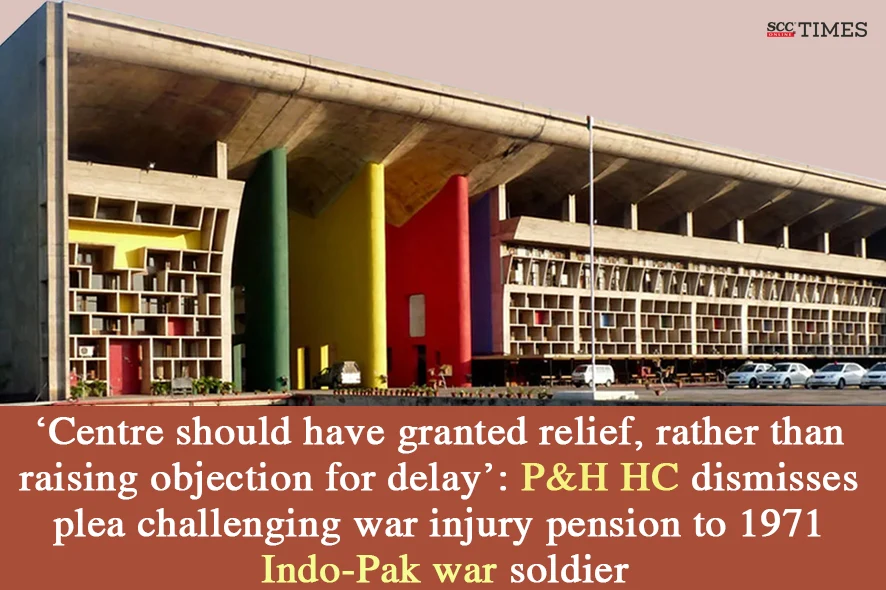
Punjab and Haryana High Court: In the present case, Union of India, the petitioner challenged the order passed by the Armed Forces Tribunal (‘Tribunal’), on the grounds that the said order was perverse. As per the said order, a soldier who was injured in Indo-Pak war, was granted benefit of war injury pension from the date of his discharge and after that, service pension till the date he died. Thereafter, he was granted the benefit of liberalized pension in his wife’s favour, from the next day of his death.
The Division Bench of Harsimran Singh Sethi* and Vikas Suri JJ. held that the Centre should have come forward to grant the benefit of war injury pension rather than raising objection for delay. The Court stated even the disability suffered by the soldier was not being treated to be attributable to military service. Such an action on the part of the petitioners could not be appreciated, especially when it related to a soldier who fought for the country and had suffered disability. Thus, the Court dismissed the present petition.
Background
The injury was suffered by the soldier in 1971, during the Indo-Pak war when a bomb exploded near him and due to splinters, heavy smoke and dust, he lost his eyesight. He was invalidated out of service, but the injury suffered by him was held to be neither attributable nor aggravated by the military service, though, it was mentioned that an appeal could be filed by the soldier, but he did not prefer any appeal.
The petitioner claimed that the soldier had raised the complaint after the lapse of 44 years from the date of rejection of claim by the Principal Controller of Defense Accounts (Pensions). Further, it was claimed that the disability rounded off from 20% to 50% by the Tribunal, was incorrect.
Analysis and Decision
Considering that the injury suffered by the soldier during the Indo-Pak war had gone unrebutted at the hands of the petitioners, the Court opined that there was nothing evident on record as to why the said disability suffered was not treated to be attributable to the military service. Further, the Court observed that any injury suffered during the war, especially loss of eyesight, which led to invalidation of the soldier could not be said to be not attributable to the military services or suffered during war.
Relying on Union of India v. Ram Avtar, 2014 SCC Online SC 1761, the Court opined that the petitioner had not been able to dispute the settled proposition of law to the effect that percentage of disability would be rounded off.
The Court held that a solider, who fought for the country in Indo-Pak 1971 war and had suffered the injuries during the bomb explosion, could not be excluded from the grant of entitled benefit especially, when nothing evident came on record to show that such solider was in knowledge that he was entitled for the benefit of war injury pension. Further, the Court held that even though the solider was not aware of the benefit of war injury pension, but the petitioners very well knew that the solider suffered an injury in war and was entitled for the benefit of war injury pension, but still ignored the said fact and did not grant the said benefit in favour of such solider, for which, he was entitled for and rather expecting such solider to revert back to claim the said benefit.
The Court stated that such an action on the part of the petitioners could not be appreciated, especially when it related to a soldier who fought for the country and had suffered disability and that too in war between two countries. The Court opined that the petitioners should have come forward to grant the benefit of war injury pension to the soldier rather than raising an objection regarding delay in denying the said benefit to him.
The Court dismissed the petition and stated that the petitioners’ could not be allowed to take advantage of their own wrong.
[Union of India v. Sham Singh, 2025 SCC OnLine P&H 6400, decided on 21-8-2025]
*Judgment authored by Justice Harsimran Singh Sethi
Advocates who appeared in this case :
For the Petitioners: Shalini Attri, Senior Panel Counsel









0 replies