The two-day National Annual Stakeholders Consultation on “Ten Years of the Juvenile Justice (Care and Protection of Children) Act, 2015: Progress, Challenges and Priorities for the Next Decade” concluded on 11 October 2026, at the Auditorium, C-Block, Administrative Buildings Complex, Supreme Court of India. The consultation was organised by the Juvenile Justice Committee of the Supreme Court of India in association with UNICEF India.
The valedictory ceremony brought together Supreme Court and High Court Judges, senior executive leadership, members of Juvenile Justice Boards, child protection practitioners, and civil society organisations to review the progress made over the past decade and identify actionable priorities for the next ten years.
The concluding session was attended by Justice B.V. Nagarathna, Judge, Supreme Court of India and Chairperson of the Juvenile Justice Committee; Justice J.B. Pardiwala, Judge, Supreme Court of India and Member of the Juvenile Justice Committee; and Justice A.S. Chandurkar, Judge, Supreme Court of India and Member of the Juvenile Justice Committee, along with other Judges of the Supreme Court, former Supreme Court Judges, and delegations from High Courts.
UNICEF Emphasises Prevention, De-institutionalisation and Standardised Preliminary Assessments
Addressing the consultation, Milen Kidane, Chief of Child Protection, UNICEF India, reflected on the establishment of core institutional structures across the country over the preceding decade. She observed that the focus must now shift towards making these systems transformative and responsive to the needs of children.
She further noted that, under the direction of Justice B.V. Nagarathna, stakeholders would work towards developing clear outlines for Juvenile Justice Boards conducting preliminary assessments in cases involving heinous offences. Such assessments, she emphasised, must balance public concerns with the fundamental principle that an adolescent remains a child whose entire circumstances must be considered.
Ministry of Women and Child Development Outlines Legislative and Administrative Priorities
Delivering the special address, Anil Malik, IAS, Secretary, Ministry of Women and Child Development, Government of India, outlined the Union Government’s administrative and statutory trajectory under Mission Vatsalya and the national budget.
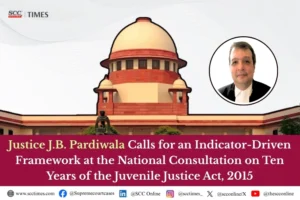
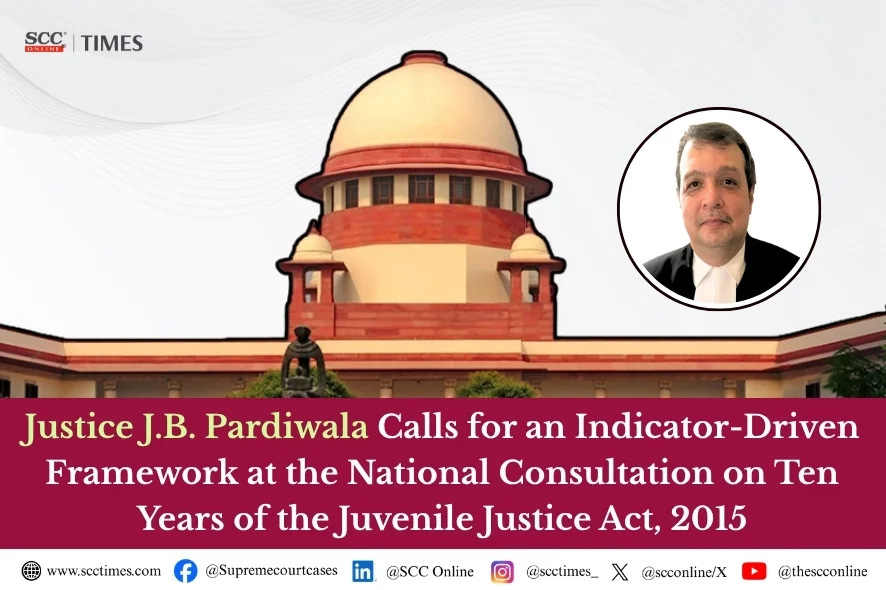
Justice J.B. Pardiwala Calls for Measurable Accountability and Grassroots Alignment
Delivering the closing remarks, Justice J.B. Pardiwala, Judge, Supreme Court of India and Member of the Juvenile Justice Committee, called for an honest and rigorous assessment of the country’s commitment to the constitutional vision of child rights.
His Lordship observed that India’s commitment to children did not originate in 2015, 2000, or 1986, but was rooted in the founding vision of the Constitution of India. Cautioning against equating incremental improvements with social transformation, His Lordship posed the question:
“For how many years may a gap remain a gap before it becomes an institutional failure?”
Referring to Dr B.R. Ambedkar’s address to the Constituent Assembly on the need for remedies beyond rights existing merely on paper, His Lordship cautioned against consultations becoming annual exercises in revisiting familiar problems without securing tangible outcomes.
Justice Pardiwala called for a streamlined and transparent annual accountability framework based on clearly defined indicators. The framework, His Lordship suggested, should measure concrete outcomes, including vacancies filled, standards improved in Child Care Institutions (CCIs), and children restored to education and aftercare.
His Lordship also called for a reversal of the conventional administrative hierarchy, emphasising the need to listen to frontline functionaries who work closest to children, including probation officers, social workers, teachers, and counsellors.
Highlighting the limitations of interventions that address only the visible symptoms of vulnerability, His Lordship observed that removing children found begging at street intersections achieves little if they return to circumstances of homelessness, hunger, and exploitation.
Justice Pardiwala further urged institutions to evaluate every expenditure against the question of whether it genuinely improves a child’s life.
Concluding his address, His Lordship articulated the objective for the coming decade: the goal must not merely be that India administers the Juvenile Justice Act better, but that India becomes a genuinely better place in which to be a child.
Also Read: Supreme Court marks 10 years of Juvenile Justice Act, 2015; focus on child rehabilitation