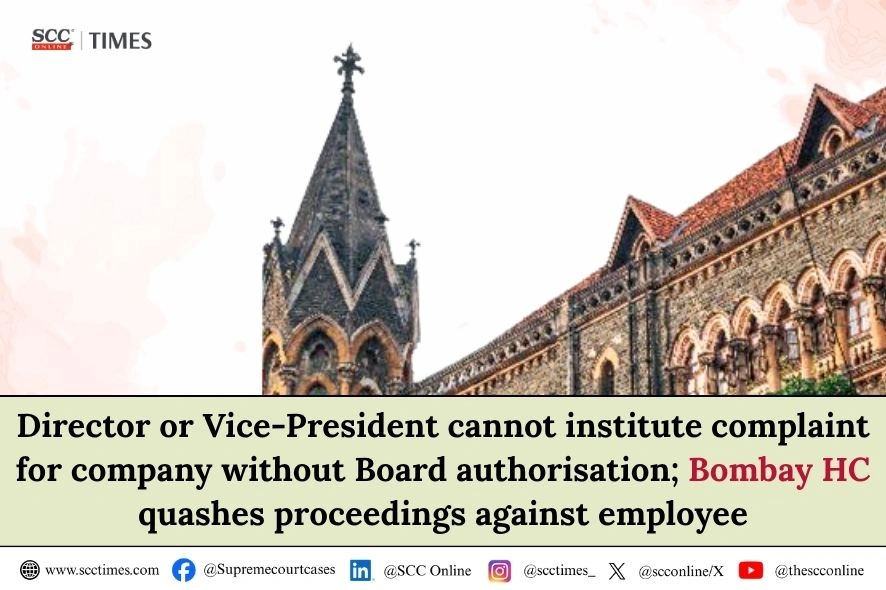
Bombay High Court: While exercising jurisdiction under Section 482, Criminal Procedure Code, 1973 (CrPC), a Single Judge Bench of Milind N. Jadhav, J., quashed criminal proceedings against an employee and held that a Director or Vice-President cannot institute complaint for company without Board authorisation. The Court observed that the complaint itself had been instituted without proper authorisation and that no prima facie case was disclosed against the employee. Accordingly, the FIR and the consequential proceedings were quashed insofar as the applicant was concerned.
Also Read: NEET-UG 2026 protests Supreme Court quashes FIRs
Background
The proceedings arose out of an FIR registered in 2008 for offences punishable under Sections 420 and 406, Penal Code, 1860 (IPC), Sections 63 and 63-B, Copyright Act, 1957 (Copyright Act) and Section 66, Information Technology Act, 2000 (IT Act). The applicant worked as design manager in the accused’s company, Enthuse Technologies Pvt. Ltd., from January 2008 till October 2009. The accused had left the complainant’s employment in 2006.
The prosecution alleged that source codes belonging to the complainant’s company, Brainvisa Technologies Ltd., had been reproduced and used without authorisation on the business website of the accused’s company. The complainant asserted that the infringement was discovered during random online surfing and that substantial financial loss of approximately ₹50 crores in 2008 had been incurred as a consequence. A charge-sheet was subsequently filed against the accused and his unnamed associates. The applicant was partially discharged under Section 66, IT Act by JMFC, Pune, which order was challenged by him before the Sessions Court, and the revision application was dismissed on 18 March 2019.
The applicant contended that he was merely an employee acting under instructions of his employer, that no specific role was attributed to him in either the FIR or the charge-sheet, and that no material existed to show unlawful use of copyrighted source code by him. He further argued that criminal law does not recognise vicarious liability merely on account of employment and that the complaint itself was defective because it had been lodged by a person claiming to be the Vice-President of the company without any Board resolution or authorisation empowering him to act on behalf of the company. It was also submitted that the major allegations in the charge sheet were against a co-accused who was already discharged by the Sessions Court vide order dated 14 October 2014, that the present case was a civil dispute between the complainant and the accused, and that the FIR was still pending after almost 18 years.
On the other hand, the State opposed the application and submitted that the applicant had facilitated the alleged infringement by working on source codes and assisting in setting up a domain server on which confidential information was allegedly uploaded, and that the discovery of alleged content in his public folder constituted sufficient material to proceed against him.
Analysis
The Court noted that the applicant was an ex-employee of the complainant’s company. The Court observed that JMFC, Pune, had taken cognizance of the complaint without ascertaining whether there existed any agreement between the complainant’s company and the applicant to hold the applicant liable for copyright infringement. The Court opined that the JMFC, Pune, had erred in not appreciating that the complaint which ought to have been filed on behalf of the company or its Directors through authorised resolution, was filed by the complainant in his individual authority.
The Court noted that the source codes were registered in the name of the complainant’s company and highlighted that unless there is a resolution by the Board of Directors, the complainant has no power to lodge a complaint as a Vice-President or an individual Director. The Court emphasised that a Vice-President or an individual Director possesses no inherent authority to act on behalf of a company except to the extent such powers are delegated by the Board of Directors or conferred through the articles of association.
The Court further noted that the applicant was merely an employee of the principal accused and that the record indicated he worked on ready material that had already been provided to him by his employer. The Court observed that even according to the prosecution case, his role was confined to assisting in the setting up of a domain server and carrying out tasks entrusted to him in the course of employment.
The Court opined that the Sessions Court erred in not appreciating that merely finding alleged content in a public folder of the applicant did not amount to his involvement in the commission of the crime. The Court observed that the order dated 18 March 2019 was liable to be set aside as it did not give any reason while concluding that there was a prima facie case against the applicant. The Court noted that the matter was pending since 2009 and the charges were not yet framed.
Also Read: S. 482 CrPC: SC’s 4 step process to check veracity of quashment prayer by accused
Decision
Accordingly, while allowing the application, the Court quashed the FIR and the proceedings before JMFC, Pune, insofar as they related to the applicant. The Court also set aside the revisional order dated 18 March 2019 and the order of the Magistrate refusing discharge, holding that no prima facie material existed to prosecute the applicant for the alleged offences.
[Nilesh Suryakant Jangam v. State of Maharashtra, 2026 SCC OnLine Bom 12575, decided on 21-8-2026]
Advocates who appeared in this case:
For the Applicant: Satyam Surana a/w Prakarsh, Advocates.
For the State: Y. M. Nakhava, APP.