Disclaimer: This has been reported after the availability of the order of the Court and not on media reports so as to give an accurate report to our readers.
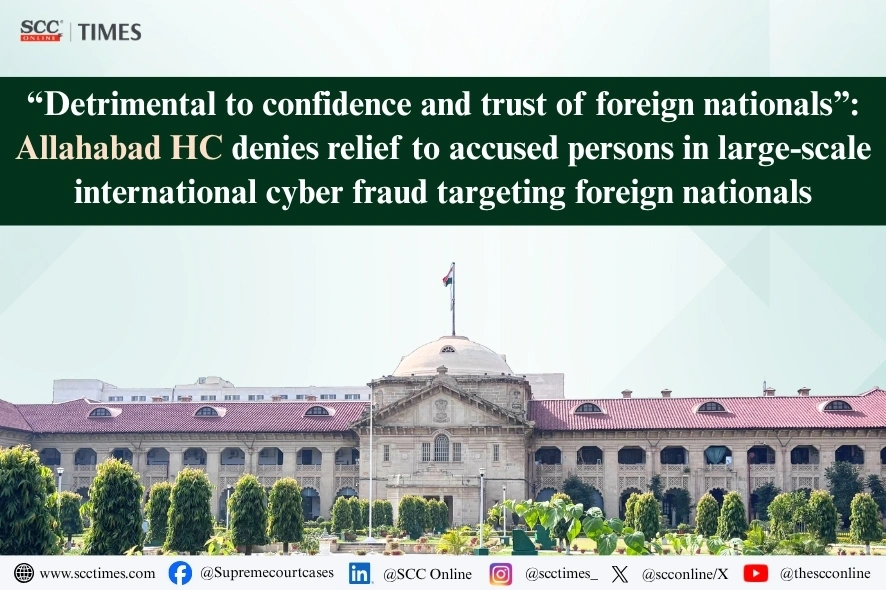
Allahabad High Court: In a writ petition filed by several accused persons in a large-scale international cyber fraud against their arrest, the Division Bench of Rajnish Kumar and Babita Rani, JJ., dismissed the petition, holding that it was filed on misconceived grounds, as the accused persons were furnished grounds and reasons for arrest through the recovery memo, and phone calls were made to the nominated persons.
The Court stated that, “procedural omission or a failure to record the information in the general diary does not automatically render the foundational arrest illegal in its entirety”.
Background
In June 2026, a sub-inspector received information that an illegal and fraudulent cyber call centre was operating from the Summit Building, Vibhuti Khand, Lucknow, where foreign nationals were being targeted. Therefore, the police raided the allegedly illegal call centre, wherein it was discovered that several persons were jointly running a fake call centre through which they obtained personal bank details of the foreign nationals and duped them by impersonating members of the United States Treasury, Federal Trade Commission, United States District Court, FBI, etc.
Allegedly, the said call centre had three teams, namely, dialler, banker, and closure. It even had vendors residing in the US collaborating in cyber fraud. The process was as follows:
-
The manager and the operations manager would send these vendors FAS-based toll-free numbers via WhatsApp, and the vendors would send pop-up messages to the mobile phones and laptops of US citizens. In these messages, the call centre would be depicted as a popular US Company, like Amazon, Microsoft, Netflix, etc.
-
When the receiver of the pop-up message called the toll-free number displayed, the dialler team would receive the call and tell the caller that their account was hacked or used for unauthorised transactions.
-
Thereafter, the call would be forwarded to the bank team, which would tell the callers that their account could be permanently blocked or their information could be used on the dark web, and under the pretext, the banking team would obtain information about the balance available in the bank accounts of the callers.
-
Lastly, the closure team would interact with the victims to redress the issue, pretending to be officials/Magistrates of the Federal Trade Commission, FBI, US District Courts, etc.
-
They would produce forged court orders and official documents in the name of government agencies and, in this process, fraudulently obtain the entire balance available in the victims’ bank accounts.
-
If the bank balance was of a small value, the money was obtained in the form of a gift card, and if the value was large, the money was converted into cryptocurrency and received in a wallet.
-
In the WhatsApp group, the QR code for transferring the crypto was also shared.
-
If the caller had money in physical form or gold, then they made the victims parcel it to the company’s agent residing in the USA. Thereafter, the money was received through Hawala.
-
The entire amount obtained from the cyber fraud was managed by the owner of the call center and one other individual.
Ultimately, 119 people were found involved in these activities on the spot, and they were arrested. While conducting the search, 103 laptops, 99 mouse, 116 headphones, 111 laptop chargers, 68 iPhones, 109 individual mobile phones, one biometric machine, and routers were taken into custody.
The FIR was lodged under Sections 3(5), 61(2), 318(4), 319(2), 336(3), 337, 338, 339 and 340(2), Nyaya Sanhita, 2023 (BNS) and under Sections 66-C and 66-D, Information Technology Act, 2000, and Section 42(2), Telecommunications Act, 2023.
The accused persons herein were arrested along with their co-accused and produced before the Special Chief Judicial Magistrate (Customs) (Special CJM), Lucknow. The Special CJM allowed the application for judicial remand and sent them to jail.
Hence, the present petition was filed by the accused persons alleging that neither the arrest memo was prepared as per the mandate of Section 36, Nagarik Suraksha Sanhita, 2023 (BNSS), nor was the same furnished to them, consisting of specific grounds and reasons for arrest, as per Article 22(1) of the Constitution and Sections 47 and 48 BNSS. The grounds of arrest were never furnished to either the arrested persons or their family members; therefore, the mandate of Section 48(3) BNSS was not complied with.
Analysis
Regarding the contention that the accused persons were illegally detained for almost 2 days while the raid was being conducted, the Court stated that the same was not sustainable, considering the number of persons present on the spot, who were involved in the alleged crime, and that a large number of devices may have taken time in the raid.
The Court noted that, undisputedly, the raid was made on 30 June 2026 at 10.30 p.m. and all the people found at the place of the crime were advised not to leave until the raid and search were completed. The police raid resulted in the recovery of a large number of electronic devices and other incriminating material from the premises, indicative of a massive, well-organised cyber-crime enterprise, which were taken into custody and sealed on the spot itself vide the recovery memo. Accordingly, the information was given to the police station concerned at 5.00 p.m. and the FIR was lodged at 9.20 p.m. on 1 July 2026 with the formal arrest of the persons involved in the offence, including the petitioners, and as per the case diary, the initial investigation continued till 2.00 p.m. on 2 July 2026 and thereafter the accused persons herein along with others were produced before the Special CJM same day. Thus, the Court held that the allegation of illegal detention beyond 24 hours was not substantiated by the record and was rejected.
On the contention that the accused persons were not provided their arrest memos, the Court noted that the accused persons signed the recovery memo created in their presence, and the recovery memo was prepared simultaneously with the arrest of the accused and arrest memos. The pleadings indicated that the receipt of the recovery memo was not denied and in the counter-affidavit, it was specifically pleaded that the recovery memo along with the arrest memo was provided to the accused persons and no rejoinder-affidavit was filed controverting the same. Therefore, the Court held that the receipt of the arrest memo by the accused persons stood admitted.
As far as the argument that the personal search memo was prepared on pre-signed blank papers, the Court noted that the search memo did not appear to have been made on pre-signed papers; however, it was a matter of scrutiny after evidence.
Regarding the contention that the arrest memos were not provided before arrest and the arrest memo produced in Court did not contain grounds and reasons for arrest, the Court noted that the arrest memo indicated that the receipt was taken on the personal search memo under Section 49 BNSS, which was appended to the arrest memo. However, there was no receipt on the arrest memo, and the State admitted that it did not bear the receipt. Further, the recovery memo, which contains the grounds and reasons for arrest in detail, was provided to the accused persons. Therefore, the Court rejected this contention as misconceived and not tenable.
The Court stated that though the communication of grounds and reasons for arrest stood admitted through the recovery memo, yet an objection was raised that grounds and reasons for arrest were not communicated in accordance with law. Thus, the Court examined whether the grounds and reasons for arrest disclosed in the recovery memo, a copy of which was provided to the accused persons, was sufficient compliance or not.
In this regard, the Court perused Sections 36 and 47 BNSS and noted that they did not provide any mode of communication of grounds and reasons for arrest. The Court also referred to Prabir Purkayastha v. State (NCT of Delhi), (2024) 8 SCC 254, and Mihir Rajesh Shah v. State of Maharashtra, (2026) 1 SCC 500, reiterating that furnishing the grounds of arrest to the arrestee is not a mere formality, but a mandatory binding of constitutional safeguards. Further, the grounds of arrest must be furnished in writing so that the true intention and purpose of Article 22(1) of the Constitution may be attained. Non-compliance will result in a breach of constitutional and statutory safeguards, rendering the arrest and detention illegal, and the person will be entitled to their release.
Also Read: Explainer on Digital Arrests and Cyber Frauds within India’s evolving Cyber Law Framework
Upon examining the FIR vis-à-vis the recovery memo prepared on the spot during the raid conducted by the police, which indicated the holistic details of modus operandi adopted by the accused persons to commit the crime, instruments used at the scene, and mala fide intention to extort money illegally, and consequential seizure of the electronic devices. The arrest memo mentioned that the evidence of cyber-crime was found in the recovered devices. Therefore, the Court held that it is apparent that, through the arrest memo read with the recovery memo, the accused persons knew the grounds and reasons for arrest.
The Court remarked that the details in the recovery memo were set out in such a way that any person of ordinary prudence can understand them easily. Furthermore, the details of offences given in the recovery memo were mentioned in a corresponding entry in the general diary after arrest of petitioners after conclusion of seizure of incriminatory items and documents and consequential sealing without any delay.
The Court stated that it is sacrosanct to mention that it can’t lose sight of the mandates and standards set out by the Supreme Court regarding supplying the grounds of arrest to an arrestee. However, in case the grounds of arrest have been furnished to the arrestee in the form of a contemporaneous document prepared at the time of arrest, the receipt of which is not disputed, then the same may be safely considered not only as mandatory statutory compliance but also to ensure the constitutional safeguard of the right to life and personal liberty, which cannot be curtailed without the procedure established by law.
In this regard, the Court relied upon Mihir Rajesh Shah, wherein the Supreme Court specifically refers to silence in the statute with regard to the mode, nature, time, and stage at which the grounds of arrest have to be communicated. Mentioning the exception, the Supreme Court has observed that there may be situations where it may not be practically possible to supply the arrested person at the time of his arrest or immediately thereafter. Therefore, a balance must be struck between compliance with constitutional and statutory mandated safeguards, vis-à-vis the effective discharge of lawful statutory law, enforcement of duties and responsibilities cast upon the State agencies.
The Court further referred to Vihaan Kumar v. State of Haryana, (2025) 5 SCC 799, wherein the Supreme Court observed that in case a contemporaneous record is prepared mentioning the grounds of arrest, then the entries in the general diary may be used for communication of grounds of arrest if the entry in this regard is found to be incorporated in the general diary.
Regarding the argument that the arrest memo was not furnished in the prescribed format of the State of Uttar Pradesh under Uttar Pradesh Bharatiya Nagarik Suraksha Rules, 2024 (UP BNS Rules), the Court held that the same would amount to irregularity and not illegality, especially in the present case wherein arrest was a consequence of a raid and 119 arrestees were apprehended including the accused persons herein committing cyber fraud, which is detrimental not only to the political, economic and social fabric of the country, but also confidence and trust of the foreign nationals of the country.
The Court further held that the UP BNS Rules provided an Arrest/Court Surrender Memo which did not align with the format for Memo of Arrest prepared in pursuance of an order passed by this Court and the law laid down by the Supreme Court. Therefore, the UP BNS Rules were required to be amended accordingly, and, in these circumstances, it was only an irregularity and not illegality.
“The law always prioritises substantial compliance over a procedural or technical compliance; therefore, a technical defect or irregularity in a document may not invalidate the entire proceeding if the substantial compliance has been made.”
The Court reiterated that the accused persons had come to know the grounds and reasons for arrest by way of arrest memo as well as through recovery memo, which was prepared along with memo of arrest and furnished to them spontaneously. The recovery memo also bears their signatures, which demonstrates not only the acknowledgment of the undisputed grounds of arrest and reasons for arrest.
Regarding the argument that the family or friends of the accused persons were not informed regarding their arrest, the Court noted that Section 48 BNSS did not state that failure in compliance with the same would deem the arrest illegal. Furthermore, the State produced call records of calls that were made to the relatives and friends of the accused persons; however, admittedly, the corresponding entry of the same was not made in the general diary as per Section 48(3) BNSS and Rule 25, UP BNS Rules. The call records also indicated that the phone calls were made before the production of the arrested persons before the Special CJM. As per the arrest memos, the accused persons had also nominated people to whom information of their arrest had to be given, but only one of them provided their local address.
The Court also noted that it was not disclosed who was designated in the police station concerned to keep the records and whether the information was mentioned in the arrest information booklet or not, as provided under the UP BNS Rules. Noting that the calls were made to inform the relatives, friends, etc. of the accused persons, the Court held that there was sufficient but not complete compliance.
Accordingly, the Court held that the accused persons were furnished grounds and reasons for arrest through the recovery memo and phone calls were made to the nominated persons. Therefore, procedural omission or a failure to record the information in the general diary does not automatically render the foundational arrest illegal in its entirety.
On the remand order passed by the Special CJM, the Court noted that at the time of production of the accused and seeking the remand, the entire case diary as well as the general diary were produced and the remand was allowed after perusal of the entire material placed by the investigating agency. The order passed by the Special CJM was on a printed proforma, which was incomplete regarding the details and compliance with Sections 47 and 48 BNSS. However, since the grounds and reasons for arrest were provided, the lack of details cannot be a ground to hold the arrest illegal.
In this regard, the Court referred to Vihaan Kumar, wherein it was held that even assuming a procedural irregularity or non-disclosing the entire contents required for passing a remand order, the arrest or remand order does not automatically vitiate the subsequent valid remand order passed by a competent Judicial Magistrate.
In view of the facts and circumstances of the case, the Court dismissed the petition, holding that it was filed on misconceived grounds and was untenable.
[Karolyn v. State of U.P., 2026 SCC OnLine All 31160, decided on 15-9-2026]
Advocates who appeared in this case:
For the petitioners: Sagar Singh and Ishan Baghel
For the respondent: Government Advocates Anant Pratap Singh and Girjesh Dwivedi