



On 4 September 2026, the Centre for Online Resolution of Disputes (CORD) launched CORD Rules 2.0 in New Delhi on Friday evening, a revised institutional arbitration framework built for commercial disputes that are too large to write off and too small to justify the cost and duration of conventional arbitration.
The Rules introduce five substantive changes: fees calibrated on a tiered schedule running from 60% to 140% of the Fourth Schedule of the Arbitration and Conciliation Act, 1996; an Independent Appointments Council to decide arbitrator challenges and set empanelment criteria; an opt-in appellate mechanism allowing parties to agree in advance that an award may be appealed before an independent tribunal constituted under MCIA; a daily cost consequence for missed procedural deadlines, charged at published rates; and an AI Practice Note that classifies uses of artificial intelligence in arbitral proceedings into prohibited, disclosable and permitted categories.
CORD administers proceedings on a digital-first basis and targets resolution within approximately six months.
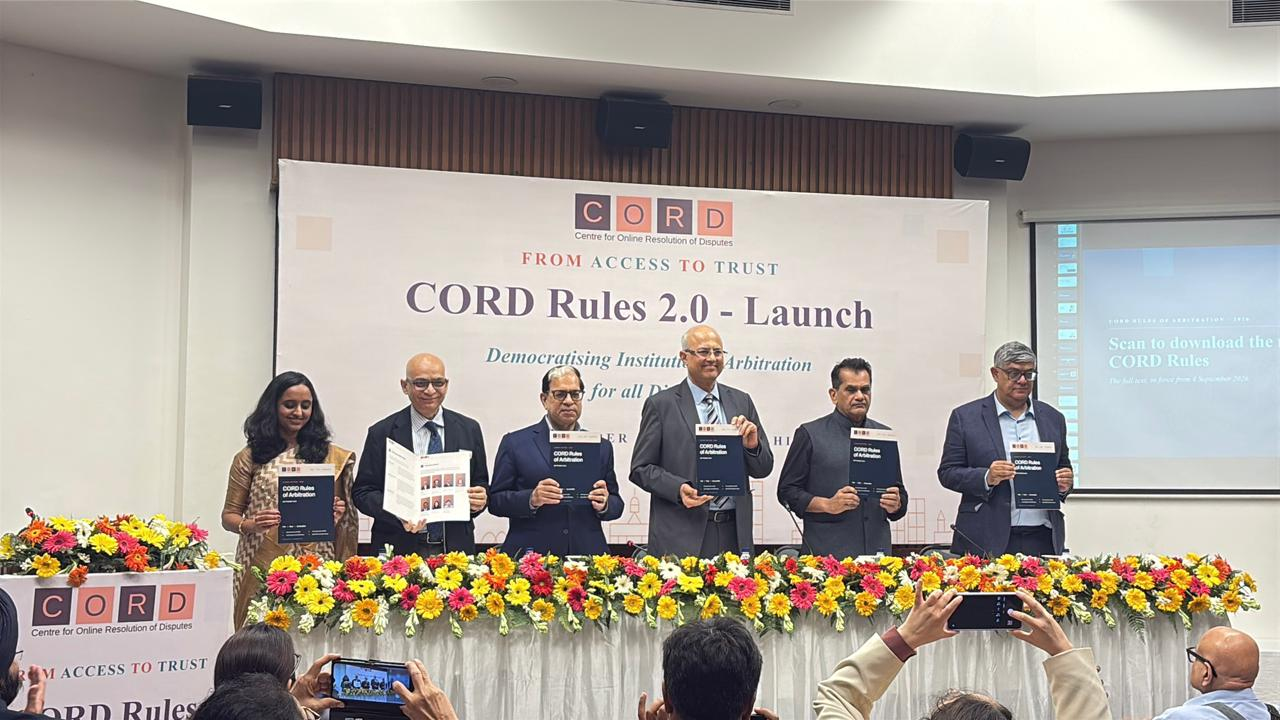
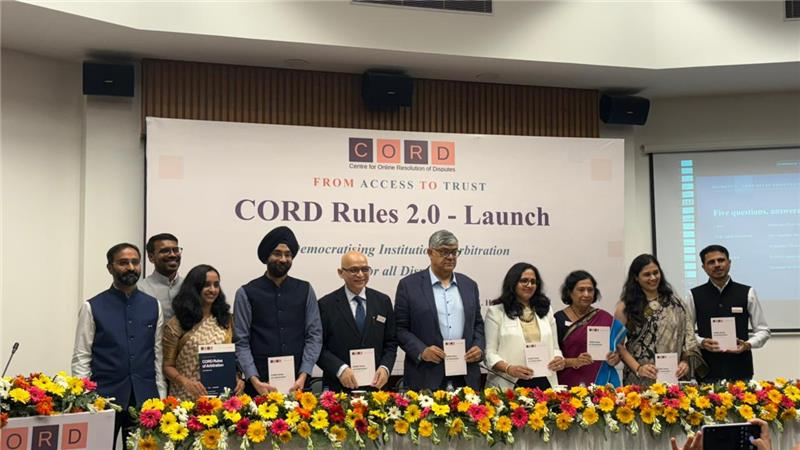
The launch was held at the India International Centre and attended by Justice (Retd.) A.K. Sikri, former Judge of the Supreme Court of India; Justice Manmohan, Judge of the Supreme Court of India; Justice (Retd.) Rajiv Shakdher, former Chief Justice of the Himachal Pradesh High Court; Shri Amitabh Kant, former Chief Executive Officer of NITI Aayog; Mr. Avnit Singh Arora, Director in the Department of Legal Affairs; Mr. Gourab Banerji, President of the Arbitration Bar of India; Ms. Vijaya Sampath, former Group General Counsel of Bharti Airtel; and Ms. Jyothi V.K., General Counsel of Aditya Birla Fashion and Retail.
An underserved segment
In his address, Justice Manmohan observed that Indian commercial arbitration operates largely at two ends of a spectrum — high-value disputes involving large corporations at one end, and high-volume banking and financial services disputes at the other — leaving disputes in the midvalue range relatively underserved. Against a judicial strength of roughly 21 judges per million people, he said, strengthening alternative dispute resolution is structural rather than optional, and institutional arbitration should be preferred to ad hoc proceedings. Institutions, he noted, supply a settled procedural framework, a dedicated administrative team, the capacity to identify defective arbitration clauses and procedural infirmities early, and function as think tanks for the wider ecosystem.
From policy to practice
Justice A.K. Sikri, who chaired the NITI Aayog committee on Online Dispute Resolution, traced the origins of India’s ODR movement to the committee’s report prepared during the COVID-19 pandemic and restated its founding principle.
He said ODR had been conceived as settled policy rather than a pilot, and that its central promise lies in resolving high-volume, lower-value disputes that courts, including commercial courts, are structurally ill-suited to absorb. He noted that thousands of disputes are now resolved through ODR in India every month, and that Indian dispute-resolution technology —including transcription and hearing systems — is being adopted by institutions and courts in jurisdictions including Singapore and Hong Kong.
Shri Amitabh Kant, who oversaw the constitution of the ODR committee as Chief Executive Officer of NITI Aayog, said the scale of India’s adoption of technology-enabled dispute resolution presents an opportunity to build indigenously designed institutions of international standard. He cautioned that the deployment of artificial intelligence in dispute resolution must be accompanied by transparency and human oversight.
CORD on the framework
“We built the rules around four questions every general counsel asks before signing an arbitration clause: what will it cost, when will it end, what if the award is wrong, and whether AI is touching my case without anyone telling me. Rules 2.0 answers all four in writing — the AI question with a published list of what’s prohibited, what must be disclosed, and what’s permitted.” — Deepika Kinhal, CEO, CORD.
Context
Online dispute resolution has moved from a pandemic-era experiment to a settled feature of Indian regulatory practice, with the Reserve Bank of India and the Securities and Exchange Board of India — the latter through its SMART ODR framework introduced in 2023 — embedding ODR in the financial sector. Segments of commercial dispute activity nonetheless remain outside the practical reach of both the courts and established arbitral institutions. CORD Rules 2.0 are directed at that gap.
The full text of CORD Rules 2.0 is available at: https://resolveoncord.com/resources/institutionrules
About CORD
The Centre for Online Resolution of Disputes (CORD) is an arbitration institution administering digital-first proceedings under its own rules.





