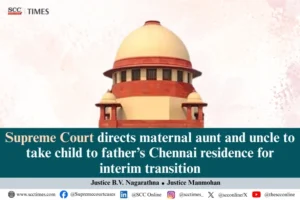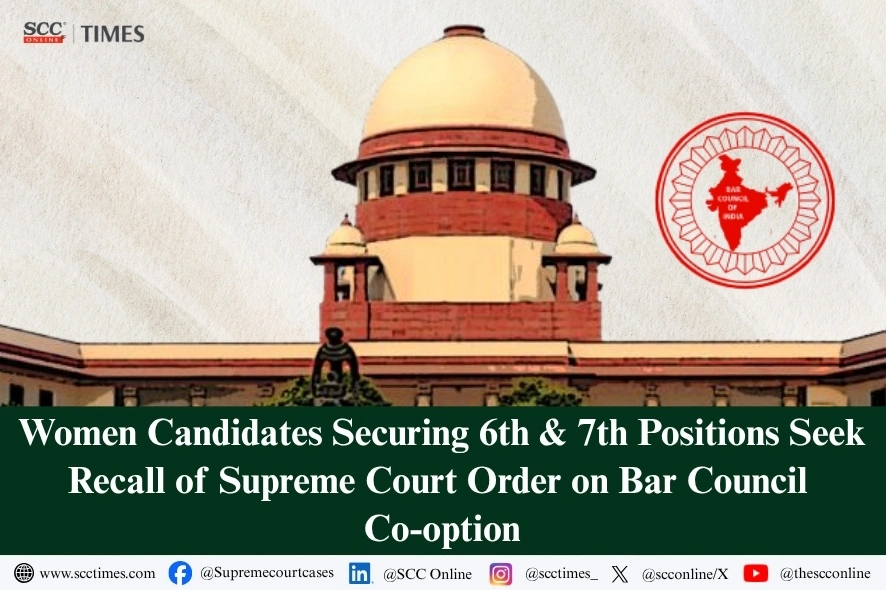
In a representation dated 13 August 2026, two women candidates who secured the sixth and seventh positions respectively among women candidates in the recently concluded Bar Council elections approached the Chief Justice of India seeking recall/reconsideration of the Supreme Court’s order in Yogamaya M.G. v. Union of India, 2025 SCC OnLine SC 2701, dated 4 August 2026, concerning the mechanism for filling the remaining 10% representation of women through co-option. They alleged that the order was passed without affording the directly affected candidates an effective and meaningful opportunity of hearing on the proposed mechanism and its consequences and contended that their electoral positions were directly relevant to determining a fair and objective mechanism for co-option.
By orders dated 8 December 2025 and 13 April 2026, the Supreme Court directed women’s representation in Bar Councils and entrusted the High-Powered Supervisory Committee (Committee), with determining the mechanism for the remaining representation through co-option. After consulting candidates and other stakeholders, the Committee formulated its recommendations, which, according to the applicants, included co-option of the 6th and 7th placed women candidates.
The Committee subsequently submitted its report to the Supreme Court in a sealed cover on 4 August 2026. The applicants contend that, as the report and recommendations were prepared pursuant to the Court’s directions and were directly relevant to the co-option mechanism, they had a legitimate expectation that these materials would be considered before the final mechanism was prescribed. The applicants submit that the determination of the co-option mechanism was part of a continuing process undertaken pursuant to the Supreme Court’s directions, involving stakeholder consultation, consideration of competing views, and submission of reports and recommendations.
Similarly, the Bar Council of India, pursuant to the Court’s subsequent directions, undertook a further consultation process and placed its views/recommendations before the Court in a sealed cover. The applicants’ grievance is that both reports, having been prepared pursuant to the Court’s directions and being material to the issue, could not have been bypassed or rendered inconsequential without consideration, particularly when the final order affected the rights and legitimate expectations of the applicants.
The applicants further referred to an application filed by the Bar Council of India in M. Vardhan v. Union of India, W.P. (C) No. 1319/2023, wherein the BCI sought co-option of women candidates who were next in line after the elected candidates, i.e., those securing the 6th and 7th positions, where 25 members were elected, 5th and 6th positions where 20 members were elected, and 4th position where 15 members were elected. The applicants noted that the same request had also been placed before the Committee.
In a communication dated 12 August 2026, the Bar Council of India directed that its earlier communication dated 11 August 2026, and the meeting proposed for 16 August 2026 concerning the co-option of women members be kept in abeyance. The BCI noted that grievances and disputes concerning the election process, including matters affecting the exclusion, elimination, ranking or electoral status of candidates, including women candidates, were pending or could fall for consideration before the competent forums, and that any determination in such proceedings could bear upon the electoral position of a woman candidate and the factual matrix concerning representation and co-option. The BCI accordingly considered it appropriate, as a matter of institutional prudence and abundant caution, to await determination of such issues by the competent forums and directed all State Bar Councils not to convene or proceed with the proposed meeting or undertake any consequential exercise until further communication.
The applicants submitted that the substantial participation of women candidates in the Bar Council elections reflected a healthy and evolving democratic phenomenon within the legal profession. They contended that, once the actual participation, performance and electoral mandate of women candidates became evident, it would be appropriate to achieve the 30% representation through the electoral process to the fullest extent possible, rather than resorting to co-option for seats that could otherwise be occupied by women candidates. In these circumstances, they argued that the principles of natural justice, audi alteram partem and procedural fairness required the affected applicants to be given a reasonable opportunity to place their objections and submissions before the mechanism was finalised, particularly since the order dated 4 August 2026, directly concerned women’s representation in elected statutory bodies and the competing claims of women candidates who had participated in the electoral process.
They also raised concerns regarding the permissible limits of the Supreme Court’s power under Article 142, submitting that although the power is wide, it cannot be treated as an unrestricted legislative power to amend, rewrite, substitute or supplant the substantive statutory scheme governing the constitution, election and functioning of Bar Councils.
The applicants have sought recall/reconsideration of the order dated 04.08.2026 insofar as it determines the mechanism, criteria or procedure for filling the remaining 10% representation through co-option, consideration of the reports and recommendations of the High-Powered Supervisory Committee and the Bar Council of India, and a meaningful and effective opportunity of hearing to the affected women candidates before any final mechanism or criteria for co-option is determined.
They have further sought consideration of their sixth and seventh positions in the electoral process while determining any objective and fair mechanism for co-option and have requested that no final co-option process be undertaken until the reports, recommendations and objections of the affected candidates are duly considered.