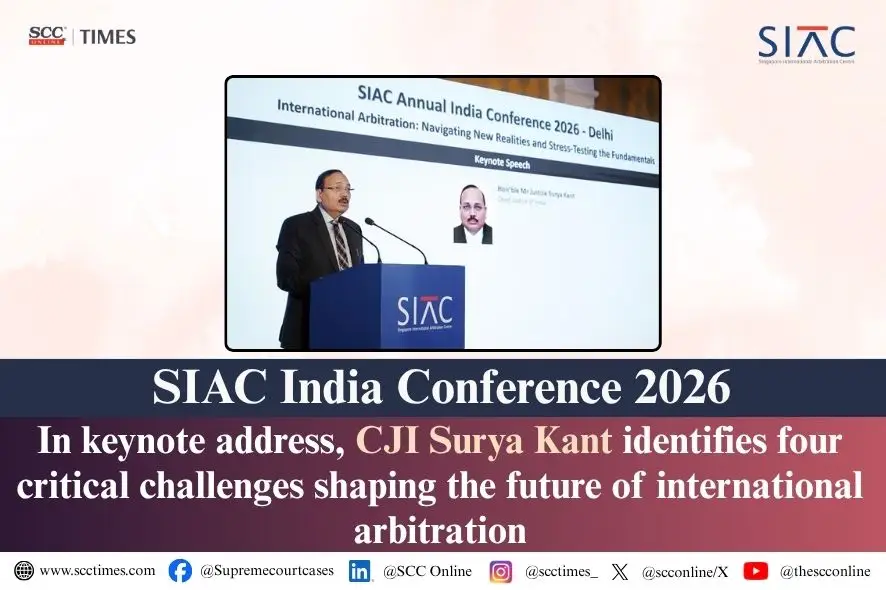
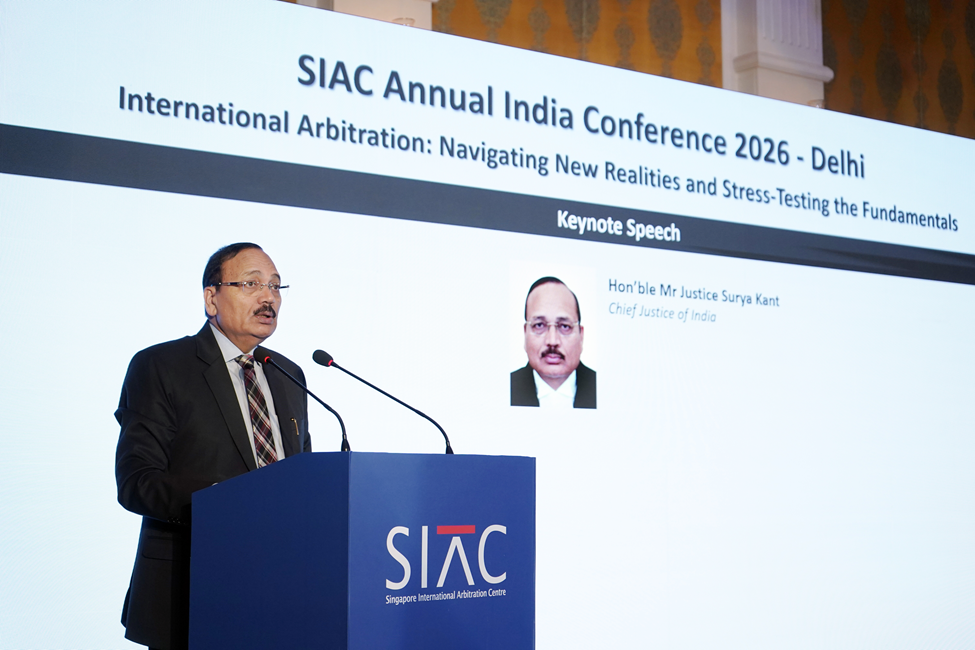
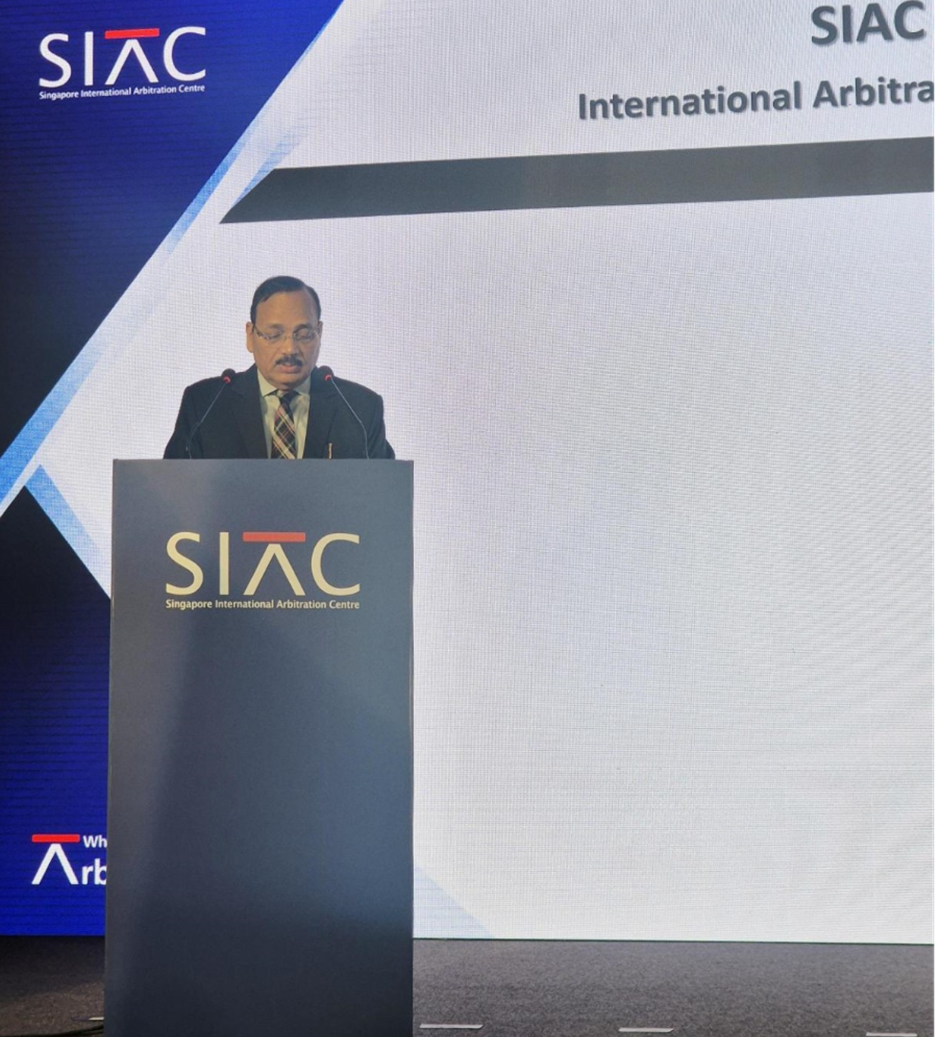
Chief Justice of India Surya Kant urged the international arbitration community to preserve the process’s defining strengths while responding to new realities that are reshaping global dispute resolution.
Speaking on the conference theme, “International Arbitration: Navigating New Realities and Stress-Testing the Fundamentals,” CJI Surya Kant observed that arbitration’s greatest strength has always been its ability to evolve. However, he cautioned that its continued success would depend not on creating new procedural frameworks but on using existing tools with greater discipline, consistency and purpose.
The Chief Justice structured his address around four “stress tests” confronting modern international arbitration and offered practical suggestions for addressing each of them.
When arbitration begins to resemble litigation
The Chief Justice began by reflecting on why businesses originally embraced arbitration as a neutral, efficient and enforceable alternative to court litigation. Recalling an early shipping dispute between an Indian charterer and a Greek shipowner, he observed that although the parties had fallen out over every other contractual obligation, they continued to trust the arbitration clause because it guaranteed a neutral forum, a fair hearing and an enforceable outcome.
That original promise, he cautioned, is increasingly under strain.
Lengthy hearings, extensive document production, multiple expert witnesses and delays in delivering awards have made arbitration resemble the court process it was designed to avoid.
Referring to the 2025 Queen Mary—White & Case International Arbitration Survey, he observed that delays are driven primarily by aggressive conduct by counsel, over lawyering and tribunals failing to manage the proceedings efficiently.
The answer, he said, is not another layer of procedural reform.
Instead, arbitral tribunals must treat procedural timelines as obligations rather than aspirations. Existing procedural tools, including the streamlined procedure introduced under the 2025 SIAC Rules and powers to dismiss manifestly unmeritorious claims or defences, should be used more confidently and consistently.
Artificial intelligence must be governed, not feared
Artificial intelligence formed the second major focus of the keynote.
CJI Surya Kant acknowledged that AI has rapidly become part of mainstream arbitration practice, presenting unprecedented opportunities alongside equally significant risks. Concerns surrounding fabricated evidence, AI-generated witness statements and submissions prepared using generative AI are no longer hypothetical but real risks faced by tribunals and institutions he observed.
To safeguard the integrity of arbitral proceedings, the Chief Justice proposed three practical measures.
First, parties should disclose whenever generative AI has been used while preparing witness statements or expert reports.
Secondly, arbitral institutions should develop standardised protocols for verifying digital evidence so that individual tribunals are not left to devise their own approaches to deepfakes or AI-generated material.
Finally, while caution is necessary, AI should also be embraced where it demonstrably improves efficiency. Tasks such as e-discovery, document management, translation and preparing initial drafts of procedural orders can all benefit from responsible AI-assisted tools operating within an appropriate regulatory framework.
Confidentiality cannot come at the cost of accountability
Turning to confidentiality, CJI Surya Kant observed that arbitration has expanded well beyond private commercial disputes to include investor-State arbitration, infrastructure projects and matters affecting broader public interest.
In such cases, he said, complete confidentiality may sit uneasily alongside the public’s legitimate expectation of accountability.
Without suggesting that confidentiality should be abandoned altogether, the Chief Justice advocated a more nuanced approach. Commercial disputes should continue to enjoy confidential proceedings, while disputes involving State action, public procurement, environmental issues or public health should, where appropriate, permit greater transparency.
He referred to the UNCITRAL Rules on Transparency in Treaty-based Investor-State Arbitration as an existing model that strikes an appropriate balance through measures such as publishing redacted awards, permitting submissions by non-disputing parties and conducting open hearings in suitable cases.
Consistency remains essential to confidence in arbitration
The fourth challenge concerned consistency in arbitral decision-making.
Observing that tribunals may sometimes reach different conclusions despite dealing with substantially similar factual circumstances, CJI Surya Kant remarked that such inconsistency undermines the predictability that commercial parties expect when choosing arbitration.
To strengthen coherence across arbitral practice, he proposed wider publication of appropriately anonymised awards together with their reasoning, enabling the gradual development of persuasive precedents. He also suggested that arbitral institutions ensure tribunals remain informed of relevant unreported awards and settled institutional practice while preserving tribunal’s decisional independence.
Equally important, he said, courts exercising supervisory jurisdiction must resist substituting their own views for those of arbitral tribunals. Consistency is best achieved through carefully reasoned awards and judicial restraint rather than increased judicial intervention.
India’s growing contribution to international arbitration
Reflecting on India’s role in international arbitration, CJI Surya Kant noted that Indian parties continue to rank among SIAC’s top three foreign users. He observed that SIAC’s decision to establish a liaison office in New Delhi reflects growing confidence in India’s importance as a centre for international commercial dispute resolution.
He also welcomed India’s efforts to strengthen institutional arbitration through the proposed International Arbitration Centre in GIFT City, expressing hope that these initiatives would be guided by disciplined case management, balanced transparency, responsible use of technology and appropriate judicial restraint.
“Rules alone cannot solve problems of behaviour”
Concluding his keynote address, CJI Surya Kant remarked that arbitration has continuously adapted from resolving disputes between merchants to addressing contemporary issues involving investment protection, digital evidence and artificial intelligence.
The challenges facing arbitration today, he said, should not be viewed as signs of institutional weakness but as evidence of its growing relevance in an increasingly interconnected commercial world.
Leaving the audience with a broader message, the Chief Justice observed that “rules alone cannot solve problems of behaviour” and “technology alone cannot solve problems of legitimacy.” What arbitration needs, he said, is not another generation of procedural reforms, but the discipline to use the tools already available and the humility to preserve the principles that have always distinguished arbitration – neutrality, party autonomy and enforceability.