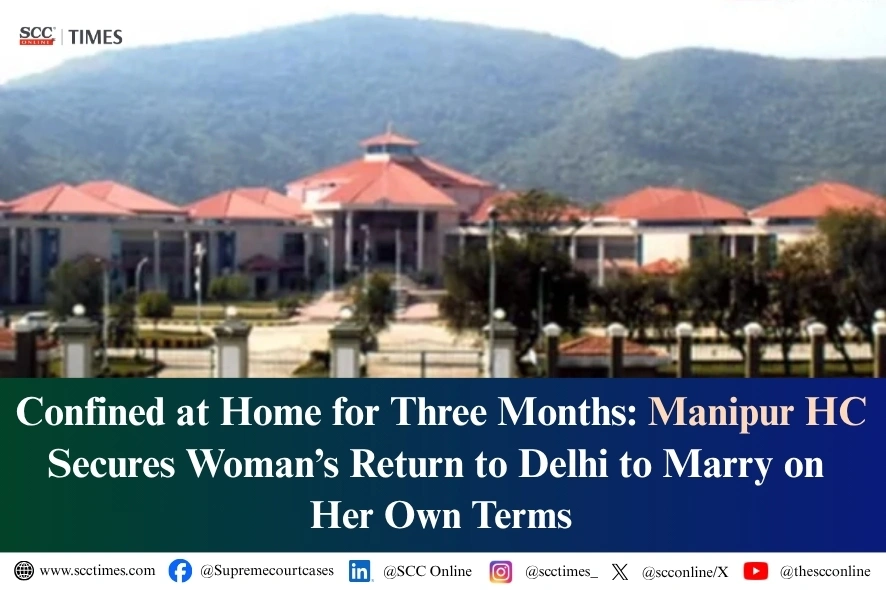
Manipur High Court: The Division Bench of M. Sundar, CJ., and Ahanthem Bimol Singh, J., allowed a habeas corpus petition after an adult woman informed the Court that she was being confined by her family against her wishes. The Court ordered police security for her to return to Delhi for continuing her professional career and marry the petitioner according to her own choice.
The mother and daughter had substantial interaction for considerable time in Court. After the interaction, the woman reaffirmed her earlier decision to return to Delhi, continue her career and marry the petitioner. Despite the restrictions by the family, the woman requested the Court that her family members are not taken to task so long as she was permitted to leave Manipur freely to resume her career and marry the petitioner.
Background
The case arose when a 29-year-old woman with whom the petitioner intended to marry, had been illegally confined by her parents in Manipur. The petitioner submitted that he and the woman had known each other for more than 4 years while residing in Delhi. They had decided to marry and both families were aware of their intention. The petitioner asserted that in March 2026, the woman’s mother requested her to return to Imphal to make preparations for the proposed marriage. Acting on that request, she travelled from Delhi to Manipur on 29 March 2026. However, instead of facilitating the marriage, her parents allegedly prevented her from returning to Delhi and kept her confined against her wishes. The petitioner alleged that the woman was prevented from communicating freely with him and kept in isolation. He further alleged that she was illegally detained incommunicado and only managed to contact him briefly after obtaining temporary access to her phone. It was submitted that a purported self-declaration had been extracted from the woman involuntarily by coercion.
The petitioner had filed a writ petition before the Supreme Court under Article 32 of the Constitution. The Supreme Court, by an order dated 12 June 2026, reserved his right to invoke its writ jurisdiction. Pursuant to that liberty, the present habeas corpus petition was filed before the High Court. On 20 June 2026, the Supreme Court considered the petition and found that a prima facie case existed for issuing notice. Notices were issued to all respondents. Recognising the urgency of the allegations, the Court directed the Officer in Charge of Patsoi Police Station to produce the woman before the Court on 22 June 2026.
Decision and Analysis
The Court considering the sensitive nature of the allegations, directed that the woman’s statement be recorded in camera. This procedure was adopted to ensure that she could express her wishes freely without external pressure or influence. The confidential interaction revealed that the woman was an adult aged 29 years and fully capable of making her own decisions. She categorically informed the Court that she wished to return to Delhi to continue her professional career and marry the petitioner according to her own choice. She also disclosed that for nearly 3 months she had not been allowed to leave her house independently. She submitted that her parents, brother and other family members had forcibly taken away her laptop and mobile phone, restricting her communication and movement.
However, the woman requested the Court that her parents or other family members are not taken to task and that they should not suffer legal consequences so long as she was permitted to leave Manipur freely to resume her career and marry the petitioner according to her wishes. The woman also informed the Court that she did not wish to be represented by the advocate who had filed a vakalatnama on her behalf. She explained that she had signed the document involuntarily at the insistence of her parents. Accepting her statement, the Court allowed the advocate to withdraw the vakalatnama. The Court clarified that this exceptional course was adopted because of the peculiar facts of the case and should not be treated as a precedent.
The Court noted that both the parties agreed to give a closure to the matter and abide by directions of the Court. The petitioner and the woman voluntarily confirmed their intention to leave for Delhi together. The Court considering that the petitioner had received some threats, directed the Superintendent of Police to give adequate protection ensuring that the petitioner and the woman are not harmed in any manner. This Court made it clear that the observation made was a matter of abundant caution and direction. It further clarified that this protective direction was merely precautionary and should not be construed as a judicial finding that any threat had actually been established.
The Court directed that the woman’s signed statement be placed in a sealed envelope under the custody of the Registrar (Judicial) as requested by her. She didn’t want her parents to be put in difficulty because of her statement as long as she is allowed to go to Delhi and exercise her personal liberty. The Court also recorded that, at her mother’s request, the mother and daughter had substantial interaction for considerable time in Court. After the interaction, the woman reaffirmed her earlier decision to return to Delhi, continue her career and marry the petitioner.
The Court directed the Superintendent of Police to escort the woman to her parental home so that she could collect her personal belongings, educational certificates and other important documents. An inventory of the articles taken by her was to be prepared and maintained by the jurisdictional police station. She was permitted to stay at a place of her own choice, whether with friends or in a hotel, until her departure for Delhi. The police were directed to provide adequate police protection and security to the woman and the petitioner to ensure that they board the flight to Delhi. The Court further directed the Superintendent of Police to submit an action taken report.
[Ashish Joseph v. State of Manipur, 2026 SCC OnLine Mani 327, decided on 22-6-2026]
*Judgment authored by: Chief Justice M. Sundar
Advocates who appeared in this case:
For the Petitioner: Kuldeep Singh Grewal, Dayali Elangbam, Advocate
For the Respondent: RK Umakanta, Senior Advocate and Public Prosecutor, State of Manipur, W. Niranjit, State Counsel, Ng. Somorjit, Advocate