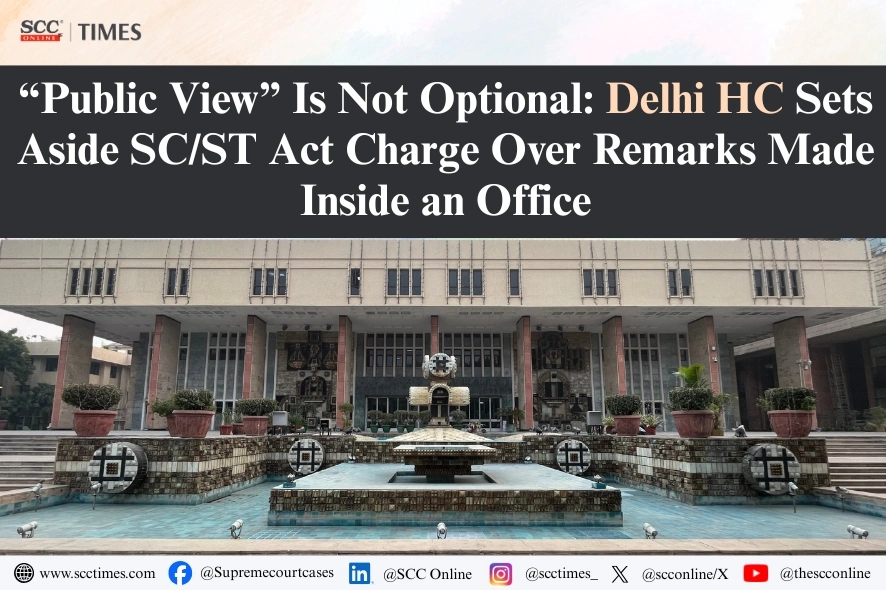
Delhi High Court: While deciding a petition under Section 482, Criminal Procedure Code, 1973 challenging an order directing framing of charges under Section 3(1)(x), Scheduled Castes and Scheduled Tribes (Prevention of Atrocities) Act, 1989 (1989 Act), a Single Judge Bench of Madhu Jain, J., held that the requirement that the alleged caste-based insult or intimidation must occur “in any place within public view” is an essential statutory ingredient of the offence. The Court found that the complaint itself alleged that the remarks were made inside the petitioners’ offices without any averment that any member of the public or independent person was present. Holding that the foundational requirement of “public view” was not prima facie disclosed, the Court set aside the order framing charges under Section 3(1)(x), 1989 Act and remanded the matter to the trial court for fresh consideration of framing of charges, if any, under the provisions of the IPC.
Background
The petition arose from an order directing framing of charges under Section 3(1)(x), 1989 Act against 4 senior officials of Trans World Radio India. The complainants, employed as “safai karamcharis” in the organisation, alleged that they were subjected to caste-based abuse, discrimination, threats of termination, and pressure to convert to Christianity. The record revealed that disciplinary proceedings had earlier been initiated against one of the complainants, culminating in his dismissal from service. Prior to his dismissal, the complainants had lodged complaints with the police alleging religious conversion and workplace discrimination. Subsequently, they filed a private complaint alleging that the petitioners had intentionally insulted and humiliated them by using caste-based slurs on multiple occasions. During the enquiry, however, the police reported that the allegations were not substantiated and observed that the earlier complaints did not contain any allegation of caste-based abuse. Despite the police report, the Additional Sessions Judge found a prima facie case and directed framing of charges under Section 3(1)(x), 1989 Act. Aggrieved thereby, the petitioners invoked the High Court’s inherent jurisdiction under Section 482, Criminal Procedure Code, 1973, contending that the essential ingredients of the alleged offence were not made out and that the order framing charges was liable to be set aside.
Analysis
The Court observed that the principal question was whether the material on record disclosed the essential ingredients of the offence under Section 3(1)(x), 1989 Act, so as to justify the framing of charge. Referring to the statutory provision and the decisions in Hitesh Verma v. State of Uttarakhand, (2020) 10 SCC 710, and Ramesh Chandra Vaishya v. State of U.P., (2023) 17 SCC 615, the Court reiterated that an intentional insult or intimidation on the basis of caste must occur “in any place within public view”, which is an indispensable ingredient of the offence. Examining the complaint dated 29 February 2008, the Court found that the alleged caste-based remarks were stated to have been made inside the petitioners’ respective offices and there was no averment that any member of the public or independent person was present at the time of the alleged incidents. While observing that disputed questions regarding omissions or improvements were matters for trial, the Court held that, even if the allegations in the complaint were accepted in their entirety, the foundational requirement of “public view” was not prima facie disclosed.
Decision
Accordingly, the Court held that the charge framed under Section 3(1)(x), 1989 Act could not be sustained, set aside the impugned order to that extent, and remanded the matter to the trial court for fresh consideration of the question of framing of charges, if any, under the provisions of the Penal Code, 1860, clarifying that it had expressed no opinion on the merits of those allegations.
[Christine Swaroop Raj v. State, 2026 SCC OnLine Del 5274, decided on 21-7-2026]
Advocates who appeared in this case:
For the Petitioners: Rebecca M. John, Sr. Adv. With Pravir Singh, Advocates
For the Respondent: Digam Singh Dagar, APP