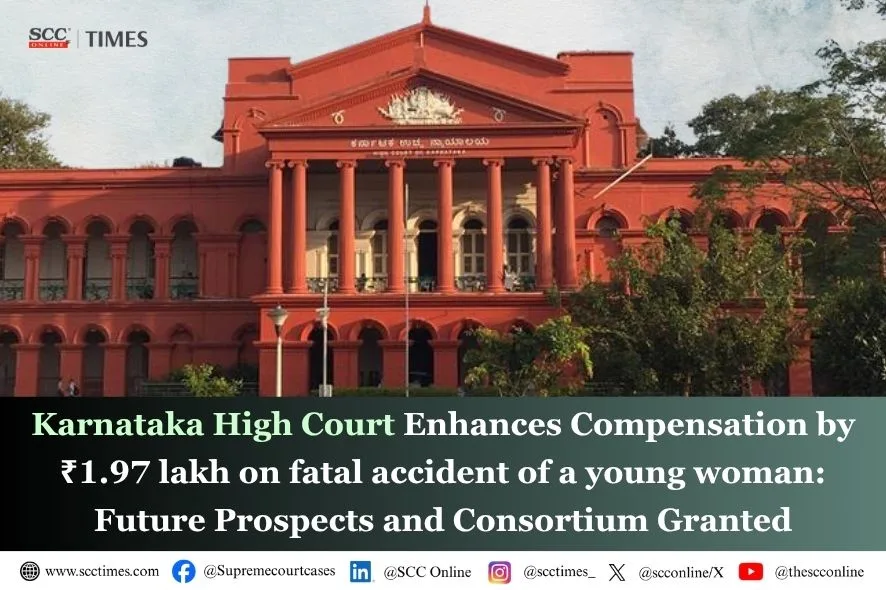
Karnataka High Court: The Division Bench of Jayant Banerji and Tara Vitasta Ganju, JJ., modified the compensation award, enhancing it to ₹16,77,000 for the family of a 20 year old woman who died in a motor vehicle accident. The Court corrected the computational errors committed by the Tribunal and ensured that the claimants received fair compensation consistent with the principles laid down by the Supreme Court in Sarla Verma v. DTC, (2009) 6 SCC 121.
Background
The case arose on 13 August 2016, at approximately 7.45 p.m., when the deceased was riding her scooter on the service road near Sumanahalli Flyover, Bengaluru. A car allegedly driven rashly and negligently from the opposite direction, collided with the scooter. Due to the impact, the deceased fell onto the road, and the car ran over her. She was immediately shifted to Essential Hospital for treatment but succumbed to the injuries on the same day. At the time of the accident, she was about 20 years old.
The deceased’s mother and 2 siblings filed a claim petition under Section 166, Motor Vehicles Act, 1988 seeking compensation for her death. They contended that the deceased was employed as a beautician and fashion designer earning ₹10,000 per month. She was the sole earning member supporting the family. The owner of the offending vehicle remained ex parte despite service of notice. The insurance company admitted that the vehicle was insured but denied the entire averments made in the claim petition.
The Motor Vehicles Accident Claims Tribunal (Tribunal), based on the oral and documentary evidence available found that the rash and negligent driving of the driver of the car was proved. It was held that the deceased died on account of the injuries sustained in the motor vehicle accident. For the award of compensation, the Tribunal calculated the loss of dependency based on the salary of the deceased and deducting 1/3rd towards the personal and living expenses of the deceased. It considered the salary of the deceased as ₹10,000 per month. Since the deceased was aged about 20 years, the multiplier of “18” was used. The Tribunal, applying the judgments in Sarla Verma v. DTC, (2009) 6 SCC 121 and National Insurance Co. Ltd. v. Pranay Sethi, (2017) 16 SCC 680 calculated for the loss of dependency, loss of estate, living expenses, funeral and other expenses making a total compensation of ₹14,80,000 with interest at 6 per cent per annum.
The claimants challenged the award on the ground that the Tribunal failed to grant future prospects and consortium and had awarded inadequate compensation under the conventional heads. The insurance company argued that the Tribunal had wrongly assessed the deceased’s income and had awarded excessive compensation.
However, during the hearing, both parties fairly conceded that certain legal principles laid down by the Supreme Court had not been correctly applied by the Tribunal. They jointly submitted that since the deceased was unmarried, deduction towards personal expenses ought to have been 50 per cent and not 1/3rd. Since no amount towards future prospects was awarded hence, 10 per cent for escalation was also to be granted towards loss of estate, transportation and funeral expenses and loss of consortium.
Decision and Analysis
The Court took note of the salary certificate and stated that the deceased earned ₹10,000 per month as a beautician. This document was supported by the oral testimony of the proprietor of the beauty parlour, who confirmed both the employment and salary of the deceased. Although the notional income chart prescribed an income of ₹9500 per month, the Court held that actual documentary evidence regarding earnings should prevail. Since the salary certificate was supported by oral evidence and remained unchallenged by the insurance company, the monthly income of ₹10,000 was accepted.
The Court relied upon the Supreme Court decision in Rajwati v. United India Insurance Co. Ltd., 2022 SCC OnLine SC 1699 wherein it was held that proceedings under the Motor Vehicles Act, 1988 are summary in nature and the Act being a beneficial legislation, strict rules of pleadings and evidence are inapplicable. The standard of proof is one of preponderance of probabilities, and once the occurrence of the accident is established, the Tribunal is required to award just compensation. Accordingly, the Court held that the salary certificate and pay slip, corroborated by the oral testimony of the dependants and co-workers, constitute reliable and corroborative proof of the income of the deceased and cannot be rejected merely on the ground that the author of such documents was not examined.
The Court further observed that the Tribunal had committed an error by deducting only 1/3rd of the income towards personal expenses. Following the principles laid down in Sarla’s case where the deceased is unmarried, deduction must be 50 per cent because an unmarried person is presumed to spend half of the income on personal expenses.
The Court noted that the Tribunal has not awarded any compensation towards the loss of consortium. The Court considering the law laid down by the Supreme Court in Pranay Sethi’s case, the loss of consortium was made payable at ₹40,000 each, to the 3 appellants/claimants totalling to ₹1,20,000. The Court further noted that no escalation had been awarded to the appellants/claimants by the Tribunal hence, an escalation at the rate of 10 per cent is also awarded on the conventional heads of compensation. Thus, the revised calculation for the award of compensation was followed as under:
|
Sl. No. |
Particulars |
Amount |
|
|
Loss of dependency [₹10,000(+)40%(-)50%x12x“18”] |
₹15,12,000 |
|
|
Loss of estate [₹15,000(+)10%] |
₹16,500 |
|
|
Loss of consortium [₹40,000×3 (+)10%] |
₹1,32,000 |
|
TOTAL |
₹16,77,000 |
|
|
Less: Awarded by the Tribunal |
₹14,80,000 |
|
|
Enhanced compensation |
₹1,97,000 |
Since the Tribunal had already awarded ₹14,80,000 the Court granted an enhanced compensation of ₹1,97,000 together with interest at the rate of 6 per cent per annum from the date of filing of the claim petition until realisation.
The Court modified the Tribunal’s award and specified that the remaining portion of the impugned award will remain undisturbed. The insurance company’s appeal seeking reduction of compensation was rejected. The insurance company was directed to deposit the enhanced amount with interest within 8 weeks.
[Chandrika v. Axa Business Services (P) Ltd., MFA No. 7811 of 2018, decided on 8-6-2026]
*Judgment authored by: Justice Tara Vitasta Ganju
Advocates who appeared in this case:
For the Appellant: Arvind Kamath, ASG, Unnikrishnan M., Advocate
For the Respondent: Joshua Hudson Samuel, Advocate